How to Record Owner's Capital, Drawings and Loans in Accounting
On this page 43 sections

By Mohnish Katre, Co-founder, ProfitBooks
Last reviewed: 19 November 2026. This is general bookkeeping guidance for India, not tax or legal advice. The correct treatment depends on your business structure, so confirm your position with a qualified accountant.
Say an owner starts a trading business by putting in ₹5,00,000 from personal savings. A few months later they add another ₹1,00,000 to buy inventory, withdraw ₹20,000 for household expenses, and take a ₹3,00,000 loan from a bank. All four transactions move money into or out of the business, but not one of them is recorded the same way.
That is the heart of recording owner's capital, drawings, and loans correctly. Money the owner invests is capital, not sales. Money withdrawn for personal use is drawings in a proprietorship, not a business expense. Borrowed money is a liability, not income. And loan repayments split into principal and interest, which are treated differently again. This guide shows how to identify each transaction, choose the right account, and record the entry, with simple journal entries and Indian examples throughout.
Understanding Owner's Capital, Drawings and Loans
What is owner's capital?
Owner's capital is the money or other assets the owner contributes to establish or fund the business. That includes the initial investment to start up, additional money paid into the business bank account, and equipment or other eligible assets introduced into the business. Capital represents the owner's investment, or equity interest, in the business. It is not revenue earned from selling products or services.
What are owner's drawings?
Drawings are cash, goods, or other business resources a proprietor withdraws for personal use, such as cash taken for household expenses, business funds used to pay a personal bill, or inventory taken home for personal consumption. Drawings are not ordinary business operating expenses.
What is a business loan?
A business loan is borrowed money the business is obligated to repay, whether from a bank, a financial institution, or the owner (separately from their capital contribution). Receiving loan money does not increase sales revenue. It increases cash or bank balance and creates a liability.
| Transaction | Accounting classification | Main effect |
|---|---|---|
| Owner invests ₹1 lakh | Capital | Increases owner's equity |
| Owner withdraws ₹10,000 personally | Drawings | Reduces owner's equity |
| Business borrows ₹2 lakh | Loan liability | Increases cash and liabilities |
How to Record Owner's Capital in Accounting
An owner can bring funds or assets into the business in several ways. Each follows the same logic: the business receives something, and the owner's capital account is credited for it. For how these accounts sit in your books, see the chart of accounts.
Recording initial capital introduced in cash
When the owner starts a sole proprietorship with cash, the business gains a cash asset and records the matching capital contribution.
Owner invests Rs 5,00,000 in cash
| Account | Debit | Credit |
|---|---|---|
| Cash A/c | ₹5,00,000 | |
| Owner's Capital A/c | ₹5,00,000 |
Cash is an asset, and assets increase on the debit side, so Cash is debited. The owner's claim on the business rises, so Owner's Capital is credited. The business now holds ₹5,00,000 that it owes back to the owner as equity.
Recording capital introduced through a bank deposit
If the owner transfers ₹2,00,000 from a personal bank account into the business account, the business bank balance rises and capital is credited. The contribution is capital, not business income.
Owner deposits Rs 2,00,000 into the business bank
| Account | Debit | Credit |
|---|---|---|
| Bank A/c | ₹2,00,000 | |
| Owner's Capital A/c | ₹2,00,000 |
Recording additional capital introduced later
A further ₹1,00,000 contributed to finance expansion is recorded the same way, and simply increases the capital balance.
Owner adds Rs 1,00,000 for expansion
| Account | Debit | Credit |
|---|---|---|
| Bank A/c | ₹1,00,000 | |
| Owner's Capital A/c | ₹1,00,000 |
Recording assets introduced by the owner
An owner may contribute an asset instead of cash, for example office equipment valued at ₹80,000.
Owner introduces office equipment worth Rs 80,000
| Account | Debit | Credit |
|---|---|---|
| Office Equipment A/c | ₹80,000 | |
| Owner's Capital A/c | ₹80,000 |
The asset should be recorded at an appropriate, supportable value, with documentation of the contribution kept. One caution: not every personal asset an owner happens to use automatically becomes business-owned. Ownership, business use, and supporting documentation all matter.
How to Record Owner's Drawings in Accounting
Personal withdrawals must be kept separate from normal business expenses, or the books will understate profit. In a proprietorship these go to a drawings account.
Recording cash withdrawn for personal use
A proprietor withdraws ₹15,000 from the business bank account for household expenses.
Owner withdraws Rs 15,000 for personal use
| Account | Debit | Credit |
|---|---|---|
| Drawings A/c | ₹15,000 | |
| Bank A/c | ₹15,000 |
Drawings is debited because the owner's equity is being reduced, and the bank balance falls, so Bank is credited.
Recording goods taken by the owner for personal use
A trader takes inventory costing ₹5,000 from the business for personal consumption.
Owner takes goods worth Rs 5,000
| Account | Debit | Credit |
|---|---|---|
| Drawings A/c | ₹5,000 | |
| Purchases / Inventory A/c | ₹5,000 |
The goods are no longer available for sale, so the relevant inventory or purchases account is reduced. The exact entry should follow the inventory accounting method your books use; this simplified version is not a universal treatment for every method.
Recording personal expenses paid using business funds
If the business bank account pays ₹8,000 for the proprietor's personal household expense, it is still a drawing, not a business expense.
Business pays Rs 8,000 personal expense
| Account | Debit | Credit |
|---|---|---|
| Drawings A/c | ₹8,000 | |
| Bank A/c | ₹8,000 |
Classifying this as an ordinary business expense would understate the business's real profit.
How drawings affect owner's capital
Drawings reduce the proprietor's capital when the accounts are closed. Take opening capital of ₹5,00,000, additional capital of ₹1,00,000, and drawings of ₹30,000. Capital before considering profit or loss is ₹5,70,000. The actual closing capital also incorporates the business's profit or loss and any other relevant adjustments.
Personal withdrawals should never inflate the business's operating expenses or distort its reported profit. Keep them in drawings, separate from the day-to-day costs of running the business.
How to Record Business Loans in Accounting
Borrowed funds are a liability, which keeps them clearly separate from the owner's capital.
Recording a loan received from a bank
A business receives a term loan of ₹5,00,000 from a bank. The bank balance rises and a matching loan liability is recorded.
Business receives a Rs 5,00,000 bank loan
| Account | Debit | Credit |
|---|---|---|
| Bank A/c | ₹5,00,000 | |
| Bank Loan A/c | ₹5,00,000 |
Recording a loan received from the owner
An owner can provide funds as a loan rather than capital, as long as it is genuinely a loan with an agreement to repay. Say the owner advances ₹2,00,000 to the business.
Owner lends Rs 2,00,000 to the business
| Account | Debit | Credit |
|---|---|---|
| Bank A/c | ₹2,00,000 | |
| Loan from Owner A/c | ₹2,00,000 |
This stays separate from the owner's capital account, because a loan and a capital contribution are different arrangements with different treatment.
Recording repayment of loan principal
The business repays ₹50,000 of the outstanding bank loan principal. This reduces the loan liability and is not an operating expense.
Repay Rs 50,000 of loan principal
| Account | Debit | Credit |
|---|---|---|
| Bank Loan A/c | ₹50,000 | |
| Bank A/c | ₹50,000 |
Recording interest paid on a business loan
The business pays ₹5,000 in loan interest, which is generally a financing expense.
Pay Rs 5,000 loan interest
| Account | Debit | Credit |
|---|---|---|
| Interest Expense A/c | ₹5,000 | |
| Bank A/c | ₹5,000 |
Recording an EMI containing principal and interest
Most loan repayments arrive as an EMI that mixes principal and interest. Say an EMI of ₹12,000 is made up of ₹10,000 principal and ₹2,000 interest.
Pay an EMI of Rs 12,000 (Rs 10,000 principal + Rs 2,000 interest)
| Account | Debit | Credit |
|---|---|---|
| Loan Payable A/c | ₹10,000 | |
| Interest Expense A/c | ₹2,000 | |
| Bank A/c | ₹12,000 |
The full EMI is not an expense. Only the interest portion is an expense; the principal portion reduces the loan liability. Real loan schedules may also involve fees, accrued interest, taxes, or other adjustments.
Difference Between Owner's Capital, Drawings and Business Loans
| Factor | Owner's capital | Drawings | Business loan |
|---|---|---|---|
| Meaning | Funds or assets contributed by owner | Personal withdrawals from business | Funds borrowed by business |
| Nature | Owner's equity | Reduction of owner's equity | Liability |
| Money movement | Usually enters business | Leaves business for personal use | Enters business from lender |
| Repayment | Not a loan repayment | Not applicable | Must be repaid under agreed terms |
| P&L treatment | Not sales income | Not an operating expense | Proceeds not revenue; interest separate |
| Example | Owner invests ₹2 lakh | Owner withdraws ₹15,000 | Business borrows ₹5 lakh |
Why these three accounts should never be mixed
- Recording capital as sales overstates revenue.
- Recording drawings as expenses understates profit.
- Recording loan proceeds as income overstates revenue and hides a liability.
- Recording an owner's loan as capital misrepresents how the business is funded.
The classification depends on the nature of the transaction, not simply on whether money entered or left the bank account. A trial balance only balances cleanly when each of these sits in the right account.
How Entity Type Changes the Accounting Treatment
The drawings approach above applies to a sole proprietor. It does not apply unchanged to every business structure, which is an important distinction to get right.
Sole proprietorship
The proprietor's capital and drawings are kept in the owner's accounts. Personal withdrawals are recorded as drawings and ultimately reduce the owner's capital. The proprietor and business are treated separately for accounting purposes, even though a sole proprietorship is not a separate legal person from its owner.
Partnership firms
Partners generally have individual capital accounts, and may also have current accounts, depending on the arrangement. Withdrawals should be recorded against the relevant partner's drawings or current account, according to the firm's accounting policy and the partnership agreement. A sole proprietor's entry cannot be applied indiscriminately to every partner transaction.
Private limited companies
A company is a separate legal entity. Shareholder contributions are generally recorded through the appropriate share capital or other equity accounts, following the legal and accounting requirements. A director or shareholder withdrawing company funds cannot automatically be recorded as proprietor's drawings. Depending on the facts, a payment may be an authorised reimbursement, salary, dividend, loan, or another transaction, and its treatment must be established and documented.
Owner or director loans to a company
A genuine loan from a director or shareholder should be recorded separately as a liability, not automatically classified as share capital. Company-law requirements and documentation may apply, so consult an accountant or company secretary for the specific transaction.
How to Calculate the Closing Owner's Capital Balance
For a sole proprietor, the closing capital pulls together the opening balance, further contributions, the profit or loss, and drawings. A simplified formula is:
Closing Capital = Opening Capital + Additional Capital + Net Profit - Drawings. A business loss reduces capital instead of adding to it.
| Particulars | Amount |
|---|---|
| Opening capital | ₹5,00,000 |
| Additional capital introduced | ₹1,00,000 |
| Net profit for the year | ₹1,50,000 |
| Personal drawings | - ₹50,000 |
| Closing capital | ₹7,00,000 |
The calculation is ₹5,00,000 + ₹1,00,000 + ₹1,50,000 minus ₹50,000, which equals ₹7,00,000. Note that the loan balance is not added to the owner's capital; it stays a separate liability. This is a simplified illustration for a sole proprietorship, and other capital adjustments may apply depending on the structure and circumstances.
Common Mistakes When Recording Capital, Drawings and Loans
1. Recording capital introduced as business income
Owner contributions are not revenue generated through business operations, and treating them as sales inflates the top line.
2. Treating personal withdrawals as business expenses
Personal withdrawals should not be mixed with legitimate operating expenses in a proprietorship.
3. Recording loan proceeds as sales revenue
Borrowed funds create a repayment obligation. They are not sales income.
4. Treating the entire EMI as an expense
Separate the principal repayment from the interest component. Only the interest is an expense.
5. Mixing owner's loans with owner's capital
A genuine loan and a capital contribution have different treatments and should be kept in separate accounts.
6. Not recording goods taken for personal use
Inventory withdrawn for personal use should not remain in the business's available stock records.
7. Using a drawings account for company directors
A company is not a sole proprietorship. Director and shareholder transactions need the appropriate classification and documentation.
Doing This in ProfitBooks
Accounting software keeps separate ledger accounts for capital, drawings, and loans, records owner contributions and withdrawals with supporting detail, tracks loan balances and repayments, separates principal from interest, and lets you review ledgers and generate reports. ProfitBooks does this through a feature called Simple Accounting Entries, which records common transactions in plain English and posts the accounting in the background.
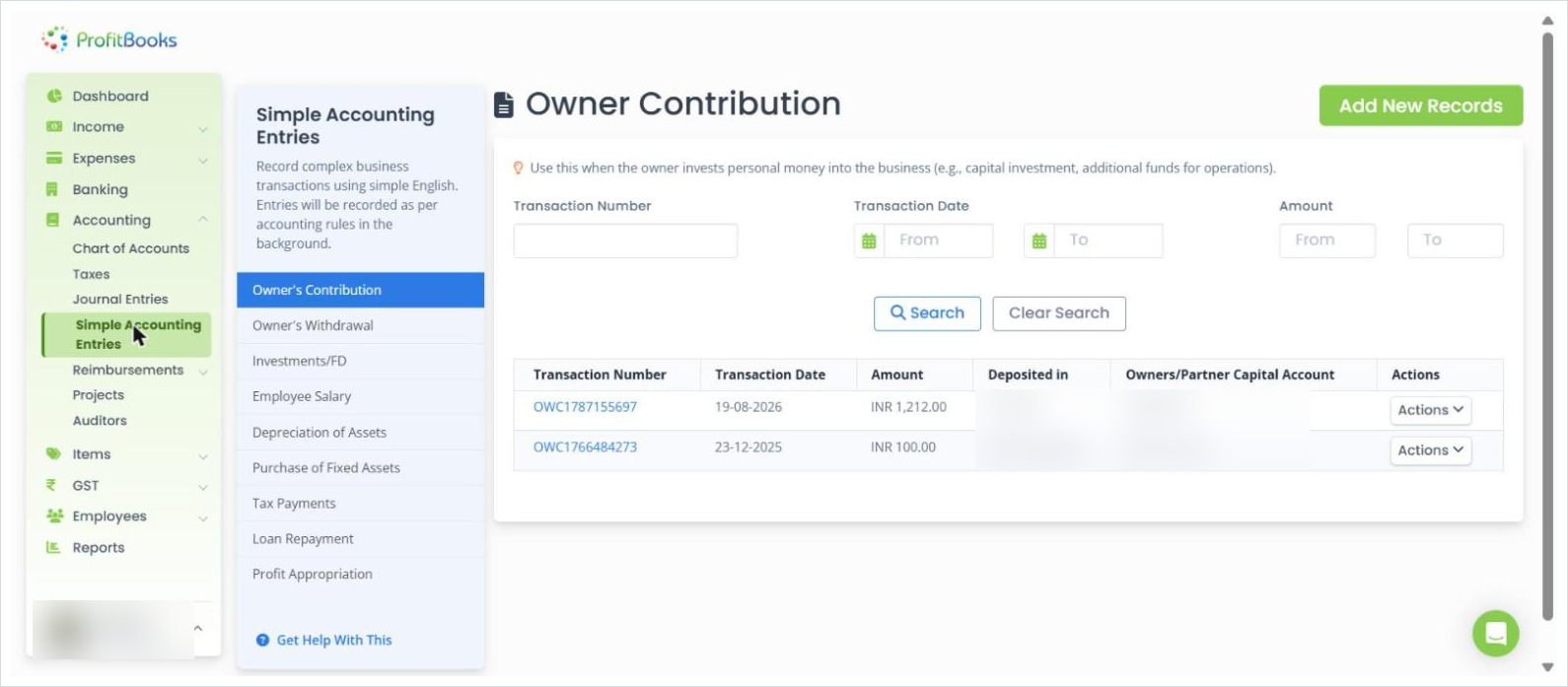
Open it from Accounting in the left menu, then Simple Accounting Entries. It lists entry types including Owner's Contribution, Owner's Withdrawal, and Loan Repayment, among others. (Simple Accounting Entries is available on the Essential plan and above, not on the Startup plan.)
Owner's capital
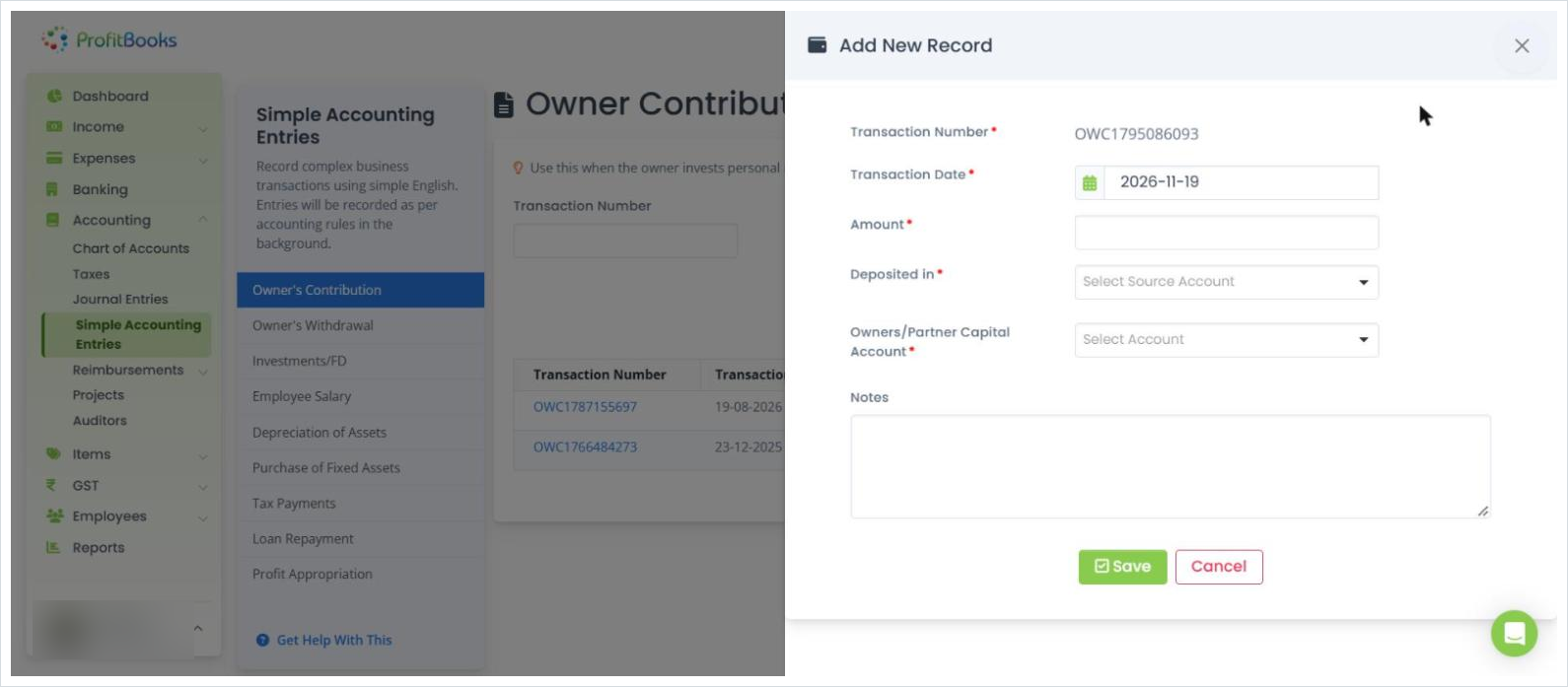
Use Owner's Contribution when the owner invests personal money into the business. Add a new record, enter the Transaction Date and Amount, choose the account the money was Deposited in and the Owners or Partner Capital Account, add an optional note, and save.
Owner's drawings
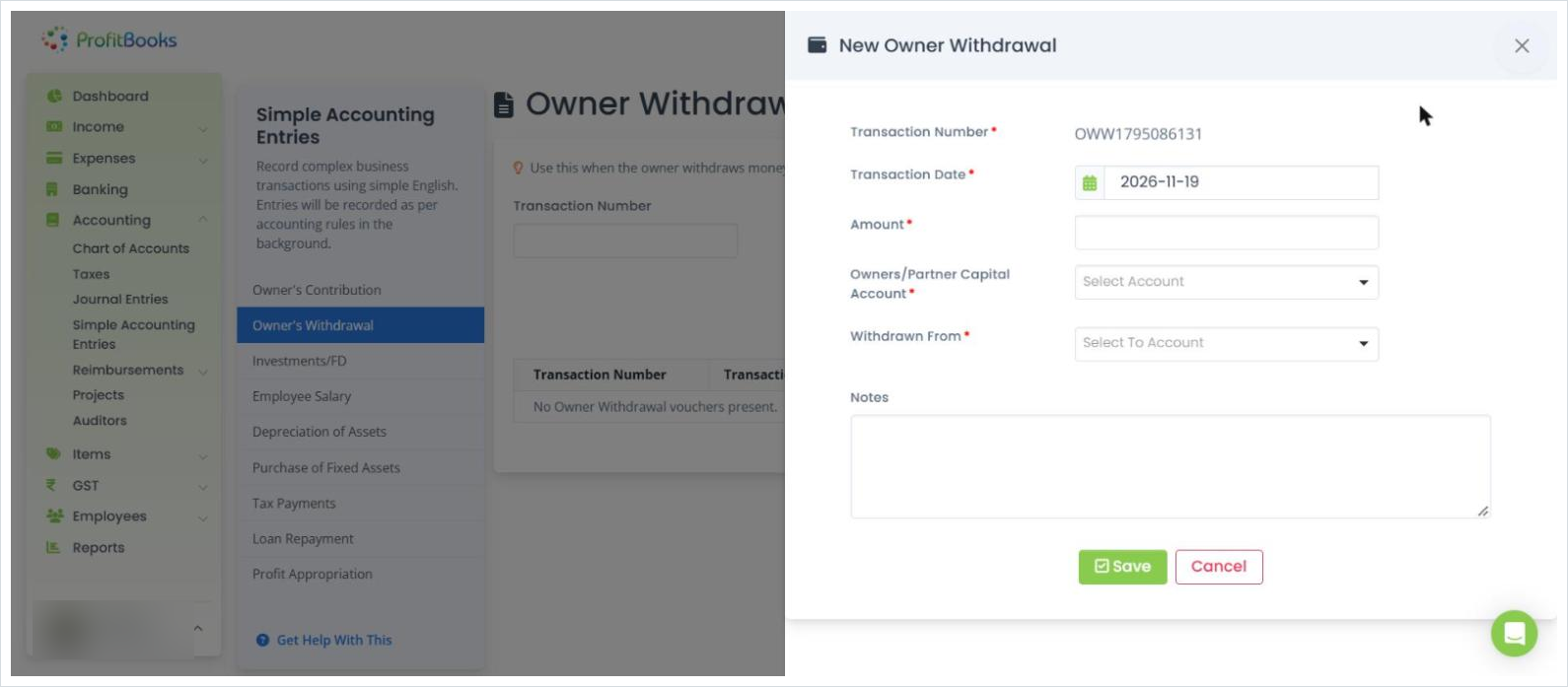
Use Owner's Withdrawal when the owner takes money out for personal use. Enter the date and amount, choose the Owners or Partner Capital Account and the account the money was Withdrawn From, and save.
Loan received
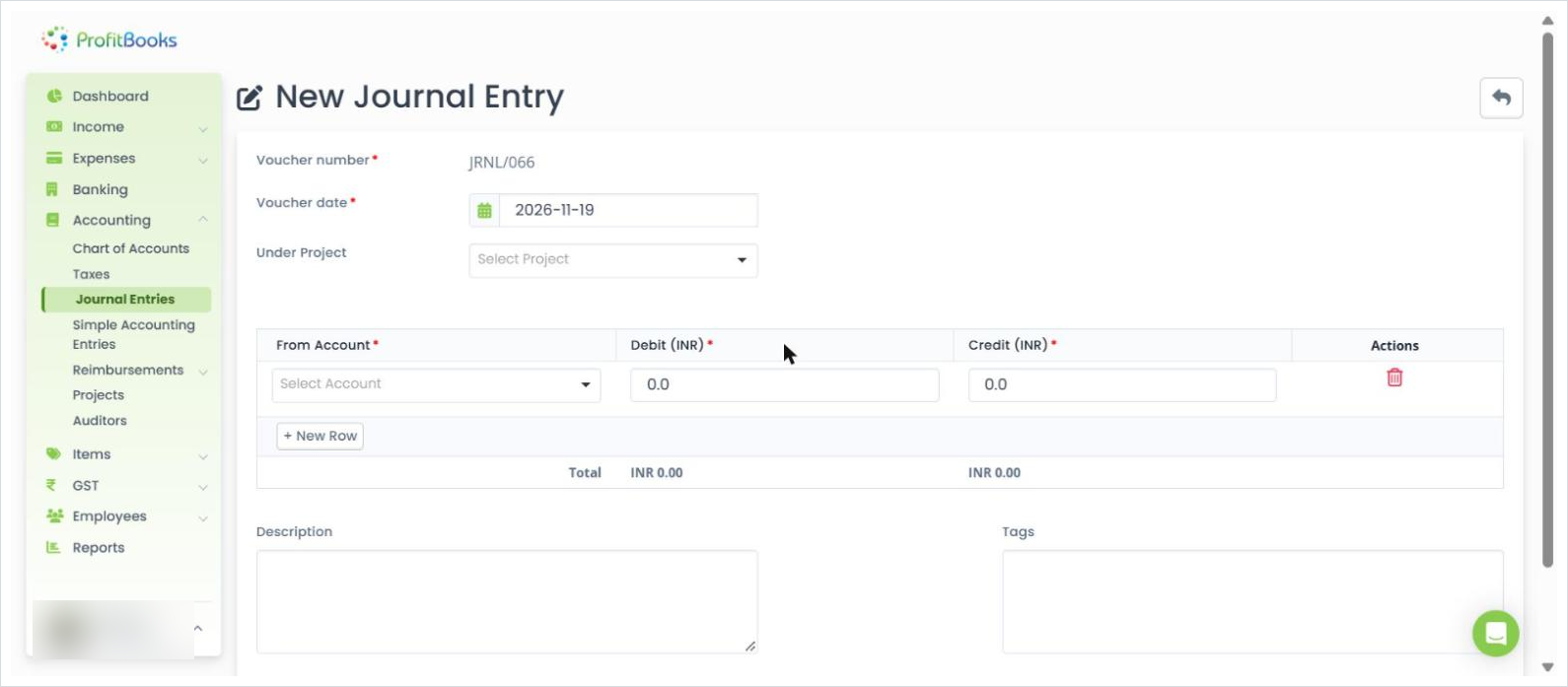
There is no simple entry for taking a loan, so record it with a journal entry. First create the loan account under Accounting, Chart of Accounts (a secured or unsecured loan account group), then go to Accounting, Journal Entries, add a new journal, debit the bank for the loan amount, add a row to credit the loan account for the same amount, and save.
Loan repayment
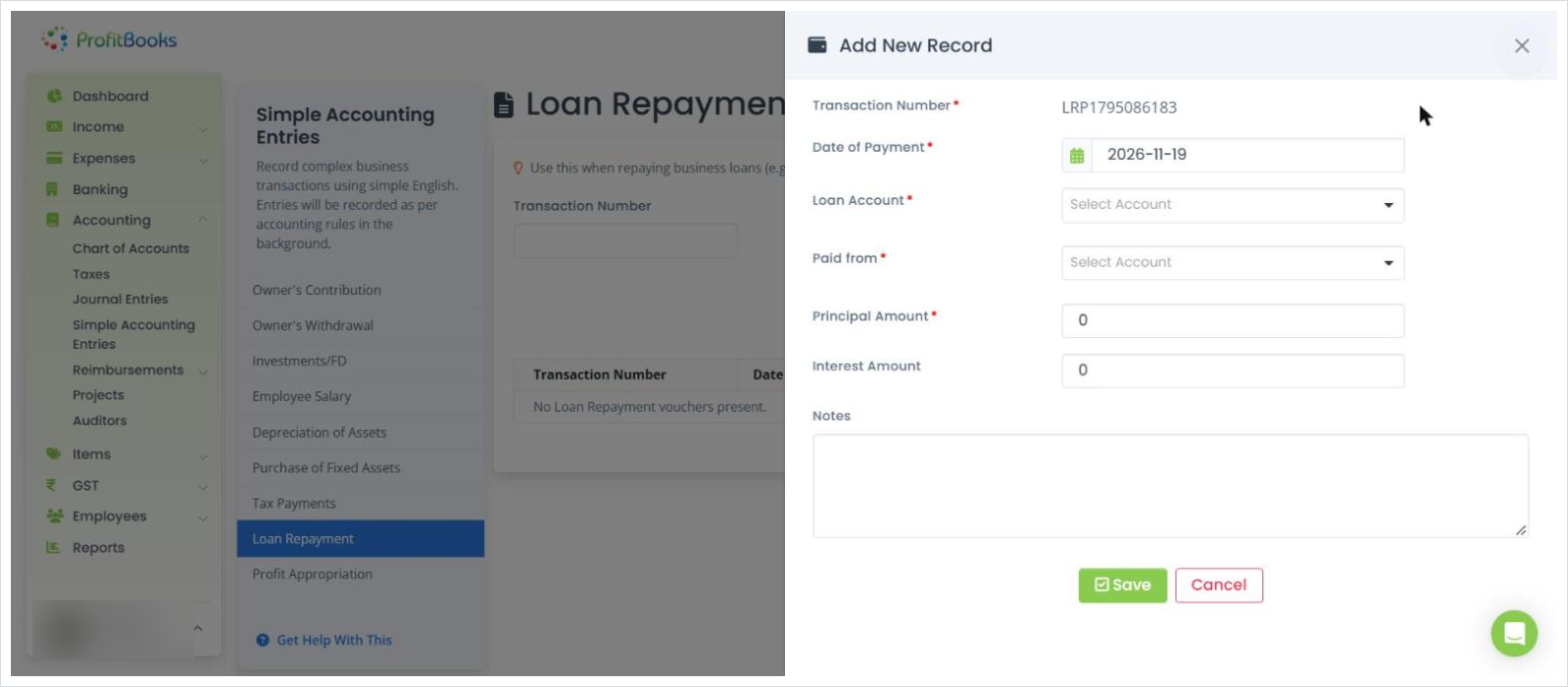
Use Loan Repayment for EMIs. Enter the Date of Payment, choose the Loan Account and the account it was Paid from, then split the payment into a Principal Amount and an Interest Amount before saving. Splitting the two is exactly the distinction the accounting requires.
Two notes. The simple-entry forms do not display the debit and credit behind each entry, since ProfitBooks posts the accounting in the background, so use the journal entries earlier in this guide to understand the postings. And confirm current fields and behaviour against your own account, as screens can change. Recording cash and bank movements cleanly also depends on regular bank reconciliation.
Frequently Asked Questions About Owner's Capital, Drawings and Loans
Is owner's capital an asset or a liability?
Neither in the usual sense. Capital is an equity balance that represents the owner's interest in the business. It is presented within equity, not as business income, and it reflects what the business owes back to the owner.
Are owner's drawings considered business expenses?
No. Drawings in a sole proprietorship are personal withdrawals, not ordinary operating expenses. Recording them as expenses would understate the business's real profit.
What is the journal entry for capital introduced?
Debit the asset received and credit the owner's capital account. For cash, it is Cash A/c Dr, To Owner's Capital A/c. For a bank deposit, it is Bank A/c Dr, To Owner's Capital A/c.
What is the journal entry for drawings?
Debit the drawings account and credit the account the value left from. For a cash withdrawal, it is Drawings A/c Dr, To Cash or Bank A/c. For goods taken, the credit goes to the purchases or inventory account instead.
Is a business loan considered income?
No. Loan proceeds increase cash or bank balance and create a liability to repay. They are not sales revenue, and treating them as income overstates the business's performance.
How should loan repayments be recorded?
The principal portion reduces the loan liability, while the interest portion is recorded separately as an expense. An EMI is split between the two, so the whole EMI is never recorded as a single expense.
Can an owner give a loan to their own business?
Yes. A genuine owner loan, with an agreement to repay, is recorded separately from capital as a liability. Keeping it distinct from the capital account matters, and the treatment can depend on the business structure and applicable requirements.
Are drawings allowed in a private limited company?
Not in the same way. A company does not use a proprietor's drawings account. A director or shareholder payment must have an appropriate legal and accounting basis, such as a reimbursement, salary, dividend, or loan, and should be documented accordingly.
Keep Capital, Drawings and Loans Separate
Three things are worth remembering. Capital is the owner's contribution, drawings are personal withdrawals in a proprietorship, and loans are borrowed funds that must be tracked separately from capital. Keeping each in its own account is what lets a business see its real operating performance, its true equity position, and its outstanding liabilities. A tool like ProfitBooks makes it easier by recording these common entries in plain English and posting them to the right accounts in the background.
Record capital, drawings and loans the right way
ProfitBooks records owner contributions, withdrawals, and loan repayments in simple English and keeps your capital, drawings, and loan accounts cleanly separate.
Explore ProfitBooks accounting →