
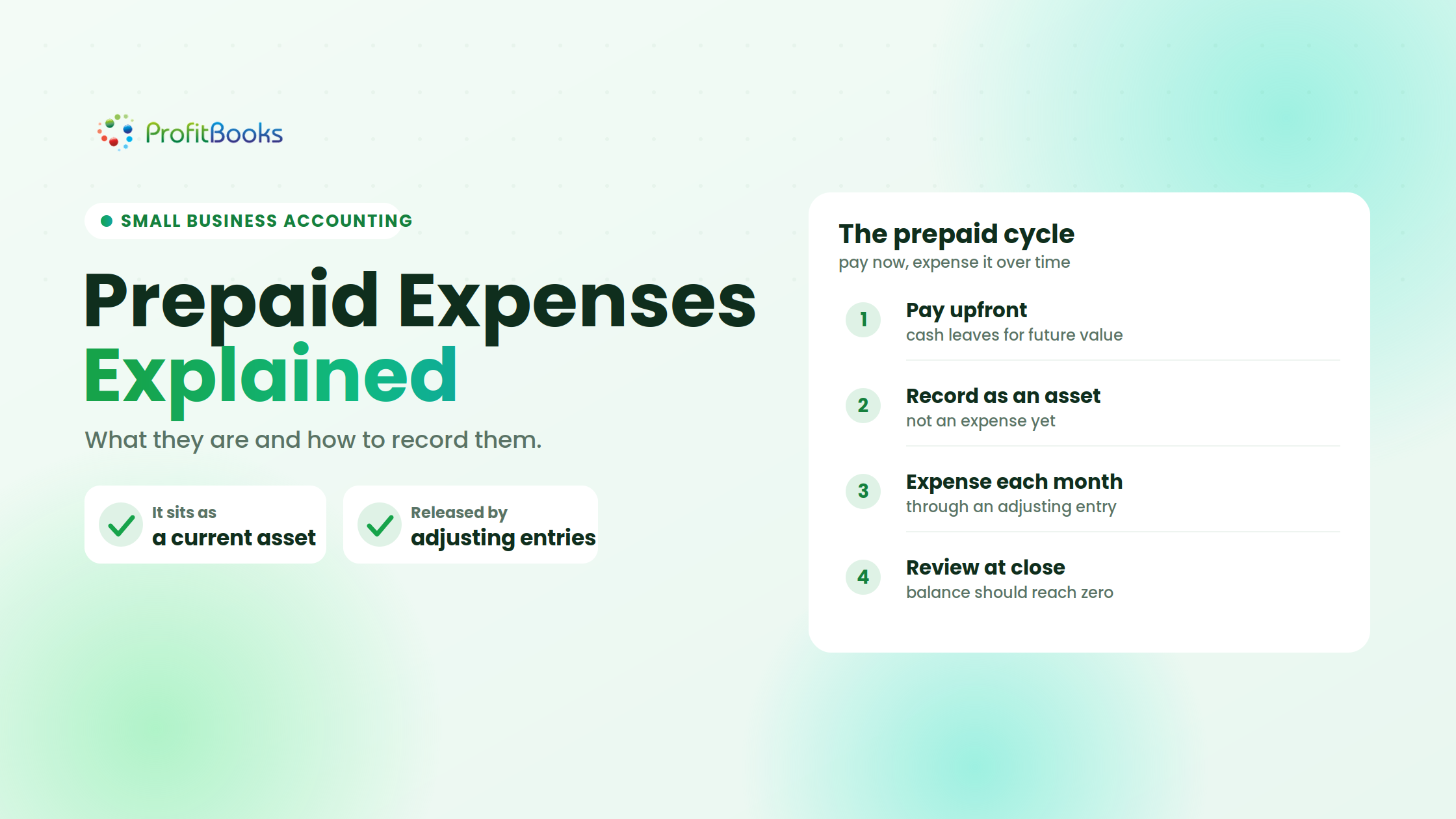
A prepaid expense is a payment your business makes now for a service or benefit it will receive later. Because the value has not been used up yet, it sits on your balance sheet as a current asset, not as an expense. It only becomes an expense gradually, as your business consumes the benefit.
Here is the whole idea in a few lines before we get into the detail.
- You pay upfront. The amount is recorded as an asset, not an expense.
- Each month, or period, you move a portion from the asset account to the expense account.
- This monthly transfer is called an adjusting entry, and skipping it is the single most common mistake I see.
- Prepaid expenses are an accrual accounting concept. They keep your profit and loss report honest by matching costs to the months they actually belong to.
- If the remaining benefit will be used within 12 months, it stays under current assets. Anything beyond that is a long-term asset.
What is a prepaid expense?
A prepaid expense is money you pay today for something your business will use over a future period. Think of it like buying a full year of office insurance in January. You hand over $12,000, but you do not use all that insurance on day one. Each month, one twelfth of the coverage protects your business.
Because the benefit stretches across twelve future months, the $12,000 is not an expense yet. It is something your business owns, a right to future coverage. That is why accountants record it as an asset first.
I talk to small business owners about this almost every day, and the confusion nearly always comes from the same place. Cash left the bank, so it feels like an expense. But the accounting follows the benefit, not the bank transaction.
Key takeaway
Record prepaid expenses when the payment buys future value. If the value is already consumed, it is just a regular expense.
Why is a prepaid expense treated as an asset?
The reason comes down to something called the matching principle. The idea, as described by the Financial Accounting Standards Board and codified in both US GAAP and IFRS, is straightforward: record an expense in the same period it helps produce revenue.
Your annual insurance policy protects revenue-generating activity across twelve months. Dumping the entire $12,000 into January’s expenses would make January look terrible and February through December look artificially profitable. The matching principle prevents that distortion.
So the payment starts life as an asset. It represents future economic benefit your business controls. That is the textbook definition of an asset, and it applies perfectly here.
When does a prepaid expense become an actual expense?
It converts piece by piece. Each month, you move the consumed portion out of the asset account and into the expense account through an adjusting entry. After the final month of coverage, the asset balance hits zero. The full cost has been expensed, spread evenly across the months it served.
This is the adjusting-entry process, done at every period close. The schedule drives the entries, not your memory.
Common examples of prepaid expenses
| Example | Why it is prepaid | How it is used up |
|---|---|---|
| Insurance premium (annual) | Coverage spans 12 future months | One twelfth expires each month |
| Office rent (paid quarterly in advance) | Three months of occupancy not yet received | One third consumed each month |
| Annual software subscription | Access runs for a future 12-month term | Monthly usage over the license period |
| Annual maintenance contract (AMC) | Service visits spread across the year | Recognized monthly or per visit |
| Prepaid advertising | Ad campaign runs over several months | Expensed as ads are published |
| Advance to a supplier for a service period | Supplier will deliver over agreed future months | Reduced as services are received |
If the payment buys future benefit across multiple periods, it belongs in prepaid. If the benefit is immediate, expense it directly.
Prepaid expenses vs related terms
Prepaid expense vs accrued expense
These two are mirror images. A prepaid expense means you paid now but will use the benefit later. An accrued expense means you used the benefit now but will pay later. Wages earned by employees but not yet paid at month end are a classic accrued expense.
Prepaid expense vs advance payment to a supplier
They overlap, but they are not identical. An advance payment to a supplier for goods, say raw materials, is typically a receivable or deposit until delivery. A prepaid expense specifically covers a service or benefit consumed over time, like insurance or rent. If you pay a supplier $5,000 for goods to be delivered next month, that is closer to an advance. If you pay $5,000 for six months of a maintenance contract, that is a prepaid expense.
Prepaid expense vs unearned revenue
Same timing concept, opposite side of the transaction. Your prepaid expense is your vendor’s unearned revenue. You paid for something you have not received yet. They received cash for something they have not delivered yet. Both sides adjust their books as the service period passes.
| Term | Who records it | Timing |
|---|---|---|
| Prepaid expense | The buyer (you) | Paid now, benefit received later |
| Accrued expense | The buyer (you) | Benefit received now, paid later |
| Unearned revenue | The seller (your vendor) | Cash received now, service delivered later |
How to record a prepaid expense (journal entries)
Recording a prepaid expense takes two steps, and each is a simple debit and credit. The first step records the asset when you pay. The second step releases it to expense as you use it.
At the time of payment
Your business pays $12,000 on January 1 for a 12-month insurance policy.
| Account | Debit | Credit |
|---|---|---|
| Prepaid Insurance (asset) | $12,000 | |
| Cash / Bank | $12,000 |
The full amount sits in the asset account. No expense has been recorded yet because no coverage has been consumed.
The monthly adjusting entry
At the end of January, one month of coverage ($12,000 divided by 12 = $1,000) has been used.
| Account | Debit | Credit |
|---|---|---|
| Insurance Expense | $1,000 | |
| Prepaid Insurance (asset) | $1,000 |
You repeat this journal entry every month through December.
What the balance looks like over time
| Month | Amount expensed | Remaining prepaid balance |
|---|---|---|
| January | $1,000 | $11,000 |
| February | $1,000 | $10,000 |
| March | $1,000 | $9,000 |
| June | $1,000 | $6,000 |
| September | $1,000 | $3,000 |
| December | $1,000 | $0 |
By December 31, the prepaid balance is zero and the full $12,000 has flowed through the income statement.
One detail that trips people up: when the contract does not start on the first of the month, you need to prorate. A policy starting January 15 means January gets roughly half a month of expense, and the final month gets the other half. The last month’s entry should equal whatever balance remains, so rounding errors do not leave a few dollars sitting in the account forever.
Where prepaid expenses appear on your financial statements
On the balance sheet, the unconsumed balance appears under current assets, assuming the remaining benefit will be received within 12 months. If you prepay a two-year service contract, the portion beyond 12 months should be classified as a non-current, or long-term, asset.
On the income statement, only the consumed portion for that period appears as an expense. This is what keeps your monthly profit figures accurate.
Why prepaid expenses matter for small businesses
Getting this right gives you a cleaner picture of monthly profit. Without proper prepaid tracking, one month absorbs the full hit and every other month looks free. That makes period-to-period comparisons meaningless.
It also matters for cash flow planning. You can see exactly how much prepaid value you still hold, which is money already spent but not yet used up on the books.
And if you ever face an audit, a tax review, or a lender request, one of the first things they check is whether balance sheet accounts have proper support behind them. A clean prepaid schedule with matching invoices answers that question instantly.
Common mistakes businesses make with prepaid expenses
I see the same handful of errors come up again and again.
Expensing the full amount in the payment month. This is the most frequent one. Cash leaves, so it gets coded to expense. Your January P&L is now $12,000 heavier than it should be.
Forgetting the monthly adjusting entry. The initial entry is recorded correctly as an asset, but nobody sets up the recurring monthly release. The prepaid balance just sits there, growing stale.
Reconciling the ledger to itself. I see bookkeepers compare the general ledger prepaid balance to the transactions in the same ledger and call it verified. That is a tie-out, not a reconciliation. True reconciliation means checking the balance against invoices, contracts, and coverage dates independently.
Not stopping old amortization when a contract is canceled or renewed. If you renew an annual subscription and add a new schedule without stopping the old one, you double-count the expense for the overlap period.
Mixing up prepaid expenses with deposits and advances. A security deposit you will get back is not a prepaid expense. An advance for goods is not either. Keep them in separate accounts.
Key takeaway
Review your prepaid account at every period close. If a balance has not moved in months, something is wrong.
Where practitioners disagree
There is an ongoing, practical debate about materiality thresholds for prepaid expenses. Some accountants argue that any payment covering future periods, even a $200 annual domain renewal, should be spread across months. Others set a dollar threshold, say $500 or $1,000, below which the full amount is expensed immediately, on the grounds that the effort of tracking outweighs the reporting benefit.
Both positions are defensible. I land on the side of setting a written policy with a clear cutoff and applying it consistently. The number you choose matters less than choosing one and sticking with it.
How accounting software handles prepaid expenses
Tracking prepaid balances and adjusting entries by hand is where most of the errors above come from. A spreadsheet schedule works until someone forgets to update it, or the renewal invoice arrives and nobody connects it to the old schedule. Good accounting software lets you record the initial asset, schedule the monthly expense recognition, and see the remaining balance on your reports without maintaining a separate file.
Track prepaid expenses without the spreadsheet headaches
ProfitBooks lets you record prepaid assets, post adjusting entries, and pull balance sheet reports in one place, so nothing sits stale and nothing gets double-counted.
Frequently asked questions
Is a prepaid expense an asset or a liability?
A prepaid expense is an asset. You paid for something and have not received the full benefit yet, so your business holds future value. A liability is the opposite, something you owe. Your vendor would record the same transaction as a liability, unearned revenue, on their books, because they owe you future service.
Is prepaid rent a current asset?
Yes, as long as the remaining rental period falls within 12 months. If you prepaid 18 months of rent, the portion covering months 13 through 18 would be classified as a non-current asset on your balance sheet.
What is the journal entry for a prepaid expense?
At payment, debit the prepaid expense asset account and credit cash, or accounts payable if the invoice has not been paid yet. Each period, debit the relevant expense account and credit the prepaid asset for the consumed amount.
What is the difference between prepaid expense and accrued expense?
A prepaid expense is paid before the benefit is received. An accrued expense is a benefit already received but not yet paid for. They sit on opposite sides of the timing question.
Do prepaid expenses apply to cash-basis accounting?
Not really. Under cash-basis accounting, expenses are recorded when cash is paid, so there is no need to defer anything. Prepaid expenses are an accrual-basis concept. If your business uses cash-basis reporting, you would simply expense the full payment when it happens.
How are prepaid expenses adjusted at month end?
At each month end, you calculate the portion of the prepaid that was consumed during that month. Then you post an adjusting entry: debit the expense account, credit the prepaid asset account. This is sometimes called the release to expense.
Is a prepaid expense a debit or a credit?
The prepaid expense account carries a normal debit balance because it is an asset. When you make the initial payment, you debit, or increase, the prepaid account. When you consume a portion, you credit, or decrease, it.
Can a prepaid expense be a non-current asset?
Yes. If the benefit extends beyond 12 months from the balance sheet date, the portion past that 12-month window is classified as a long-term, non-current, asset. A common example is a multi-year service agreement where only the first year sits in current assets.
Final takeaway
Prepaid expenses follow a simple cycle. Pay now, record the payment as an asset, expense it gradually as the benefit is consumed, and review the balance at every close. The concept is not complicated. The failure is almost always in the follow-through: a missing adjusting entry, a stale schedule, or a renewal that nobody connected to the old one. Set up the schedule once, tie it to your contracts, and do not skip the monthly review.
Keep your prepaid balances accurate without the manual work
Record assets, automate adjusting entries, and pull clean financial reports in ProfitBooks. Try it free and run it on your own numbers.