Invoice Numbering: Formats, Examples and Best Practices for Small Businesses
On this page 27 sections
Invoice numbering is the process of assigning a unique reference number to each invoice a business issues. That number identifies the specific transaction, so the invoice can be found, tracked, followed up on, and matched to a payment later, without hunting through customer names or dates.
By Mohnish Katre, Co-founder, ProfitBooks
Last verified: 17 November 2026, against Rule 46(b) of the CGST Rules, 2017 via the CBIC tax repository. GST rules change by notification, so confirm the current position for your business before relying on it. Examples use Indian rupees and the 2026-27 financial year.
This is general information on invoice numbering and the GST invoice-number requirements as of 17 November 2026, not tax or legal advice. The sample invoice numbers are illustrative business formats, not GST-prescribed formats. Confirm the current rules and your own GST registration position, and refer to the official CBIC GST portal or a qualified professional before relying on any format.
A business owner gets a payment query from a customer and goes looking for the original invoice. One invoice was saved under a date, another under the customer's name, a third has a number someone typed in by hand, and two look almost identical. Twenty minutes later the invoice still is not found. The problem is not the invoices; it is that the business never settled on a way to number them.
Inconsistent invoice references cause real, everyday friction: invoices are hard to locate, payment follow-ups get confusing, missing or duplicate records are difficult to spot, transactions are harder to reconcile, and the accounting records drift out of order. Invoice numbering is a small part of invoicing, but it is the part that keeps all of this organised. This guide covers the common numbering formats with examples, the GST requirements you must not overlook, practical best practices, and how to choose a system that fits your business.
What Is Invoice Numbering?
Every invoice needs an identifiable reference because that is how a business retrieves and tracks a transaction after the fact. The invoice number is not the same as a few other references it often sits next to: the invoice date is when the invoice was issued; a purchase order number is the buyer's reference for their order; and a customer ID identifies the customer, not the invoice. The invoice number identifies the invoice itself.
In practice it looks like this:
| Invoice number | Customer | Invoice date |
|---|---|---|
| INV/26-27/001 | ABC Traders | 10 April 2026 |
| INV/26-27/002 | Sunrise Stores | 11 April 2026 |
| INV/26-27/003 | Greenleaf Services | 12 April 2026 |
The invoice number identifies the transaction; the invoice date tells you when it was issued. They work together, but they answer different questions.
Why Is Invoice Numbering Important for Small Businesses?
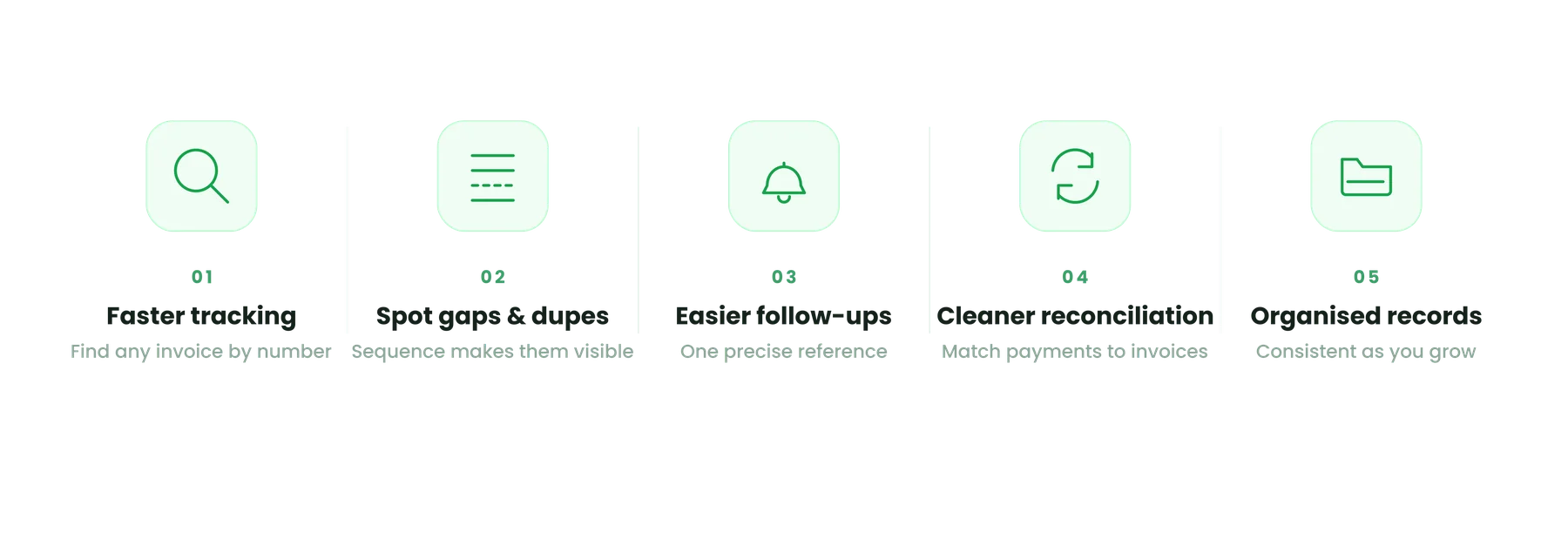
Makes invoice tracking easier
A consistent sequence lets you find a specific invoice by its number, rather than searching through customer names or scrolling by date. When a customer quotes an invoice number, you can go straight to it.
Helps identify missing or duplicate records
Reviewing a numbering sequence makes gaps and possible duplicates visible: a jump from 045 to 047 is worth a look. A gap does not automatically mean an invoice is missing or invalid; it means the reason is worth checking and recording, which is far easier when the numbers run in order.
Simplifies payment follow-ups
When you follow up on an outstanding payment, the invoice number is the precise reference both sides can point to, so there is no confusion about which transaction is being discussed.
Supports accounting and reconciliation
Invoice references help match invoices with receipts, bank transactions, and accounting entries. That same reference is what makes bank reconciliation quicker, because each payment can be tied back to the invoice it settled.
Improves record organisation
A consistent convention keeps invoices organised as the business grows across teams, branches, or business units, so everyone is working from the same orderly set of records.
Invoice Numbering Rules Under GST in India
For a tax invoice, the serial number is not entirely free-form. Rule 46(b) of the CGST Rules, 2017 sets out what the invoice serial number must satisfy. There are five points to get right:
- Consecutive serial numbers: the tax invoice must carry a consecutive serial number.
- Maximum 16 characters: the serial number cannot exceed sixteen characters.
- Permitted characters: alphabets, numerals, and the special characters hyphen or dash and slash, symbolised as '-' and '/', in any combination.
- Unique for a financial year: the serial number must be unique within a financial year.
- One or multiple series: the number may run in one or multiple series.
| GST requirement | What it means |
|---|---|
| Consecutive serial numbers | Maintain an orderly invoice numbering sequence |
| Maximum 16 characters | Keep the serial number within the prescribed limit |
| Permitted characters | Use alphabets, numerals, hyphens and slashes |
| Financial-year uniqueness | Do not reuse the same serial number within the financial year |
| Multiple series | Separate series may be maintained where appropriate |
A few distinctions matter, because they are where businesses often go wrong:
- GST does not prescribe one universal format such as INV-2026-001. Any format that satisfies Rule 46(b) is acceptable.
- A financial-year prefix is a business convention, not a mandatory format.
- Multiple series are permitted, but the uniqueness and consecutive-numbering requirements still apply to each.
- An invoice number and an Invoice Reference Number (IRN) are not the same thing.
- A gap in a sequence does not automatically establish that an invoice is invalid.
Rule 46(b), in the CBIC text, requires a consecutive serial number not exceeding sixteen characters, in one or multiple series, using alphabets, numerals, hyphen/dash and slash, unique for a financial year. Verify the current wording on the official CBIC GST portal before finalising your format.
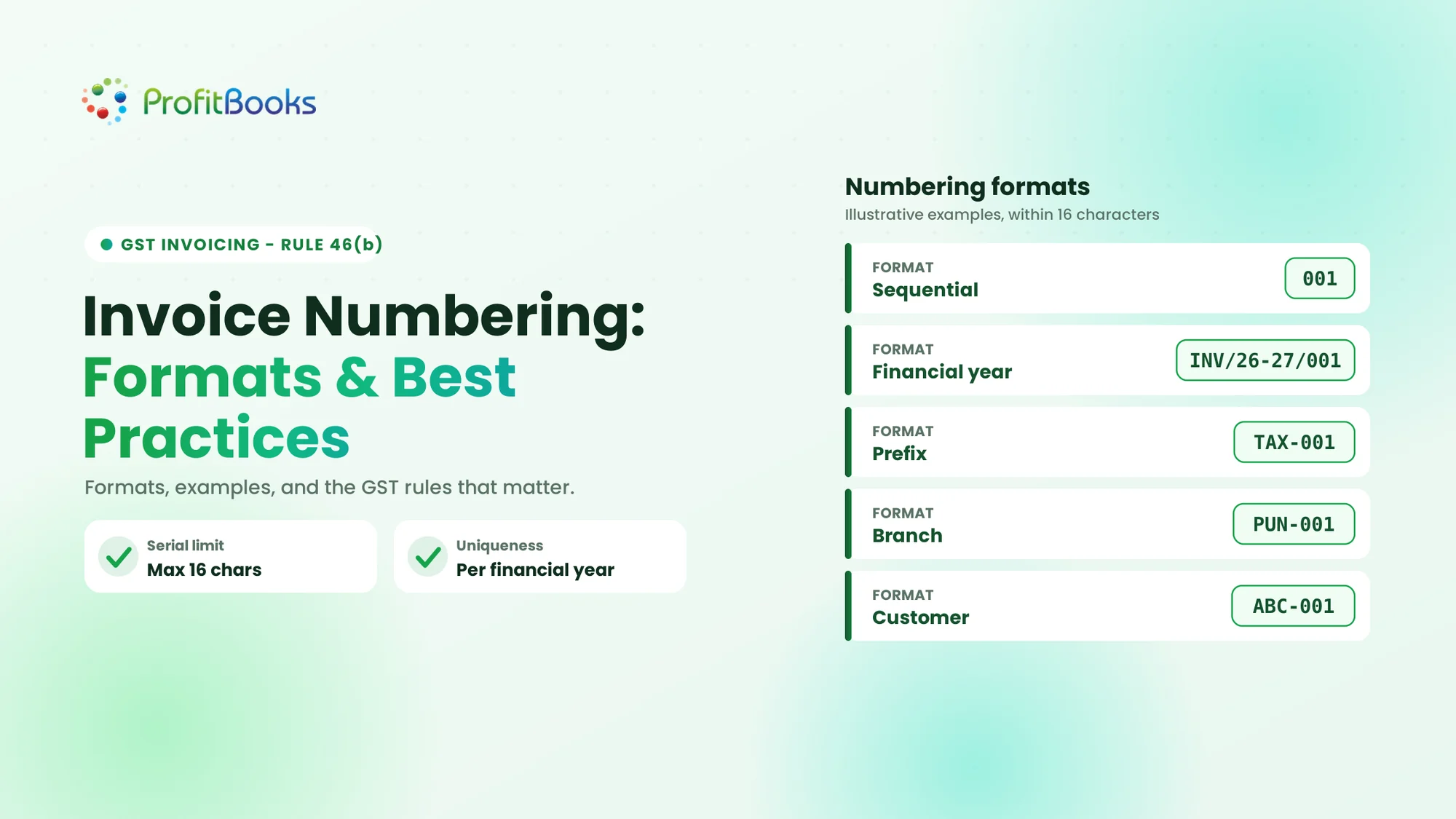
Common Invoice Numbering Formats with Examples
There is no single correct format. A business can choose one based on its size, invoice volume, number of branches, and how it operates. Here are five common approaches, with illustrative examples. These are business formats, not GST-prescribed ones, and each sample stays within the 16-character limit using only permitted characters.
1. Sequential Invoice Numbering
EXAMPLES
001002003004Numbers are assigned consecutively, one after the next. It is simple to maintain, easy for anyone to understand, and well suited to businesses with straightforward invoicing. Best for: freelancers, independent consultants, and small businesses.
2. Financial-Year-Based Invoice Numbering
EXAMPLES
INV/26-27/001INV/26-27/002INV/26-27/003This format builds the financial year into the number. The components are INV (an invoice identifier), 26-27 (the financial year 2026-27), and 001 (the sequential number). It makes the financial year of any invoice obvious at a glance. The financial-year prefix is an optional format choice, not a specific GST requirement.
3. Prefix-Based Invoice Numbering
EXAMPLES
TAX-001TAX-002TAX-003A prefix can identify a particular document type or invoice series, which helps a business keep a consistent naming convention across its documents. A prefix such as TAX is not mandatory, and it should not be used in a way that suggests every business document is a tax invoice when it is not.
4. Branch-Based Invoice Numbering
EXAMPLES
PUN-001MUM-001DEL-001A branch identifier organises invoices by location, which makes internal tracking and branch-wise reporting easier and keeps records tidy across sites. Branch codes alone do not establish GST compliance; a multi-location business should consider its GST registrations and how invoices are issued from each place.
5. Customer-Based Invoice Numbering
EXAMPLES
ABC-001ABC-002XYZ-001A customer code can help group customer-specific records. It has limits, though: it can get complicated as the number of customers grows, it raises the risk of duplicate numbers, and it needs careful control of the overall series. Restarting numbers for each customer does not, on its own, satisfy the GST requirements, so the uniqueness and consecutive-numbering rules still have to hold across the business.
Keep every tax-invoice number within 16 characters, use only alphabets, numerals, hyphens and slashes, and make sure it stays unique for the financial year. The format is your choice; those limits are not.
How to Choose the Right Invoice Numbering Format
The right format follows how your business actually operates. A rough guide:
| Business type | Suggested approach | Reason |
|---|---|---|
| Freelancer | Simple sequential series | Easy to maintain |
| Small service business | Financial-year-based series | Easier financial-year tracking |
| Retail business | Sequential or structured series | Suitable for regular invoicing |
| Wholesaler or distributor | Structured series | Helps organise larger invoice volumes |
| Multi-branch business | Separate controlled series | Helps distinguish locations |
| Growing SME | Software-managed series | Reduces manual numbering work |
Whatever you pick, a good format is easy to understand, consistent, easy to maintain, scalable as you grow, and compliant with the applicable GST requirements. No single format is universally best; the best one is the one that fits your operations and that you can keep consistent.
Invoice Numbering Best Practices for Small Businesses
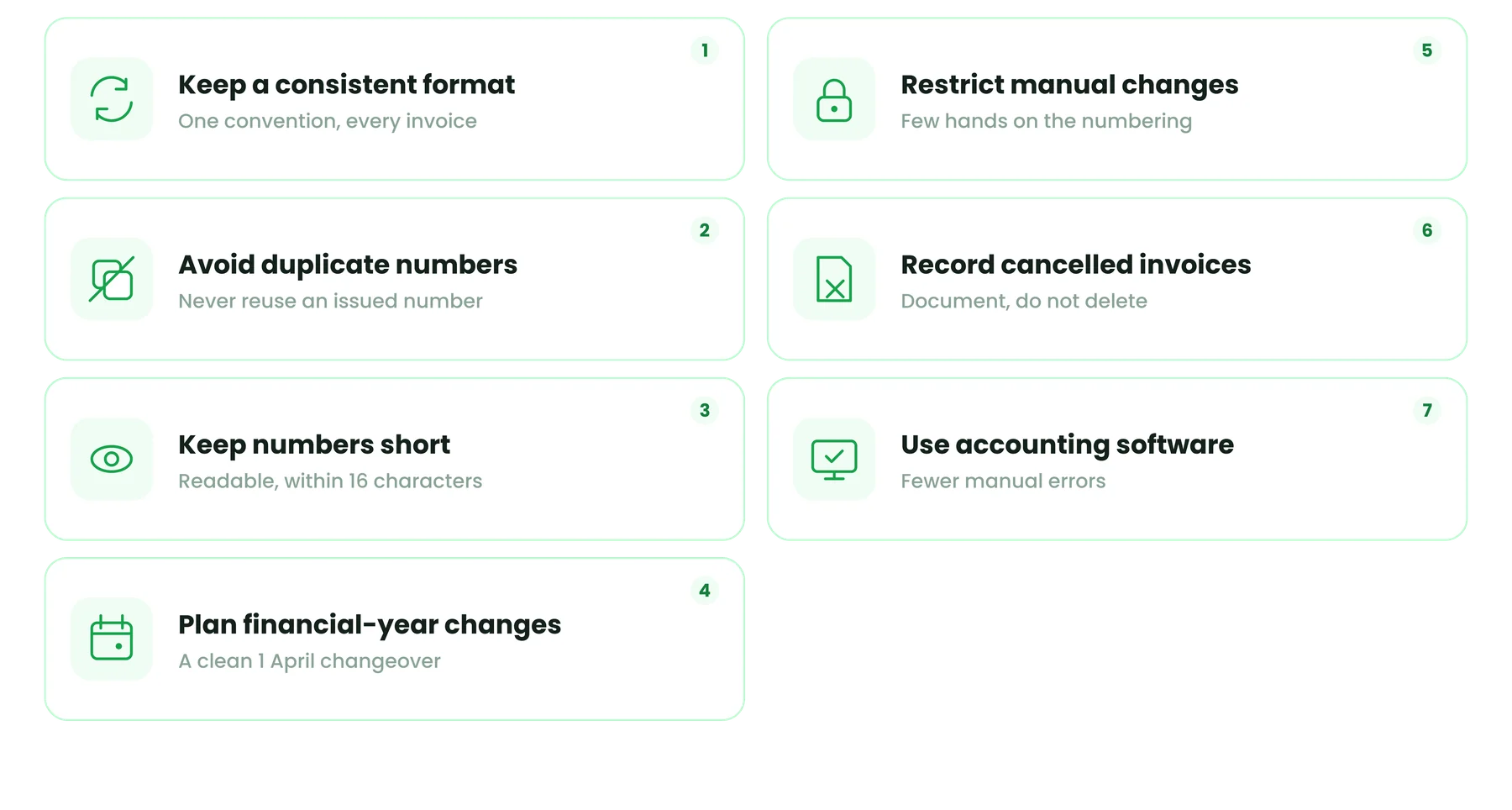
Keep a consistent format
Choose one numbering convention and follow it for every invoice. Consistency is what makes the whole sequence useful; switching formats partway through undoes most of the benefit.
Avoid duplicate invoice numbers
Maintain a controlled sequence and never manually reuse a previously issued number. Duplicate numbers break tracking and can create confusion during reconciliation and any GST review.
Keep invoice numbers short and readable
Use a format your staff and customers can read and repeat without error, and remember the 16-character limit for tax-invoice serial numbers. A shorter, clearer number is easier to quote on a payment and less prone to mistakes.
Plan for financial-year changes
If your format includes a financial-year identifier, decide in advance how the new year's series will begin, so the changeover on 1 April is clean rather than improvised.
Restrict manual changes
Limit who can change invoice-numbering settings, and keep appropriate records of any corrections. Fewer hands on the numbering logic means fewer accidental duplicates and gaps.
Maintain a clear record of cancelled invoices
When an invoice is cancelled, document it rather than silently deleting or reusing the number. The cancelled number should remain accounted for, so the sequence still makes sense and there is an audit trail for the cancellation.
Use accounting software
Accounting software can generate invoice numbers systematically, keep the records, and reduce the manual errors that creep into spreadsheet-based numbering, which is where most duplicates and gaps begin.
Common Invoice Numbering Mistakes to Avoid
- Reusing an invoice number. Two invoices sharing a number break tracking and reconciliation.
- Creating duplicate numbers across different series. Separate series still need to stay unique within the financial year.
- Changing numbering formats frequently. Each switch makes older records harder to follow.
- Exceeding the 16-character limit on a tax-invoice serial number, which breaches Rule 46(b).
- Using unsupported special characters. Only hyphen/dash and slash are permitted alongside letters and numerals.
- Confusing invoice numbers with invoice dates or IRNs. They are different references and should not be mixed up.
- Deleting cancelled invoice records without retaining an appropriate audit trail of the cancellation.
- Letting employees create invoice numbers independently without coordination, which produces duplicates and gaps.
How Accounting Software Simplifies Invoice Numbering
Manual numbering through spreadsheets works until it does not: someone types the wrong number, two people issue invoices at once, or the financial-year changeover gets missed. Software-based invoicing removes most of those failure points by handling the numbering for you.
- Automatic invoice-number generation in a controlled sequence.
- Consistent numbering that does not drift between staff.
- Invoice history and quick retrieval by number.
- Customer-wise invoice records.
- Better visibility into which invoices have been issued.
- Integration of invoicing with accounting records, where supported.
ProfitBooks is an accounting and invoicing solution built for small businesses, where invoices and accounting records sit in one place rather than in disconnected spreadsheets. That makes it easier to keep a clean, consistent numbering sequence and to find any invoice later. Confirm the specific numbering options your business needs, such as custom formats, multiple series, or branch-wise numbering, against the current product documentation, and treat GST compliance as something you verify for your own registration rather than assume from any tool.
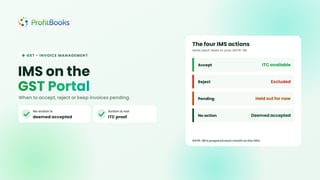
Related reading on keeping GST records organised: the Invoice Management System (IMS) on the GST Portal.
Frequently Asked Questions About Invoice Numbering
What is the correct invoice number format in India?
GST does not prescribe one universal format. A tax invoice must satisfy Rule 46(b): a consecutive serial number, no more than 16 characters, using only alphabets, numerals, hyphens and slashes, and unique for the financial year. Any format meeting those conditions is acceptable.
Can invoice numbers start from 1 every financial year?
Yes. A business can begin a new financial-year-based series each year, as long as the applicable serial-number requirements are met: the numbers stay consecutive, within 16 characters, use permitted characters, and remain unique within that financial year.
Can a business use multiple invoice series under GST?
Yes. Rule 46(b) allows one or multiple series. If you maintain more than one series, each must still use consecutive, unique serial numbers within the financial year and stay within the character and format rules, so the uniqueness requirement holds across the business.
Can invoice numbers contain letters and special characters?
Alphabets and numerals are allowed, and so are the special characters hyphen or dash and slash, symbolised as '-' and '/'. Other special characters are not permitted in a tax-invoice serial number under Rule 46(b), so a format should use only these.
Can invoice numbers be changed after issuing an invoice?
A business should not casually overwrite or reuse an issued invoice number. If a correction is genuinely needed, it must follow the applicable GST and accounting-document procedures, with the change properly recorded, rather than editing the number quietly.
What happens if an invoice number is skipped?
Investigate and document the reason for the gap, for example a cancelled or voided invoice. A gap on its own does not establish a GST violation, but keeping a clear record of why a number is missing avoids questions later during reconciliation or review.
Is an invoice number the same as an IRN?
No. The supplier assigns the invoice number. An Invoice Reference Number (IRN) is generated through the e-invoicing system for the documents to which e-invoicing applies. They are different references, and one does not replace the other.
Do small businesses need accounting software for invoice numbering?
Software is not the only way to maintain numbering; a careful manual sequence can work. But software helps manage the sequence, keep the records, and track invoices more efficiently, which reduces the duplicates and gaps that manual, spreadsheet-based numbering tends to produce.
Build a More Organised Invoicing Process
A good invoice numbering system is consistent, easy to track, unique, scalable, and compliant with the applicable requirements. Get those right and most of the everyday friction, the lost invoices, the confused follow-ups, the duplicate records, simply stops happening.
As a business grows, manual numbering through disconnected spreadsheets becomes harder to keep clean. Managing invoicing and accounting together, in a tool like ProfitBooks, keeps the numbering consistent and every invoice easy to find, so the system still works when the invoice volume is many times what it is today.
Keep your invoicing organised as you grow
ProfitBooks helps small businesses generate invoices in a consistent sequence and manage invoicing and accounting in one place, so your records stay orderly and every invoice is easy to find.
Explore ProfitBooks →