EBITDA vs EBIT vs net profit: key differences, formulas and examples
On this page 32 sections
A business owner reviews the quarter's numbers. EBITDA shows ₹3,50,000. Net profit shows ₹1,90,000. Both are positive and both are called "profit", yet one is nearly double the other. Which number reflects how the business actually performed?
Both do, because they answer different questions. EBITDA, EBIT and net profit measure profitability at different stages of the same profit and loss statement, and each one removes or includes a different set of costs. The gaps between them are as informative as the numbers themselves.
This guide covers the formula for each metric, calculates all three from one income statement, compares their margins, and explains where each measure is useful and where it can mislead.
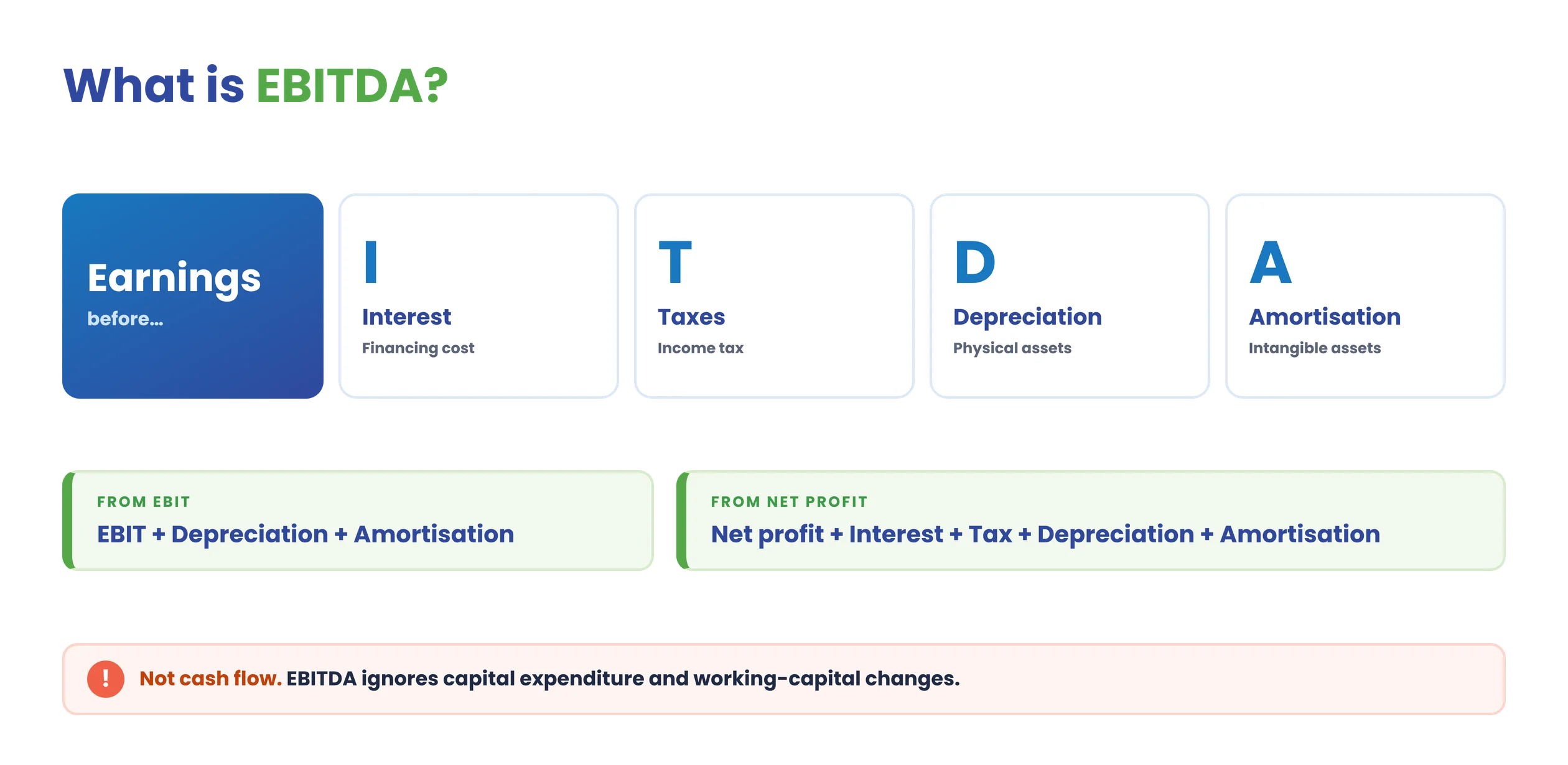
EBITDA is earnings before interest, taxes, depreciation and amortisation. EBIT is earnings before interest and taxes, so it does deduct depreciation and amortisation. Net profit is what remains after all relevant expenses, including interest and income tax. Each measures a different stage of profitability, and none of them is the same as cash flow.
Here is the whole idea before the detail.
- EBITDA = EBIT + depreciation + amortisation.
- EBIT = EBITDA − depreciation − amortisation.
- Net profit = EBIT − interest expense − income-tax expense (simplified).
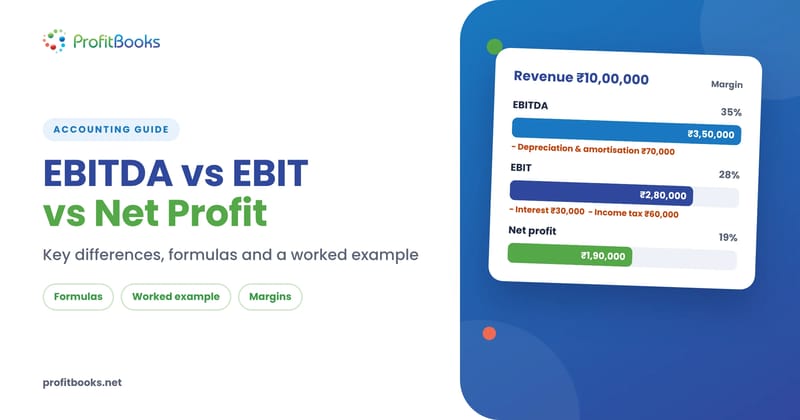
- In the worked example: EBITDA ₹3,50,000 (35%), EBIT ₹2,80,000 (28%), net profit ₹1,90,000 (19%).
- None of the three is cash flow, and EBITDA has no single standard definition.
EBITDA vs EBIT vs Net Profit: What's the Difference?
EBITDA shows operating profitability before interest, income tax, depreciation and amortisation (D&A) are deducted. EBIT deducts depreciation and amortisation but still excludes interest and income tax. Net profit deducts everything, giving the accounting result at the bottom of the income statement.
| Feature | EBITDA | EBIT | Net profit |
|---|---|---|---|
| Interest expense deducted? | No | No | Yes |
| Income-tax expense deducted? | No | No | Yes |
| Depreciation deducted? | No | Yes | Yes |
| Amortisation deducted? | No | Yes | Yes |
| Primary use | Operating profitability before financing, tax and D&A | Profitability after D&A, before interest and tax | Overall accounting result after relevant expenses and tax |
| Same as cash flow? | No | No | No |
The three metrics are not interchangeable. Each one answers a different question about the same business, and this table follows the simplified definitions used throughout this article. Real financial statements may classify items differently, so check the line items before comparing businesses.
What Is EBITDA?
EBITDA Meaning
EBITDA stands for earnings before interest, taxes, depreciation and amortisation. It tries to isolate operating performance by removing costs that depend on how a business is financed (interest), where and how it is taxed (income tax), and how it accounts for its long-lived assets (depreciation and amortisation). Analysts, lenders and acquirers use it to compare businesses with different capital structures on more comparable terms.
EBITDA is not a standardised subtotal with one prescribed calculation under IFRS. IFRS 18, effective for annual periods beginning on or after 1 January 2027, introduces a defined operating profit subtotal, but EBITDA is not one of the standard's required subtotals. Companies may define it differently. In the US, the SEC requires companies that report non-GAAP measures such as EBITDA to reconcile them to the most directly comparable GAAP measure.
EBITDA Formula
There are two common ways to calculate it. Building up from EBIT:
EBITDA = EBIT + Depreciation + Amortisation
Or building up from net profit:
EBITDA = Net Profit + Interest Expense + Income-Tax Expense + Depreciation + Amortisation
You need the income statement figures for interest, income tax, depreciation and amortisation. Both routes should produce the same result from the same statement. If they don't, an item has been missed or classified differently.
What EBITDA Does Not Tell You
EBITDA is not cash flow. It does not deduct capital expenditure, so a business can report strong EBITDA while spending heavily on replacement equipment. It does not reflect working-capital changes, such as receivables growing or inventory building up. And the interest and tax it excludes still have to be paid.
What Is EBIT?
EBIT Meaning
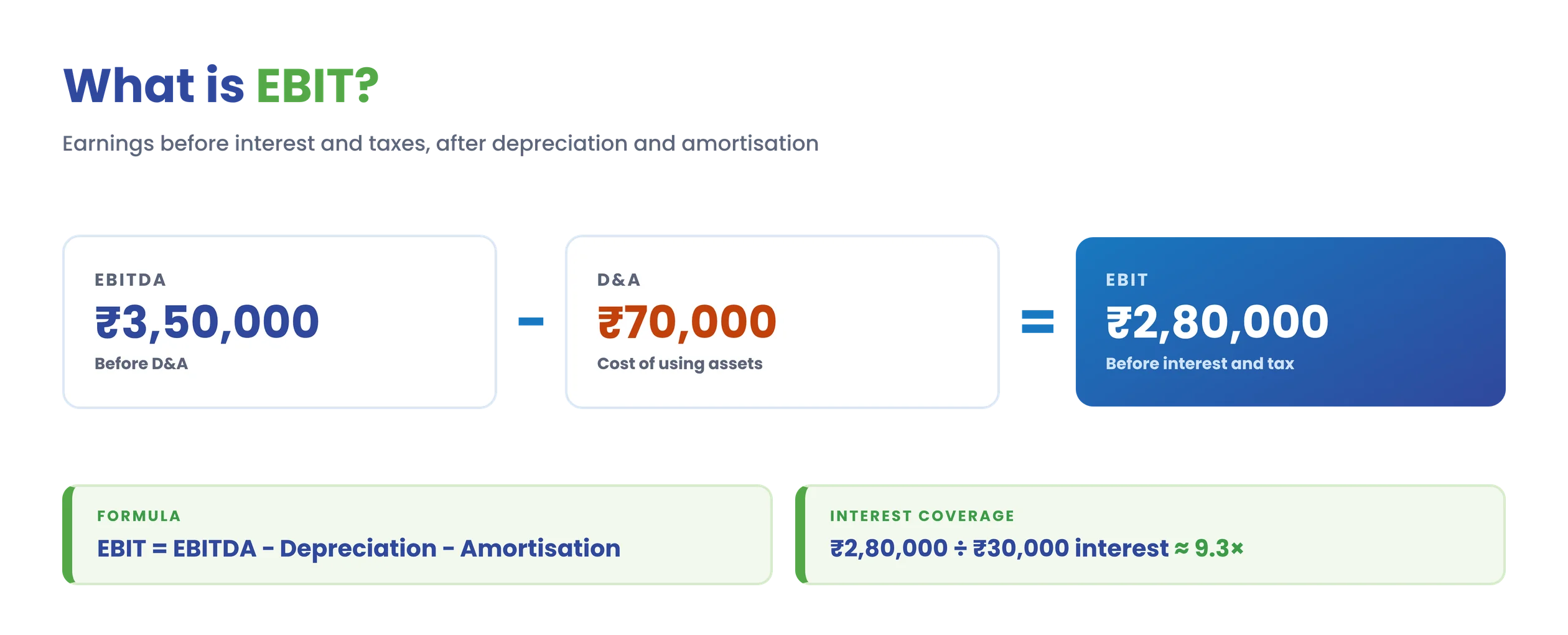
EBIT stands for earnings before interest and taxes. Unlike EBITDA, it deducts depreciation and amortisation, which represent the consumption of assets the business uses to earn revenue. A business that buys a ₹5,00,000 machine records depreciation against EBIT over the machine's useful life, even though no further cash leaves the bank for that machine in later periods.
EBIT Formula
For this article's simplified calculation:
EBIT = EBITDA − Depreciation − Amortisation
EBIT is often close to operating income, but the two are not automatically identical. Some income statements include or exclude items, such as other income or foreign-exchange gains, that create a gap.
When EBIT Is Useful
EBIT is useful when you want to see profitability after recognising the cost of using assets, but before the effects of financing and income tax. Lenders often use it to calculate interest coverage (EBIT ÷ interest expense), which shows whether operating profit comfortably covers interest costs. In the worked example below, interest coverage is ₹2,80,000 ÷ ₹30,000, or about 9.3 times.
What Is Net Profit?
Net Profit Meaning
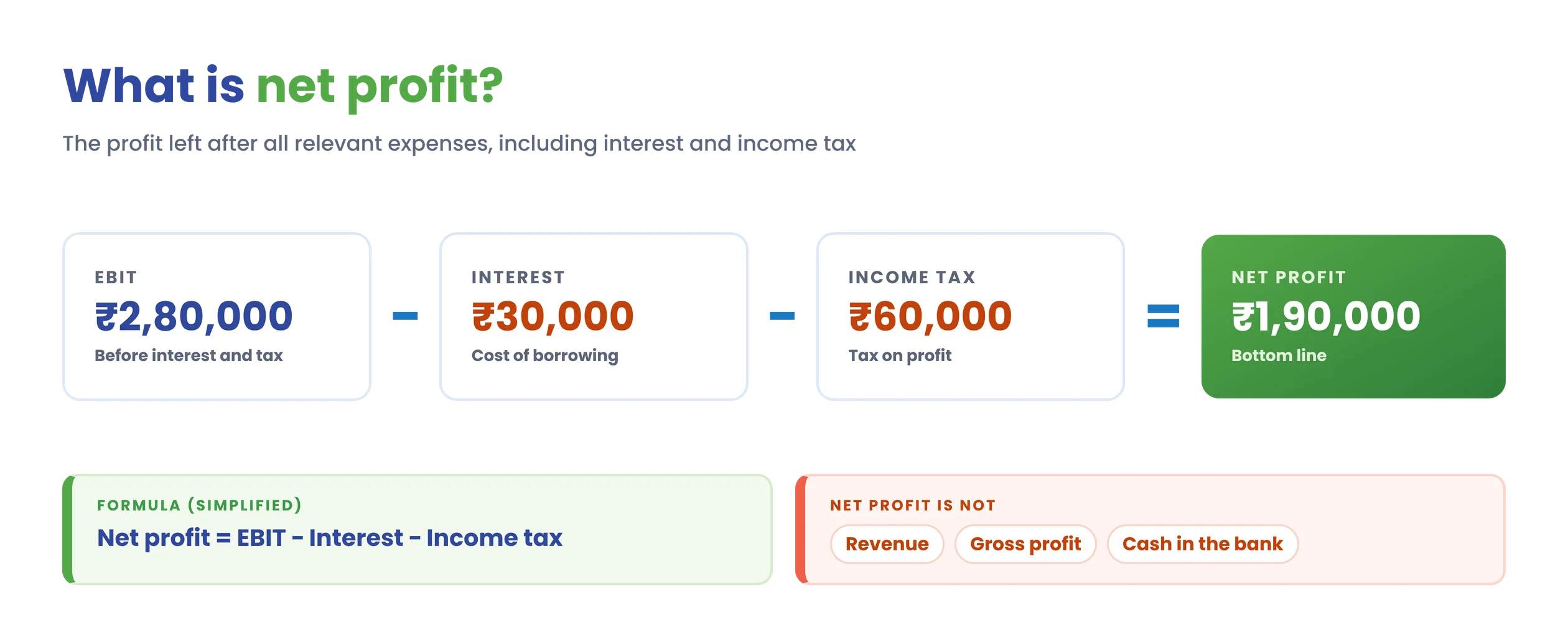
Net profit is the profit remaining after all relevant expenses, including cost of goods sold, operating expenses, depreciation, amortisation, interest and income-tax expense, are deducted from revenue. It is not revenue, it is not gross profit, and it is not cash in the bank.
Net Profit Formula
Net Profit = EBIT − Interest Expense − Income-Tax Expense
This is a simplified formula. On actual financial statements, other income, finance income, exceptional items and other non-operating items can also affect the final figure.
Why Net Profit Matters
Net profit is the overall accounting result for the period, which is why owners, shareholders and lenders look at it closely. It is shaped by financing (more borrowing means more interest), tax and one-off items, and it is still an accrual figure. A profitable period does not guarantee the business had enough cash to meet its obligations.
EBITDA vs EBIT vs Net Profit: Worked Example
Here is one hypothetical income statement. Every figure in the rest of this article comes from these numbers.
| Income statement item | Amount |
|---|---|
| Revenue | ₹10,00,000 |
| Cost of goods sold | ₹4,00,000 |
| Operating expenses excluding D&A | ₹2,50,000 |
| Depreciation | ₹50,000 |
| Amortisation | ₹20,000 |
| Interest expense | ₹30,000 |
| Income-tax expense | ₹60,000 |
Step 1: Calculate EBITDA
Start with revenue and deduct only the costs of running the business before D&A: ₹10,00,000 − ₹4,00,000 − ₹2,50,000 = ₹3,50,000. As a cross-check, building up from net profit gives the same answer: ₹1,90,000 + ₹30,000 + ₹60,000 + ₹50,000 + ₹20,000 = ₹3,50,000.
Step 2: Calculate EBIT
Deduct depreciation and amortisation from EBITDA: ₹3,50,000 − ₹50,000 − ₹20,000 = ₹2,80,000. The ₹70,000 gap is the cost of using the business's long-lived assets for the period.
Step 3: Calculate Net Profit
Deduct interest and income-tax expense from EBIT: ₹2,80,000 − ₹30,000 − ₹60,000 = ₹1,90,000.
| Metric | Amount | What it has deducted from revenue |
|---|---|---|
| EBITDA | ₹3,50,000 | COGS and operating expenses |
| EBIT | ₹2,80,000 | Plus depreciation and amortisation (₹70,000) |
| Net profit | ₹1,90,000 | Plus interest (₹30,000) and income tax (₹60,000) |
Each step deducts another category of cost. The ₹1,60,000 gap between EBITDA and net profit is fully explained by depreciation (₹50,000), amortisation (₹20,000), interest (₹30,000) and income tax (₹60,000). The example is simplified and excludes other income and exceptional items that might appear in a real income statement.
EBITDA Margin vs EBIT Margin vs Net Profit Margin
Margins express each metric as a percentage of revenue, which makes it easier to compare periods or businesses of different sizes.
EBITDA Margin Formula
EBITDA Margin = EBITDA ÷ Revenue × 100
₹3,50,000 ÷ ₹10,00,000 × 100 = 35%
EBIT Margin Formula
EBIT Margin = EBIT ÷ Revenue × 100
₹2,80,000 ÷ ₹10,00,000 × 100 = 28%
Net Profit Margin Formula
Net Profit Margin = Net Profit ÷ Revenue × 100
₹1,90,000 ÷ ₹10,00,000 × 100 = 19%
| Margin | Calculation | Result | What the drop from the previous margin reflects |
|---|---|---|---|
| EBITDA margin | ₹3,50,000 ÷ ₹10,00,000 | 35% | Starting point |
| EBIT margin | ₹2,80,000 ÷ ₹10,00,000 | 28% | 7 points of depreciation and amortisation |
| Net profit margin | ₹1,90,000 ÷ ₹10,00,000 | 19% | 3 points of interest and 6 points of income tax |
These are illustrative results from the example, not industry benchmarks or targets. Margins vary widely by industry, asset intensity and financing. A software business and a manufacturer with the same EBITDA margin could have very different EBIT margins, because their depreciation charges are nothing alike.
Why EBITDA, EBIT and Net Profit Can Tell Different Stories
The gaps between the metrics depend on the shape of the business. Three situations show why.
- High depreciation and amortisation. A logistics business with a large vehicle fleet may report EBITDA well above EBIT, because depreciation on its trucks is deducted in EBIT but not in EBITDA.
- High interest expense. A business funded mainly by loans may report healthy EBIT but much lower net profit, because interest is deducted after EBIT.
- Working capital and capital expenditure. A retailer may report positive EBITDA and net profit while its bank balance shrinks, because cash is tied up in inventory and unpaid invoices or spent on new equipment, none of which EBITDA deducts.
| Situation | Metric or measure affected | Why |
|---|---|---|
| High depreciation and amortisation | Gap between EBITDA and EBIT | D&A is excluded from EBITDA but deducted in EBIT |
| High interest expense | Gap between EBIT and net profit | Interest is deducted below EBIT |
| Large working-capital investment | Operating cash flow | Cash is tied up in receivables and inventory |
| Major equipment purchases | Cash flow (investing) | Capex uses cash but is not deducted in EBITDA |
EBITDA vs EBIT vs Net Profit: Which Should You Use?
When EBITDA May Be Useful
EBITDA can help when comparing operating performance across businesses with different financing, tax positions or depreciation policies, and it is often used in valuations and lending discussions. It is less reliable for asset-heavy businesses, where it ignores the cost of maintaining and replacing assets.
When EBIT May Be Useful
EBIT is useful when you want profitability after the cost of using assets but before financing and tax, for example when assessing interest coverage or comparing the core performance of businesses with different debt levels.
When Net Profit May Be Useful
Net profit is the measure to use when you need the overall accounting result for the period, after all relevant expenses and income tax. It is the starting point for profit available to owners.
Why You Should Review All Three Together
Each metric hides something the others reveal. Read them together, alongside your financial statements and, where relevant, the cash flow statement, rather than relying on any single figure.
Use the metric that answers your question, then check it against the balance sheet and cash flow.
EBITDA Is Not the Same as Cash Flow
Because EBITDA adds back non-cash charges like depreciation, it is easy to assume it approximates cash generated. It doesn't. EBITDA is built from accrual-based figures, while operating cash flow reflects the cash actually generated or used, after working-capital movements.
Take the worked example. EBITDA is ₹3,50,000. Now suppose some customers have not yet paid their invoices, the business has bought extra inventory ahead of a busy season, and it has purchased new equipment. Each of those uses cash, or delays it, without reducing EBITDA. Interest and income tax are also paid in cash. The cash the business actually has available could be well below ₹3,50,000, and EBITDA alone cannot tell you how far below.
That is why growing accounts receivable, inventory and capital expenditure need to be reviewed alongside profit. For practical ways to close the gap, see our guide to managing cash flow in a small business.
Limitations of EBITDA and Other Profitability Measures
- EBITDA's exclusions: it ignores depreciation, amortisation, interest, income tax, capital expenditure and working-capital needs, all of which affect the business.
- Adjusted EBITDA varies: companies choose which items to add back, such as one-off costs, so "adjusted EBITDA" from two businesses may not be comparable without reconciling the adjustments.
- Depreciation assumptions affect EBIT: the same machine depreciated over five years instead of ten produces a lower EBIT from identical operations.
- Net profit reflects financing and non-operating items: interest, tax, other income and exceptional items all affect it, so net margins across businesses can mislead without context.
Always look at the underlying statements and the definitions the business uses.
Common Mistakes When Comparing EBITDA, EBIT and Net Profit
| Mistake | Why it matters | What to do instead |
|---|---|---|
| Treating EBITDA as cash | Ignores working capital, capex, interest and tax payments | Check the cash flow statement |
| Assuming EBIT always equals operating profit | Other income and unusual items can create a gap | Check which lines each figure includes |
| Deducting interest twice | Understates net profit | Deduct interest once, below EBIT |
| Mixing GST with income tax | GST is a tax collected on sales, not a tax on profit | Deduct only income-tax expense; see GST vs income tax |
| Comparing inconsistent periods | A quarter compared with a full year, or seasonal months, distorts the picture | Compare like periods |
| Comparing adjusted with unadjusted EBITDA | The add-backs differ | Reconcile the definitions first |
All three metrics are only as reliable as the books behind them. Missing accruals, duplicate entries or unreconciled bank accounts will distort every figure, however correctly the formulas are applied.
Get an accurate P&L before you calculate
ProfitBooks records your invoices and expenses and generates profit and loss, balance sheet and cash flow reports, giving you reliable figures to calculate EBITDA, EBIT and net profit from.
Frequently Asked Questions
What is the difference between EBITDA and net profit?
EBITDA measures earnings before interest, income tax, depreciation and amortisation. Net profit is what remains after all of those costs, plus other relevant expenses, are deducted. The gap between them shows how much asset charges, financing costs and tax reduce the final result. In the worked example, EBITDA is ₹3,50,000 and net profit is ₹1,90,000.
Is EBITDA higher than EBIT?
Usually, yes. EBITDA equals EBIT plus depreciation and amortisation, so EBITDA is higher whenever the business has depreciation or amortisation expense. The two are equal only when D&A is zero. In the example, EBITDA of ₹3,50,000 exceeds EBIT of ₹2,80,000 by the ₹70,000 of D&A.
Is EBIT the same as operating profit?
Often close, but not automatically identical. Operating profit is a line defined by how a business presents its income statement, while EBIT is usually calculated by adding interest and tax back to net profit. Other income, foreign-exchange items or unusual gains and losses can make the two figures differ, so check the line items.
Can EBITDA be positive while net profit is negative?
Yes. If depreciation, amortisation, interest and income-tax expense together exceed EBITDA, the business reports positive EBITDA but a net loss. This is common in asset-heavy or highly borrowed businesses, where large depreciation charges and interest costs sit below the EBITDA line.
Is EBITDA the same as cash flow?
No. EBITDA is an accrual-based profit measure. It ignores working-capital movements such as unpaid customer invoices and inventory build-up, capital expenditure, loan repayments and the cash paid for interest and tax. A business can report strong EBITDA while its bank balance falls.
How do you calculate EBITDA margin?
Divide EBITDA by revenue and multiply by 100. Using the worked example, ₹3,50,000 ÷ ₹10,00,000 × 100 = 35%. Compare margins only with businesses that define EBITDA the same way and operate in similar industries, because asset intensity and accounting choices affect the result.
Which is more important, EBITDA or net profit?
Neither is universally more important. EBITDA helps compare operating performance before financing, tax and asset charges. Net profit shows the overall accounting result after all relevant expenses. Choose the metric that answers your question, and read it alongside the balance sheet and cash flow statement.
Does accounting software calculate EBITDA automatically?
Not always. Many accounting tools, including ProfitBooks, generate a profit and loss report from which you can calculate EBITDA by adding back interest, tax, depreciation and amortisation. Whether a product shows EBITDA directly depends on its report options. Check your software's reports rather than assuming the figure is there.
Final Takeaway
EBITDA shows profit before interest, tax, depreciation and amortisation. EBIT deducts depreciation and amortisation but still excludes interest and tax. Net profit is the accounting result after all relevant expenses and tax. None of them is cash flow, and the gaps between them reveal how much your assets, financing and tax cost. Use the metric that answers your specific financial question, then check it against your cash flow statement.
See your real numbers, not estimates
Generate profit and loss, balance sheet and cash flow reports from your own books with ProfitBooks.
Disclaimer: This article provides general information about profitability measures using a simplified hypothetical example. It is not personalised accounting, investment or tax advice. Definitions of EBITDA and related measures vary between businesses and reporting frameworks.