Bad debt expense: how to calculate, record and recover unpaid invoices
On this page 27 sections
You delivered the work, sent the invoice and recorded the revenue. Three months later, the customer has gone quiet, and the accounts receivable balance on your books looks less like an asset every week.
Bad debt expense is the accounting mechanism that corrects your financial statements when an invoice moves from "they'll pay eventually" to "they probably won't". This guide shows how to calculate it, the journal entries for the direct write-off and allowance methods, how it affects your statements, how to record a recovery, and where accounting treatment separates from income tax and Australian GST rules. One running example is used throughout, so you can follow the same numbers from calculation to journal entry to financial statements.
Bad debt expense is the loss a business recognises when a customer receivable is unlikely to be collected. It is calculated as the receivable balance minus the amount expected to be recovered, or estimated across receivables through an allowance. It reduces profit and receivables, but it does not move cash and is not automatically tax-deductible.
Here is the whole idea before the detail.
- An overdue invoice is not automatically a bad debt. The evidence decides, not the calendar.
- Direct write-off: Dr Bad Debt Expense, Cr Accounts Receivable.
- Allowance method: Dr Bad Debt Expense, Cr Allowance for Doubtful Debts. A later write-off against the allowance creates no second expense.
- A recovery is recorded as a recovery, not as new sales.
- Accounting expense, income-tax deduction and GST adjustment are three separate questions.
What Is Bad Debt Expense?
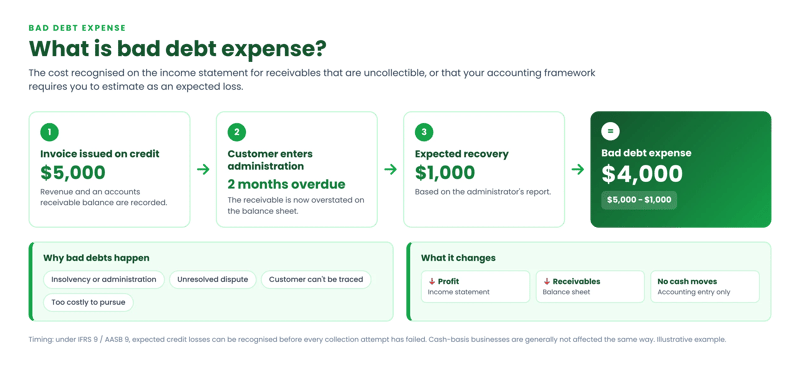
Bad debt expense is the cost recognised on the income statement for the portion of accounts receivable that a business has determined is uncollectible, or that its accounting framework requires it to estimate as an expected loss.
When you invoice a customer on credit under accrual accounting, you record revenue and an accounts receivable balance. If the customer cannot or will not pay, that asset is overstated. Bad debt expense brings the books back to reality by reducing both reported profit and the carrying amount of receivables.
Bad debts usually arise from a customer's insolvency or administration, a dispute that will not be resolved, a customer who cannot be traced, or a debt that would cost more to pursue than it is worth. Cash-basis businesses are generally not affected in the same way, because they have not recorded the revenue until payment arrives.
Timing matters. You do not always wait until every collection attempt has failed. Under IFRS 9 Financial Instruments (adopted in Australia as AASB 9), entities apply an expected credit loss model and, for trade receivables, generally recognise lifetime expected losses using historical, current and forward-looking information. The framework you report under sets the timing, not instinct.
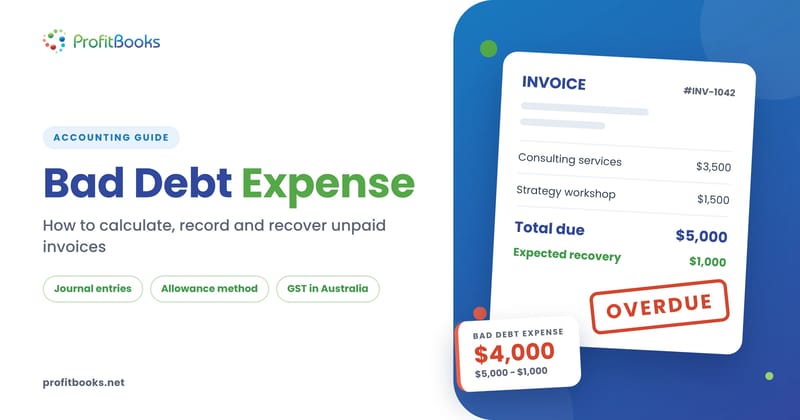
Running example: you provide consulting services worth $5,000 on credit. Two months after the due date, the customer enters administration. Based on the administrator's report, you expect to recover only $1,000.
 Bad Debt vs Doubtful Debt vs Overdue Invoice
These terms are often used interchangeably, but they mean different things in your accounts.
| Term | What it means | Accounting consideration |
|---|---|---|
| Overdue invoice | The payment due date has passed | Assess collectability; no automatic write-off |
| Doubtful debt | Collection is uncertain but not confirmed lost | May need an allowance or expected credit loss estimate |
| Bad debt | Amount assessed as uncollectible | Written off; loss recognised if not already covered by an allowance |
| Allowance for doubtful debts | Estimated losses across receivables | Contra-asset that reduces the net carrying amount of receivables |
An invoice does not move from overdue to bad on a fixed timetable. A 45-day-old invoice from a reliable customer with a known cash-flow delay is very different from a 45-day-old invoice where the customer has stopped responding. Clear invoice payment terms make that assessment easier, because you know exactly when an amount became overdue.
How to Calculate Bad Debt Expense
There are two levels of calculation: a specific debt you have assessed individually, and an estimate across all your receivables.
Calculating a Specific Bad Debt
Using the running example:
| Item | Amount |
|---|---|
| Original receivable | $5,000 |
| Expected recovery | $1,000 |
| Uncollectible amount (bad debt) | $5,000 − $1,000 = $4,000 |
The formula is simple. The judgment about expected recovery is where the real work happens, and it should rest on documented evidence, such as the administrator's report, correspondence or a settlement offer, rather than a guess.
Estimating Losses Across Multiple Receivables
Under the allowance method, you estimate losses across the whole receivable balance. IFRS 9 and AASB 9 allow a provision matrix for trade receivables: loss rates applied to aging buckets, based on your historical loss experience and adjusted for current and forward-looking conditions. The loss rates below are hypothetical, not benchmarks.
| Aging bucket | Receivable balance | Assumed loss rate | Expected loss |
|---|---|---|---|
| Current | $80,000 | 1% | $800 |
| 1–30 days overdue | $25,000 | 3% | $750 |
| 31–60 days overdue | $12,000 | 10% | $1,200 |
| 61–90 days overdue | $6,000 | 25% | $1,500 |
| Over 90 days | $4,000 | 60% | $2,400 |
| Total | $127,000 | $6,650 |
If the allowance already holds $4,000 (for example, because the consulting customer in the running example was provided for last period), the adjustment for this period is $6,650 − $4,000 = $2,650. Your rates should come from your own customer mix and payment history, not a generic percentage.
Journal Entries for Bad Debt Expense
The correct journal entry depends on the method your business uses and on whether the loss has already been provided for. All three entries below use the running example.
Journal Entry Using the Direct Write-Off Method
Where no allowance is maintained, the specific uncollectible amount is written off when it is identified:
| Account | Debit | Credit |
|---|---|---|
| Bad Debt Expense | $4,000 | |
| Accounts Receivable | $4,000 |
This removes the $4,000 from receivables and records the expense, leaving $1,000 still receivable. It is simple, but the expense may fall in a different period from the revenue it relates to. For that reason, it is generally acceptable only where the amounts are immaterial or the business is not required to follow an expected-loss framework.
Journal Entry Using the Allowance Method
Under the allowance method, the expected loss is recognised before any specific customer is written off. Last period, when the customer's difficulties emerged, the business provided for the expected $4,000 loss:
| Account | Debit | Credit |
|---|---|---|
| Bad Debt Expense (or Impairment Loss) | $4,000 | |
| Allowance for Doubtful Debts (or Loss Allowance) | $4,000 |
At this period end, the aging review requires a total allowance of $6,650, so the top-up entry is:
| Account | Debit | Credit |
|---|---|---|
| Bad Debt Expense | $2,650 | |
| Allowance for Doubtful Debts | $2,650 |
Account names vary by framework and chart of accounts. Under IFRS 9 and AASB 9, "impairment loss" and "loss allowance" are common.
Journal Entry When Writing Off a Debt Already Covered by an Allowance
When the administrator confirms the $4,000 will not be paid, the specific receivable is written off against the allowance:
| Account | Debit | Credit |
|---|---|---|
| Allowance for Doubtful Debts | $4,000 | |
| Accounts Receivable | $4,000 |
No new expense arises here, because the loss was already recognised when the allowance was created. Recording Bad Debt Expense again at this stage double-counts the loss, which is one of the most common errors in small-business accounts. After this entry, the allowance holds $6,650 − $4,000 = $2,650 for the remaining receivables.
Allowance method: the expense is recognised once, when the loss is estimated. The write-off only moves the balance out of receivables.
Direct Write-Off Method vs Allowance Method
| Factor | Direct write-off | Allowance method |
|---|---|---|
| Timing of loss | When a specific debt is confirmed uncollectible | When the loss is estimated, before a specific default |
| Accounting treatment | Dr Bad Debt Expense, Cr Accounts Receivable | Dr Bad Debt Expense, Cr Allowance; later Dr Allowance, Cr Accounts Receivable |
| Balance sheet effect | Receivables fall only at write-off | The allowance reduces net receivables continuously |
| Matching with revenue | Expense may land in a later period | Better alignment with the revenue period |
| Limitations | Can overstate assets and profit until write-off | Relies on estimates that need regular review |
| Applicability | Immaterial amounts; simplified or tax-focused records | Expected under IFRS 9 / AASB 9 and US GAAP (CECL) for material receivables |
IFRS 9, AASB 9 and the US CECL model (ASC 326) all require forward-looking expected-loss estimates for in-scope receivables. If your business reports under one of these frameworks, the allowance method is not optional. A very small business with infrequent, immaterial credit losses may use the direct write-off method where the timing difference does not matter. Your reporting obligations set the boundary.
How Bad Debt Expense Affects Financial Statements
Using the running example, here is where the $4,000 shows up in your financial statements.
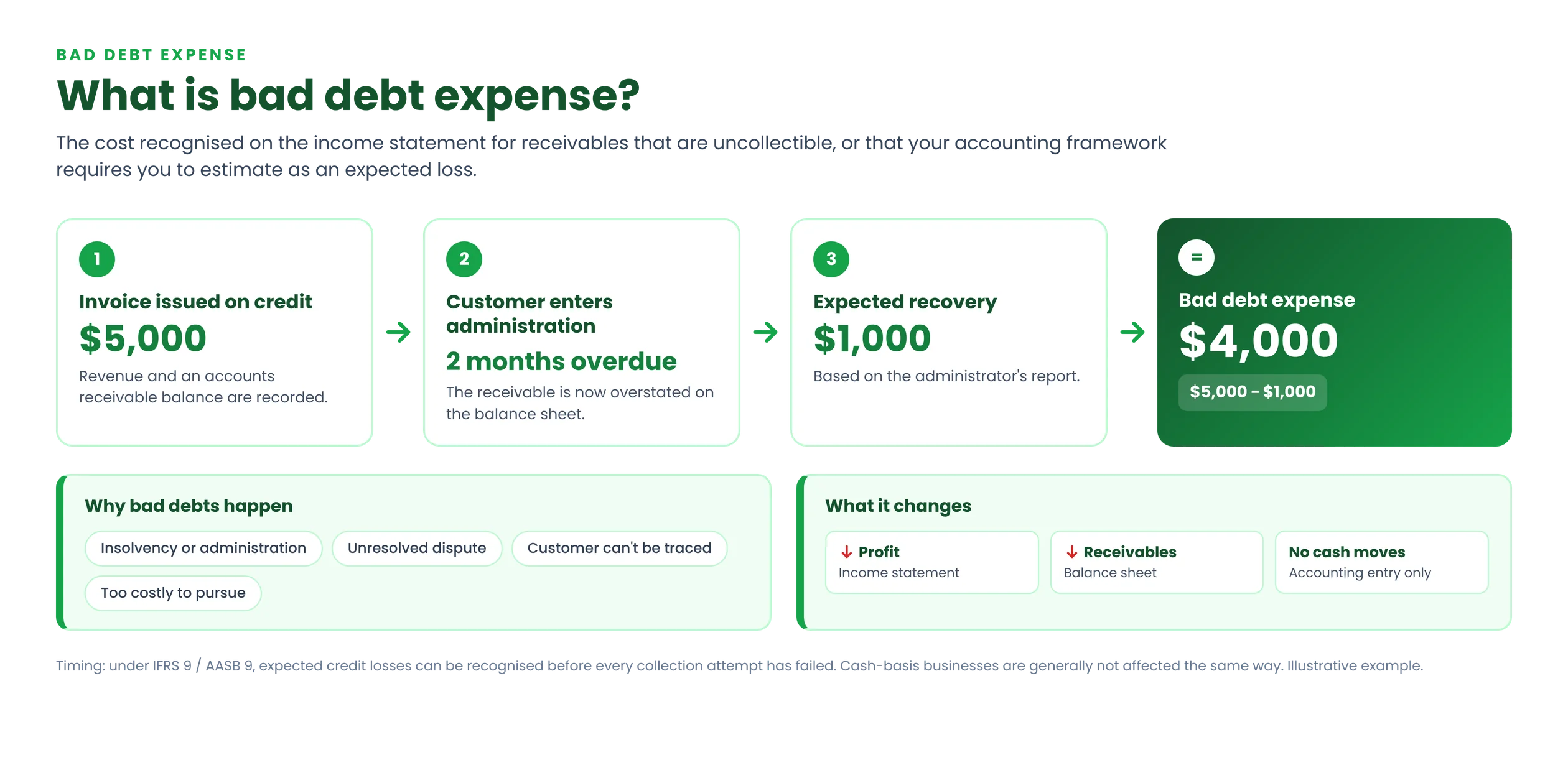
Impact on the Income Statement
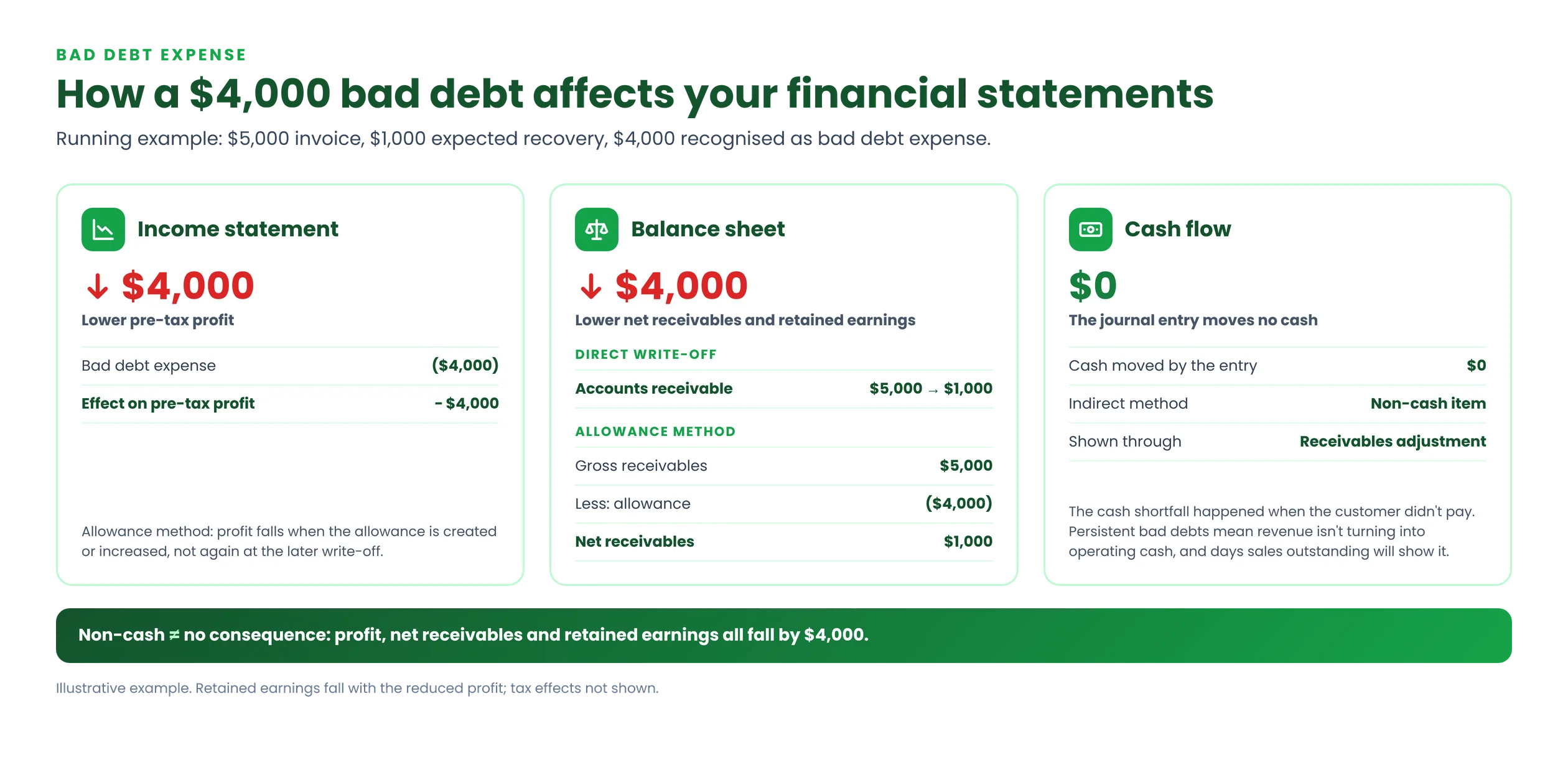
Bad debt expense reduces profit for the period in which it is recognised. A $4,000 expense means $4,000 less in pre-tax profit. Under the allowance method, that happens when the allowance is created or increased, not at the later write-off.
Impact on the Balance Sheet
Under the direct write-off method, accounts receivable falls by $4,000. Under the allowance method, gross receivables stay the same until the write-off, while the allowance increases. On the balance sheet, net receivables (gross receivables minus the allowance) fall either way. Retained earnings fall with the reduced profit.
Impact on Cash Flow
The journal entry does not move cash. The cash shortfall happened when the customer did not pay. The entry simply acknowledges it. In a cash flow statement prepared using the indirect method, bad debt expense is a non-cash item, reflected through the adjustment for receivables. Non-cash does not mean no consequence, though. Persistent bad debts mean revenue is not turning into operating cash, and your days sales outstanding will show it.
How to Record a Bad Debt Recovered After Write-Off
Suppose the administrator later pays $1,500 in total. $1,000 settles the receivable still on the books, and $500 relates to the $4,000 already written off. One common approach records the recovery directly:
| Account | Debit | Credit |
|---|---|---|
| Bank | $1,500 | |
| Accounts Receivable | $1,000 | |
| Bad Debts Recovered (income) | $500 |
Under the allowance method, many policies instead reinstate the written-off portion first (Dr Accounts Receivable $500, Cr Allowance for Doubtful Debts $500) and then record the $1,500 receipt against Accounts Receivable. That keeps the customer's payment history in the sub-ledger. The precise treatment depends on the original method and your accounting policy.
Either way, do not reopen the original invoice as new sales or create duplicate revenue. Record the recovery separately, and remember it may have income-tax and GST consequences.
Bad Debt Expense vs Tax Deduction
An accounting expense and a tax deduction are separate questions. Recording bad debt expense in your financial statements does not automatically entitle you to a tax deduction.
Australia: under the ATO's guidance on bad debt deductions, the amount generally must have been included in assessable income (so accruals-basis businesses), the debt must be genuinely bad rather than merely doubtful, and the decision to write it off must be made and recorded in writing before the end of the income year. Companies must also satisfy continuity tests. An amount later recovered after being deducted must be included in assessable income.
Other jurisdictions: in the US, the IRS generally allows a business bad debt deduction for a specific debt that becomes wholly or partly worthless, not for a general reserve. In India, a deduction is generally available for a debt written off as irrecoverable in the books, where the amount was previously taken into income. These systems do not share rules.
The common thread: a general allowance that satisfies accounting standards often does not satisfy the tax authority. Keep the original invoice, evidence of the debt, records of collection attempts and the written write-off decision.
Bad Debt and GST in Australia
This section applies only to Australian businesses registered for GST. It is separate from both the accounting treatment and the income-tax deduction above. See also our guide on how to calculate GST in Australia.
When an Australian Business May Make a GST Adjustment
According to the ATO's guidance on GST adjustments, a business that accounts for GST on a non-cash (accruals) basis may make a decreasing adjustment for a debt relating to a taxable sale where the debt has been written off as bad or has been overdue for 12 months or more. The detailed rules are in GSTR 2000/2. Cash-basis businesses have not paid GST on an unpaid sale, so the adjustment is not relevant to them.
The adjustment is generally one-eleventh of the GST-inclusive amount written off or overdue. In the running example, if the $5,000 were a GST-inclusive taxable sale, writing off $4,000 would give a decreasing adjustment of $4,000 × 1/11 = $363.64, On the BAS, you enter the full amount written off ($4,000) on the bad debts worksheet as a decreasing adjustment, and the GST effect is one-eleventh of that amount. If the original sale was only partly taxable, the adjustment is reduced accordingly. On the other side, the customer that has not paid generally needs to make an increasing adjustment to reverse its GST credit.
What Records Should a Business Keep?
Keep the original tax invoice, evidence of the debt and the overdue period, the written write-off decision, collection correspondence, and the BAS period in which the adjustment was made. The ATO generally expects business records to be kept for five years.
What Happens If a Written-Off Debt Is Recovered?
If you recover an amount after making a bad debt adjustment, you generally make an increasing adjustment of one-eleventh of the amount recovered. In the recovery example, the $500 recovered on the written-off portion would mean an increasing adjustment of about $45.45. Check the ATO's current guidance before lodging.
Common Bad Debt Accounting Mistakes to Avoid
| Mistake | Why it matters | What to do instead |
|---|---|---|
| Premature write-offs | Removes collectible amounts and understates assets | Write off only when evidence shows the debt is uncollectible |
| Duplicate expenses | Recording expense at both the allowance and the write-off double-counts the loss | Write off against the allowance with no new expense |
| Unsupported estimates | Generic loss rates distort profit and receivables | Base rates on your own history and review them at least quarterly |
| Tax assumptions | A book allowance usually is not deductible | Keep the book allowance separate from tax deductions and get advice |
| Deleting or voiding the invoice | Destroys the audit trail and the GST record | Use a write-off journal entry or the appropriate credit note |
| Inadequate records | Weakens tax and GST claims and audit support | Keep invoices, reminders, correspondence and the written decision |
| Recording a recovery as sales | Inflates revenue | Post to a recovery account or reinstate and settle the receivable |
After every write-off, reconcile the customer's sub-ledger so the balance is actually cleared. Use bank reconciliation to confirm that any later recovery receipts are matched correctly.
How Accounting Software Helps Manage Bad Debts
Bad debt decisions depend on knowing which invoices are overdue, by how long and what has been done about them. ProfitBooks receivables software provides real-time receivables tracking with aging reports, automatic invoice reminders before and after the due date, and one-click customer statements. That gives you the evidence trail to support a write-off or an allowance estimate.
You can record write-off and allowance entries through journal entries, reconcile bank accounts as recoveries come in, and review the effect in your balance sheet, profit and loss and other financial reports. The software does not decide whether a debt is bad or whether a tax or GST adjustment is available. That remains a judgment for you and your accountant.
See every overdue invoice before it becomes a bad debt
Track receivables with aging reports, send automatic reminders and keep your write-off records in one place with ProfitBooks.
Frequently Asked Questions About Bad Debt Expense
What is bad debt expense?
Bad debt expense is the loss a business recognises when an accounts receivable balance, or part of it, is unlikely to be collected. It reduces profit on the income statement and the carrying amount of receivables on the balance sheet. It can be recorded for a specific debt or estimated in advance through an allowance.
How do you calculate bad debt expense?
For a specific debt, subtract the amount you realistically expect to recover from the receivable balance. For an allowance, estimate expected losses across receivables, often by applying loss rates to aging buckets, then record the difference between that estimate and the existing allowance balance as the expense for the period.
What is the journal entry for bad debt expense?
Under the direct write-off method, debit Bad Debt Expense and credit Accounts Receivable. Under the allowance method, debit Bad Debt Expense and credit Allowance for Doubtful Debts. When a debt already covered by the allowance is written off, debit the allowance and credit Accounts Receivable, with no new expense.
Is bad debt expense an asset or a liability?
Neither. Bad debt expense is an expense on the income statement. The related allowance for doubtful debts is a contra-asset on the balance sheet. It reduces the net carrying amount of accounts receivable rather than appearing as a liability.
What is the difference between bad debt and doubtful debt?
A doubtful debt is a receivable whose collection is uncertain but not yet judged lost, so it is usually covered by an allowance estimate. A bad debt is an amount the business has assessed as uncollectible, based on evidence such as insolvency or failed recovery efforts, and is written off.
Does writing off a bad debt mean the business cannot collect it?
No. A write-off is an accounting entry that removes the balance from receivables. It does not, by itself, forgive the debt or extinguish the customer's legal obligation. The business can continue collection efforts, subject to any settlement, insolvency process or limitation rules that apply.
Is bad debt expense tax-deductible?
Not automatically. Tax rules are separate from accounting rules. In Australia, the debt generally must have been included in assessable income, be genuinely bad and be written off in writing before the end of the income year. A general allowance or provision usually does not qualify. Check your local rules.
Can a business recover a debt after writing it off?
Yes. If the customer later pays, record the receipt as a recovery, either through a bad debts recovered account or by reinstating the receivable and then recording the payment, depending on your policy. Do not record it as new sales revenue. A recovery may also have income-tax and GST consequences.
Can an Australian business claim a GST adjustment for bad debts?
Yes, if it accounts for GST on a non-cash basis and the debt relates to a taxable sale that has been written off as bad or has been overdue for 12 months or more. The adjustment is generally one-eleventh of the amount written off. A later recovery triggers an increasing adjustment.
Final Takeaway
An overdue invoice is not automatically a bad debt. Recognise the loss based on evidence and your reporting framework, using either a direct write-off or an allowance, and never record the expense twice when writing off a debt already provided for. Treat recoveries as recoveries, not sales. Keep accounting, income-tax and GST treatment as three separate decisions, and support each one with reliable receivable records.
Keep your receivables records audit-ready
Use ProfitBooks to track invoices, payments and journal entries so every write-off and recovery is backed by clean records.
Related Resources for Australian Businesses
Also read
Guide
How to lodge your Business Activity Statement (BAS) →
Your BAS is where GST bad debt adjustments are reported.
Guide
Small business taxes in Australia →
An overview of the taxes Australian small businesses need to manage.
Guide
ATO tax deductions: 14 things you didn't know about →
Deductions small businesses often miss when lodging with the ATO.
Guide
CGT vs GST: what's the difference in Australia? →
How capital gains tax and GST differ, and when each applies.
GST tools and software for Australia
Software
ProfitBooks GST accounting software for Australia →
See how ProfitBooks supports GST accounting for Australian small businesses.
Disclaimer: This article provides general information about accounting for bad debts and related tax and GST rules. It is not personalised accounting, legal or tax advice. Rules differ by jurisdiction and change over time. Consult a qualified professional about your business.