Inventory Shrinkage: How to Find and Record Stock Losses in Your Accounts
On this page 45 sections
This is general accounting education for small businesses, not advice on your specific inventory, accounting framework, or policy. Confirm the treatment of any verified loss against the applicable standard and your own chart of accounts.
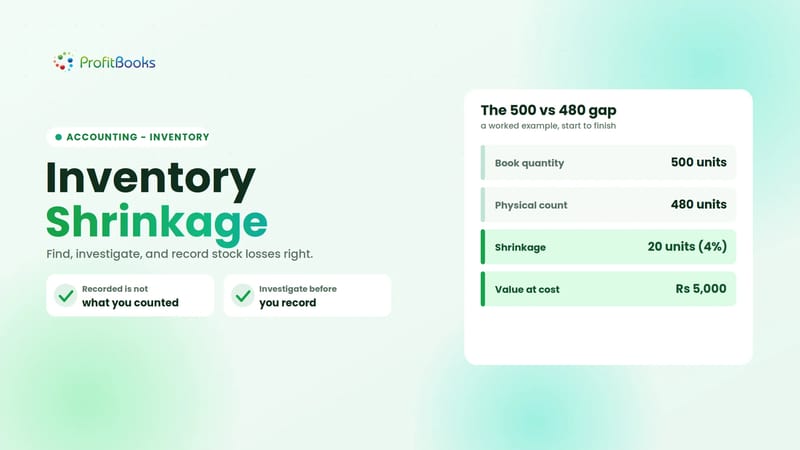
Your inventory system shows 500 units. The team counts the shelf and finds 480. Twenty units are unaccounted for, and there is no explanation yet. That gap does not automatically mean theft. It might be a counting error, an unrecorded transfer, a damaged carton, or a sale that posted against the wrong code.
That difference between recorded stock and physical stock is inventory shrinkage. This guide covers what it is, what causes it, how to calculate the shortage and its value, how to investigate before you touch the books, how to record a verified loss, and how it flows through your profit and financial statements. The thread running through all of it: investigate first, record only what you have verified.
Inventory shrinkage is the difference between the stock your records show and the stock physically present, once every documented movement has been accounted for. It is a signal to investigate, not a confirmed loss. You record it as an expense and reduce the inventory asset only after verifying the shortage and ruling out counting errors, unposted transactions, and timing differences.
What Is Inventory Shrinkage?
Meaning of Inventory Shrinkage
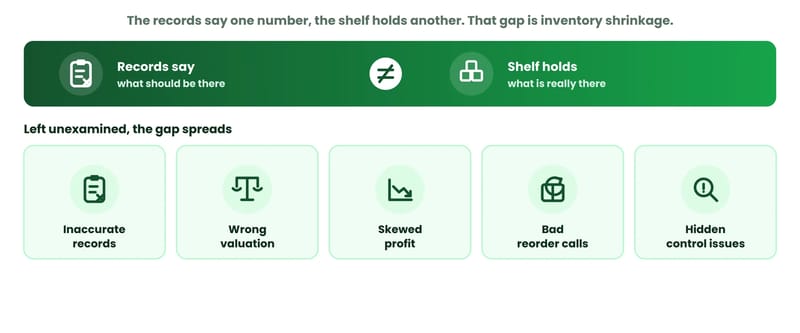
Inventory shrinkage is the reduction in stock that cannot be traced to a recorded sale, transfer, return, or any other documented movement. In a system that updates quantities as you buy and sell, shrinkage is whatever the records missed: the gap between what should be on the shelf and what is actually there.
One distinction matters from the start. An initial stock discrepancy is simply a number that does not match on the day you count. A confirmed inventory loss is what remains after you have investigated and ruled out errors and timing differences. The first is a prompt to look closer. Only the second belongs in your accounts as a loss.
How Inventory Shrinkage Affects a Business
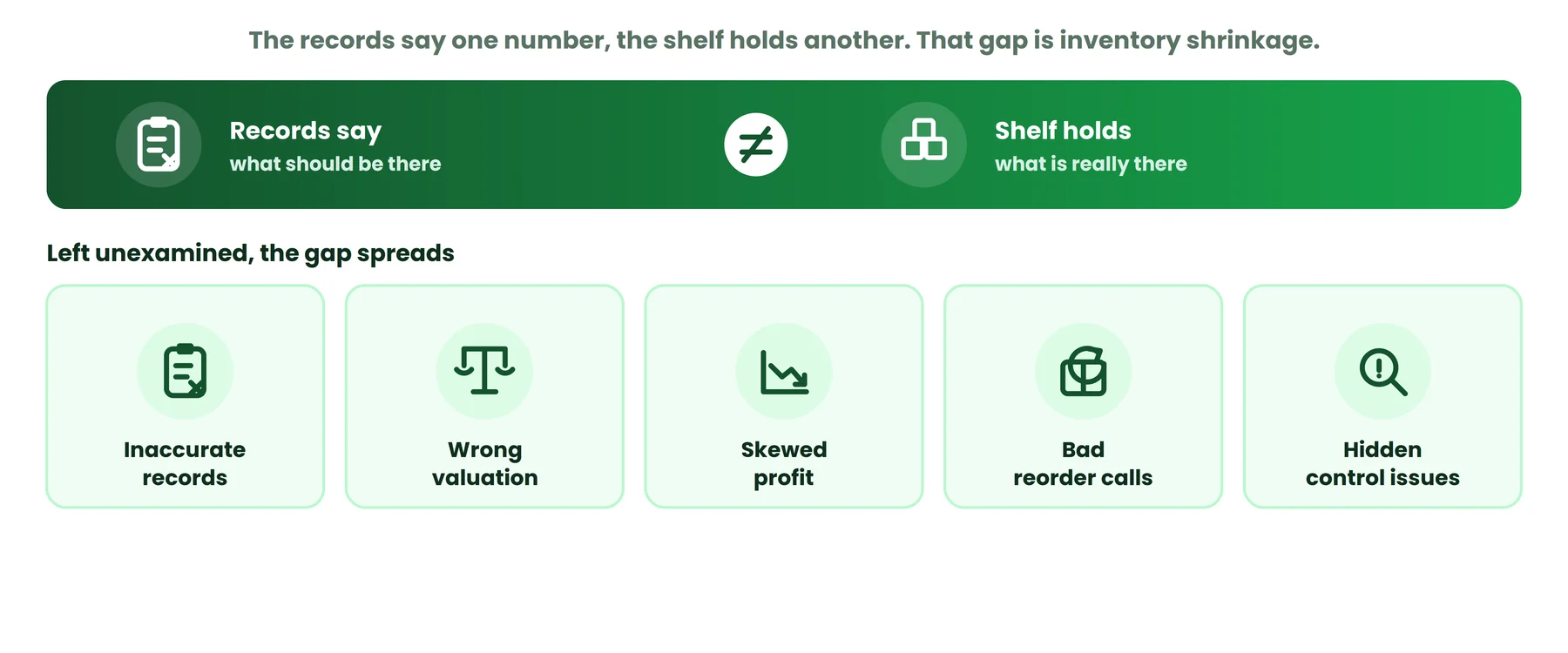
Left unexamined, a shrinkage gap spreads well beyond one line in a report:
- Inaccurate inventory records that no longer reflect what is on hand.
- Incorrect inventory valuation on the balance sheet.
- Potentially incorrect expense and profit reporting.
- Stock replenishment and purchasing decisions based on quantities that do not exist.
- Difficulty identifying recurring inventory-control problems hiding inside the noise.
 What Causes Inventory Shrinkage?
Theft or Unauthorized Removal
Stock can leave without a matching recorded transaction, whether through external theft or internal removal. It shows up as repeated shortages, often in high-value, easy-to-move items. A shortage on its own is not proof of theft, so treat it as one possible cause to investigate, not the default explanation.
Damaged, Spoiled, or Expired Stock
Products that are broken, spoiled, or past their usable date become unsaleable. If those units are never recorded as a loss and stay in the system as available stock, they create a discrepancy the next time anyone counts.
Counting and Data-Entry Errors
An incorrect physical count, a duplicate entry, a wrong unit of measure (counting cases as individual units), or a simple recording mistake all move the book figure away from reality without a single item actually going missing.
Receiving and Dispatch Errors
Differences between what was ordered, received, recorded, picked, and dispatched all open gaps. A supplier short-ships and nobody flags it; a dispatch is physically sent but the transaction is delayed or never posted. Each one shows up later as shrinkage.
Unrecorded Transfers, Returns, and Internal Consumption
Stock moved between locations, customer returns, supplier returns, samples given away, and items consumed internally all change physical quantities. When those movements are not recorded correctly, the system and the shelf drift apart.
Summary of Common Causes
| Cause | Example | What to check |
|---|---|---|
| Theft or removal | Repeated shortages in small, high-value items | Access records, adjustment history, unusual patterns by item or location |
| Damage, spoilage, expiry | Broken or out-of-date stock still shown as available | Quarantine and returns areas, expiry and batch tracking |
| Counting or data entry | Case counted as a single unit; duplicate entry | Count sheets, units of measure, product codes |
| Receiving or dispatch | Supplier short-shipped; dispatch not posted | Delivery notes against purchase orders; pending transactions |
| Unrecorded movements | Transfer or return never entered in the system | Transfer documents at both ends; returns and sample logs |
How to Calculate Inventory Shrinkage
Calculate the Inventory Shortage in Units
Using the example, the book quantity is 500 units and the physical count is 480 units, so the shortage is 20 units. Verify the count before you rely on the number; a miscount here flows into everything that follows.
Calculate the Inventory Shrinkage Rate
For the example, 20 ÷ 500 × 100 = 4%. That is the rate for this situation only, not an industry benchmark. A 4% rate for one business is not directly comparable to 4% for another with a different product mix and different risks.
Calculate the Financial Value of Inventory Shrinkage
Value the loss at the inventory carrying cost, not the selling price. Using the selling price overstates the balance-sheet reduction and breaks the link with your inventory records.
With 20 units and an assumed carrying cost of ₹250 per unit, the inventory value reduction is 20 × ₹250 = ₹5,000. Treat this as a confirmed loss only after the discrepancy has been investigated, not the moment the count comes up short.
Inventory Shrinkage vs Stock Wastage vs Inventory Write-Off
These three terms are used interchangeably, and they should not be. The table sets them side by side, and the sections below explain each.
| Term | Meaning | Example |
|---|---|---|
| Inventory shrinkage | A reduction in stock not explained by any recorded movement | 20 units missing with no recorded reason |
| Stock wastage | A loss caused by breakage, spoilage, expiry, or production waste | Flour lost during baking; a spoiled perishable batch |
| Inventory write-off | An accounting action that removes or reduces inventory's carrying value | Last season's stock with no resale value removed from the books |
Inventory Shrinkage
Shrinkage is the unexplained part: a reduction in quantity that your recorded movements do not account for. It is defined by what is missing from the explanation, not by a particular cause.
Stock Wastage
Wastage is a loss of material through breakage, spoilage, expiry, or production. It is often expected and sometimes built into standard costs. It becomes a cause of shrinkage only when it is not recorded.
Inventory Write-Off
A write-off is the accounting action of removing or reducing the recognised carrying value of inventory, usually after a management review. It is something you do in the books, not a type of loss.
How These Terms Are Connected
Unrecorded wastage can contribute to shrinkage. A write-off is the entry you make once a loss is confirmed, not another word for shrinkage itself. It also helps to separate physical shrinkage, where stock has actually gone, from inventory that is still physically present but has lost value because it is obsolete or impaired; the second is a valuation question, not a missing-stock question.
How to Investigate Inventory Losses Before Adjusting Your Accounts
A count tells you a variance exists. It does not tell you why. Work through these steps before posting anything.
Step 1: Compare Physical Stock With Inventory Records
Conduct a physical count, compare it with the recorded quantity, and identify exactly which products and storage locations are affected.
Step 2: Review Recent Inventory Movements
Check receipts, sales, dispatches, returns, transfers, damaged stock, and internal consumption. Look for transactions that are pending or were recorded incorrectly.
Step 3: Recount and Verify the Discrepancy
Verify product codes, units of measure, storage locations, and count sheets. Recount material discrepancies where it is worth doing rather than trusting a single pass.
Step 4: Identify the Likely Cause
Determine whether the difference came from an administrative error, an unrecorded movement, damage, wastage, or another cause. Do not assume theft without supporting evidence.
Step 5: Document the Findings
Keep the count records, supporting documents, investigation findings, the reason for any adjustment, and the required approvals. If you can explain 15 of the 20 missing units through a transfer and a unit error, the verified loss is 5 units, not 20.
Step 6: Correct the Records and Address the Root Cause
Correct any recording errors, process the verified adjustment, and put a control in place so the same gap does not reopen next cycle. For the broader matching process behind this, see ProfitBooks on how to reconcile physical stock with inventory records, and avoid jumping to theft, which is one of the common inventory management mistakes small businesses make.
How to Record Inventory Shrinkage in Accounting
Step 1: Determine the Appropriate Accounting Treatment
The treatment depends on the nature of the loss, the applicable accounting framework, and your accounting policy. Keep a verified loss separate from an unexplained discrepancy; only the first gets recorded as a loss.
Step 2: Calculate the Value of the Verified Loss
Using the same figures, 20 units at an assumed carrying cost of ₹250 per unit gives a total inventory value reduction of ₹5,000.
Step 3: Record the Inventory Shrinkage Journal Entry
Assuming the loss is appropriately recognised as a separate expense, the illustrative entry is:
| Account | Debit | Credit |
|---|---|---|
| Inventory Loss Expense | ₹5,000 | |
| Inventory | ₹5,000 | |
| Total | ₹5,000 | ₹5,000 |
The expense account is debited to recognise the cost of the loss, and the inventory asset is credited to reduce it by the value that has gone. The exact account may differ: an appropriate cost-of-goods-sold, wastage, inventory-adjustment, or other expense account may be the right home depending on the circumstances and your policy.
Step 4: Update Inventory and Accounting Records
Keep the inventory records and the financial accounts consistent. If you reduce the ledger inventory balance but leave the stock system unchanged, the next reconciliation flags the same variance again. Attach the supporting documentation and keep an audit trail, and remember that an unexplained discrepancy should not be written off automatically.
How Inventory Shrinkage Affects Profit and Financial Statements
Effect on Inventory Valuation
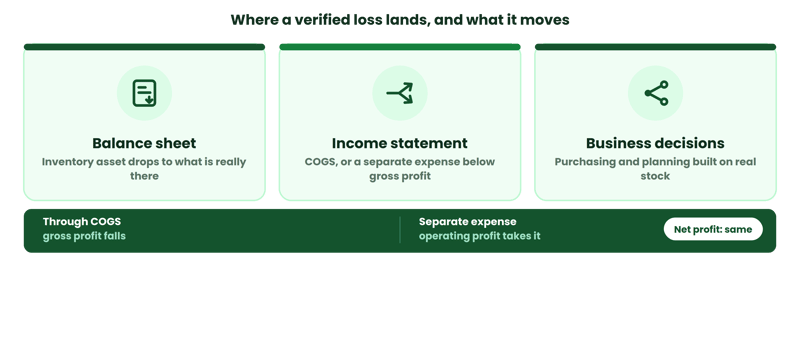
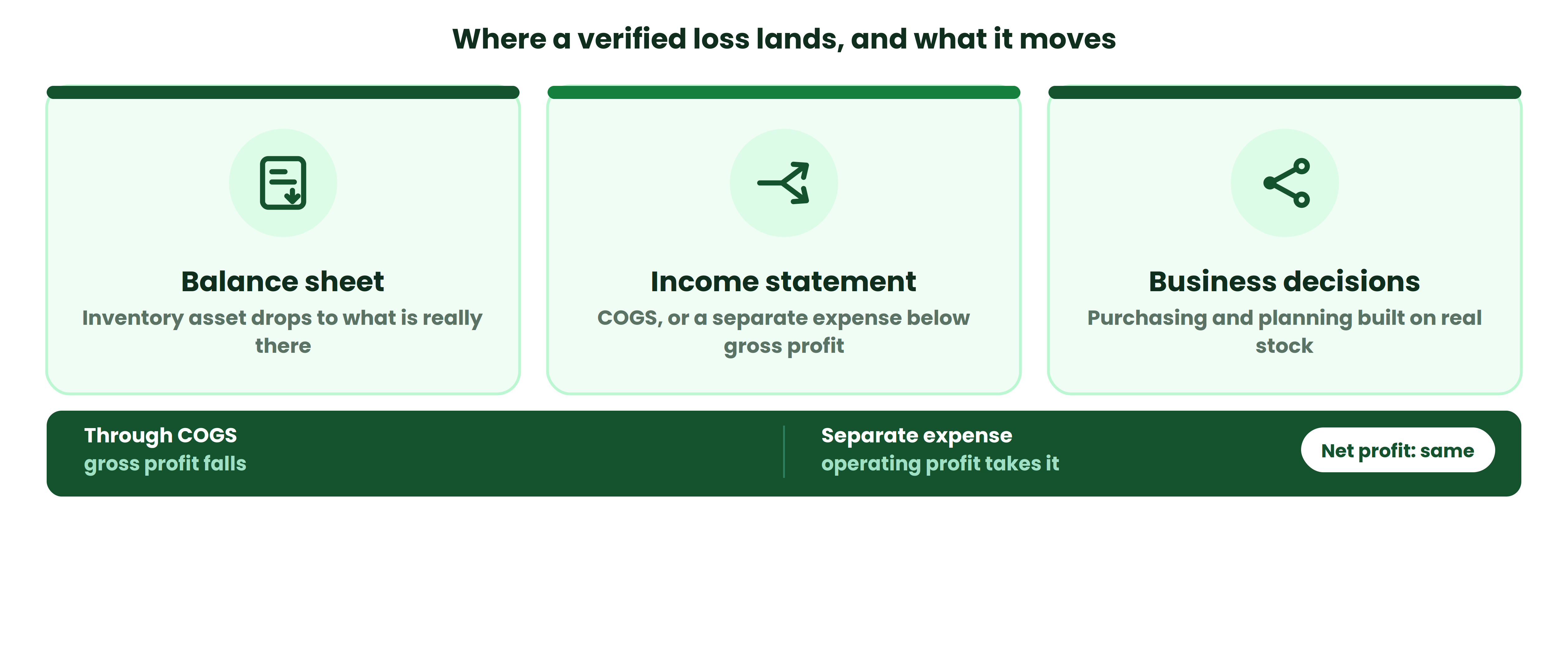
A verified loss reduces the recognised carrying value of inventory on the balance sheet. Until it is recorded, the balance sheet carries an asset that is not actually there.
Effect on Cost of Goods Sold and Profit
The impact on the income statement depends on the account used. If the loss goes through cost of goods sold, gross profit falls. If it sits in a separate shrinkage expense below gross profit, operating profit takes the charge instead. The effect on net profit is the same; where it lands decides which margin absorbs it.
Effect on Business Decisions
Unreliable inventory figures ripple outward into purchasing, replenishment, margins, reporting, and stock planning. Because shrinkage inflates book inventory until it is caught, decisions made on those numbers are built on stock that does not exist.
 Practical Ways to Reduce Inventory Shrinkage
Conduct Regular Physical Counts and Cycle Counts
Periodic checks catch discrepancies early. Count high-value and fast-moving items more often and the rest less frequently; the right cadence depends on your business and its inventory risks.
Strengthen Receiving and Dispatch Controls
Match quantities against the supporting documents before stock goes on the shelf, and record movements promptly. A short-shipment caught at the dock is a supplier claim; caught months later, it is your loss.
Track Damaged, Expired, and Wasted Stock
Set a clear procedure for identifying, documenting, and adjusting unusable inventory, and keep it out of the saleable count so it does not create phantom shortages later.
Restrict and Monitor Inventory Adjustments
Limit who can post adjustments, and keep a record of changes and approvals. If the person who counts also approves the write-off, there is no independent check.
Review Repeated Stock Discrepancies
Look for recurring problems by product, location, or process, and investigate the underlying cause rather than repeatedly correcting the quantity. A pattern points to a broken process; a random spread usually points to counting or system issues.
Maintain Accurate Inventory Records
Keep transactions up to date, reconcile physical stock with recorded quantities, and rely on sound inventory reports and documentation. ProfitBooks lets you record stock adjustments, log wastage, and run inventory reports, so the adjustment trail stays built into your workflow.
Inventory Shrinkage Checklist for Small Businesses
- ✓Compare physical quantities with recorded quantities.
- ✓Verify product codes, units, and locations.
- ✓Review receipts, dispatches, returns, and transfers.
- ✓Recount significant discrepancies.
- ✓Investigate the cause of the difference.
- ✓Distinguish recording errors from confirmed losses.
- ✓Calculate the appropriate carrying-value reduction.
- ✓Document the findings and obtain the required approval.
- ✓Update inventory and accounting records consistently.
- ✓Address the root cause to prevent recurrence.
Frequently Asked Questions About Inventory Shrinkage
What is inventory shrinkage?
Inventory shrinkage is the difference between the stock your records show and the stock physically present, once every documented movement has been accounted for. It reflects the gap between recorded and physical inventory, and it is a prompt to investigate rather than a confirmed loss.
How do you calculate inventory shrinkage?
Subtract the verified physical count from the book quantity to get the shortage in units: 500 − 480 = 20 units. The shrinkage rate is the shortage divided by the book quantity times 100, so 20 ÷ 500 × 100 = 4%. Multiply the shortage by the carrying cost per unit for the value.
What is the journal entry for inventory shrinkage?
For a verified loss, debit an inventory loss or shrinkage expense account and credit the inventory asset at cost, for example ₹5,000 each side. The exact account depends on your chart of accounts and whether the loss is material enough to separate from cost of goods sold.
Is inventory shrinkage the same as stock wastage?
No. Wastage is a known or expected loss through damage, spoilage, expiry, or production. Shrinkage is the unexplained gap between book and physical stock. Unrecorded wastage can cause shrinkage, but shrinkage also covers theft, errors, and unrecorded movements.
How does inventory shrinkage affect profit?
A recorded loss reduces profit by the cost of the lost stock. Depending on the account used, cost of goods sold rises and gross profit falls, or a separate expense reduces operating profit. Until it is recorded, profit is overstated because the balance sheet carries stock that is not there.
Should an unexplained stock shortage be written off immediately?
No. Investigate first. Check for unposted transactions, unit-of-measure errors, pending transfers, and receiving discrepancies, and record the adjustment only after confirming the loss is real and documenting the cause.
How often should a business check for inventory shrinkage?
It depends on inventory value, how fast stock moves, the risk involved, and operational needs. High-value, fast-moving items benefit from weekly or monthly cycle counts, with a full stocktake at least once a year and an immediate check whenever a significant or recurring discrepancy appears.
Investigate, Document, and Record Stock Losses Correctly
The sequence is always the same: identify the discrepancy, investigate the cause, verify the loss, calculate its value at carrying cost, and record the appropriate adjustment with supporting documentation. Skipping from count straight to adjustment makes the number disappear from a report without fixing whatever created the gap.
Accurate stock records and documented adjustments are what keep inventory valuation, profit, and purchasing decisions reliable. A regular reconciliation routine is the simplest place to start.
Keep stock and books in step
ProfitBooks tracks inventory, records stock adjustments and wastage, and runs the reports that surface discrepancies early, so verified losses are documented and your books stay aligned with the shelf.