UPI MDR charges in India: who pays, what’s exempt and how to record them
On this page 32 sections
Last verified: 22 October 2026. The MDR framework is announced but not yet in force; see the implementation status below.
This is general information for Indian merchants, not tax or legal advice. The rates and rules below reflect the announced framework and are not yet in effect. Verify the current position against the official Department of Financial Services MDR FAQs and the NPCI UPI circulars, and confirm your own category, exemption, and GST treatment with your acquirer and tax advisor before relying on any figure.
On this page
The Government of India has announced a Merchant Discount Rate (MDR) framework for selected UPI person-to-merchant (P2M) transactions. It does not cover every UPI payment, and it does not touch person-to-person transfers. It applies to a specific subset of P2M transactions above ₹2,000, with exemptions for small-value payments and for qualifying small merchants under the P2PM category. Crucially, the framework has been announced but is not yet in force: the original 15 October 2026 go-live was deferred, and a revised date is still to be notified.
This guide explains what MDR is, the announced rate structure, which transactions stay free, who bears the charge, and how to record and reconcile the fee in your books, using UPI MDR charges for merchants that are verified against the official sources rather than headlines.
| Question | What you should learn |
|---|---|
| What is MDR? | A fee for processing a qualifying merchant payment, deducted from the merchant's settlement |
| Who pays it? | The merchant, not the customer, under the announced framework |
| Are all UPI payments chargeable? | No. Treatment depends on the transaction category, value, and applicable rules |
| When does it take effect? | Deferred. The 15 October 2026 date was postponed; a new date is to be notified |
| How is MDR recorded? | As a separate payment-processing expense, based on the actual settlement |
What Is UPI MDR?
UPI MDR is the processing fee a merchant's acquiring institution charges on a qualifying UPI person-to-merchant payment. Under the announced framework it applies only to selected P2M transactions above ₹2,000, is paid by the merchant (not the customer), and is not yet in force.
How does Merchant Discount Rate work?
MDR is the fee that covers the cost of handling a digital payment, shared among the parties that make it possible: the customer who pays, the merchant who receives, the acquiring bank or payment service provider, and other payment-system participants. The precise split depends on the applicable framework and your provider's terms.
A simple illustration: a customer pays ₹10,000 for a purchase. Under the announced 0.4% rate for a qualifying transaction, the merchant's processing fee would be ₹40, and the merchant would receive ₹9,960 through settlement while the customer's account is debited the full ₹10,000. The figure is illustrative and assumes the transaction qualifies at that rate.
Is MDR the same as a UPI transaction fee?
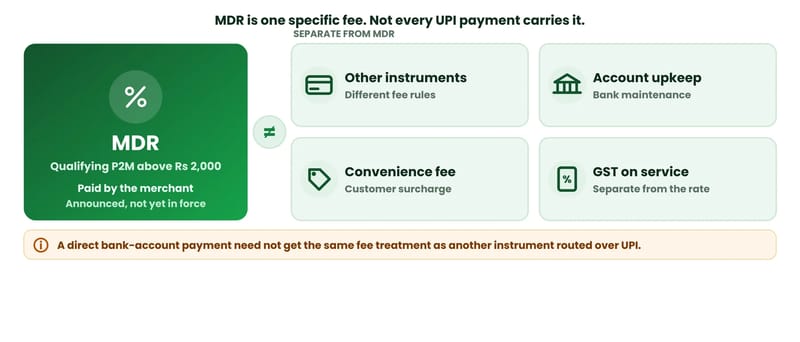
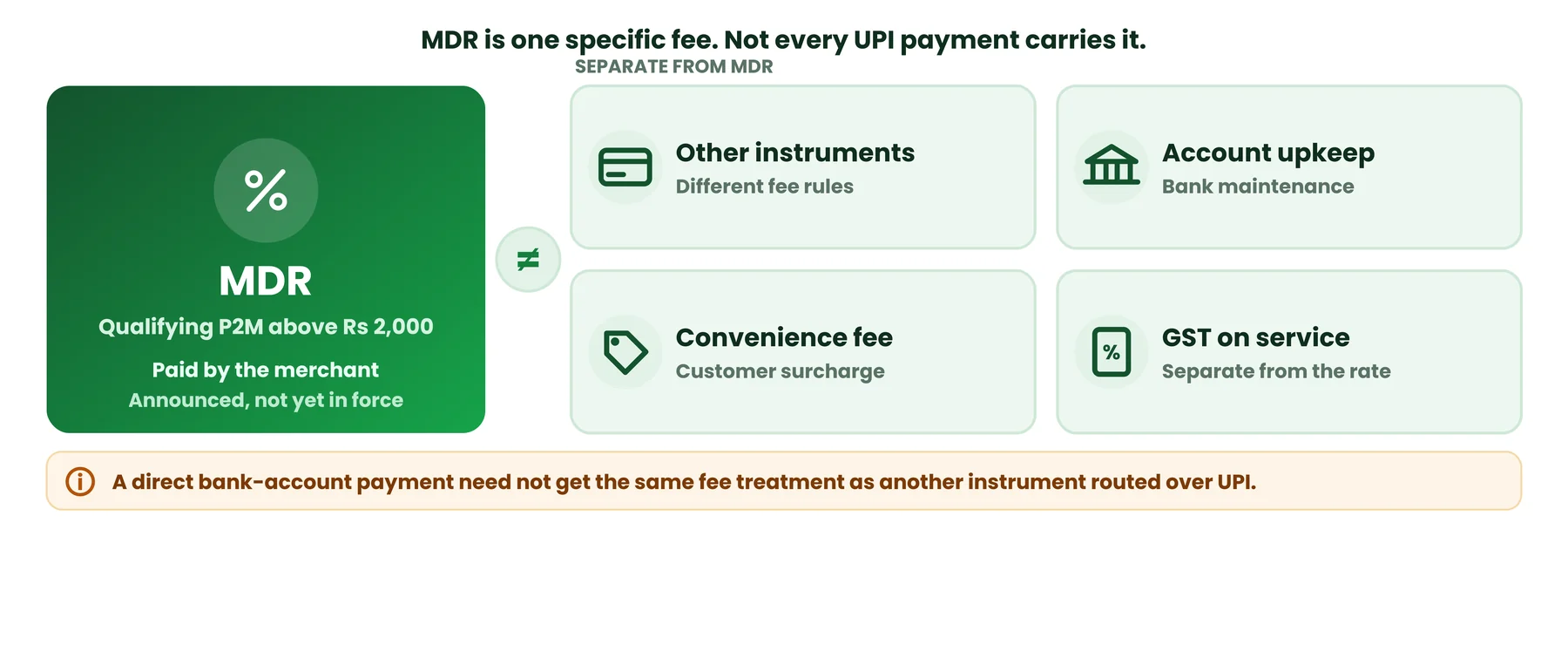
No. It helps to separate MDR from other charges that are often lumped together:
- MDR applies only to qualifying merchant (P2M) transactions under the framework.
- Fees linked to other payment instruments or arrangements can work differently.
- Bank account maintenance charges are separate from MDR.
- Any customer-facing convenience fee or surcharge is a different thing again.
- GST charged on a processing service, where applicable, is separate from the MDR rate itself.
Not every UPI payment carries MDR, and a customer paying directly from a bank account does not necessarily get the same fee treatment as one using a different payment instrument routed over UPI.
 What Is the Latest UPI MDR Implementation Date?
This section is time-sensitive. Check the official sources immediately before acting on it.
What was the original implementation date?
The announced framework from the Department of Financial Services originally pointed to 15 October 2026 as the go-live date for MDR on selected P2M transactions above ₹2,000, with consumers and transactions up to ₹2,000 kept free.
Why was implementation deferred?
Shortly before the go-live date, NPCI deferred the rollout until after the festive season (Diwali), with the new effective date to be notified separately. The deferral followed industry representations about the framework.
Has a revised date been announced?
As of 22 October 2026, no revised effective date has been officially notified. The framework remains announced but not live, and NPCI has said the date will be notified separately. The NPCI UPI circulars page is the place to check for the confirmed date.
Latest implementation update: As of 22 October 2026, the UPI MDR framework is deferred and not in force; the original 15 October 2026 date was postponed and a revised date is still to be notified. Merchants should rely only on an official NPCI circular or Government notification, not on dates inferred from the Diwali calendar or media reports.
UPI MDR Rates in India: Who May Pay and How Much?
The announced framework is category-dependent; a single flat percentage does not cover every transaction type. The figures below follow the official DFS FAQs and should be confirmed there before you rely on them.
Standard MDR for qualifying merchant transactions
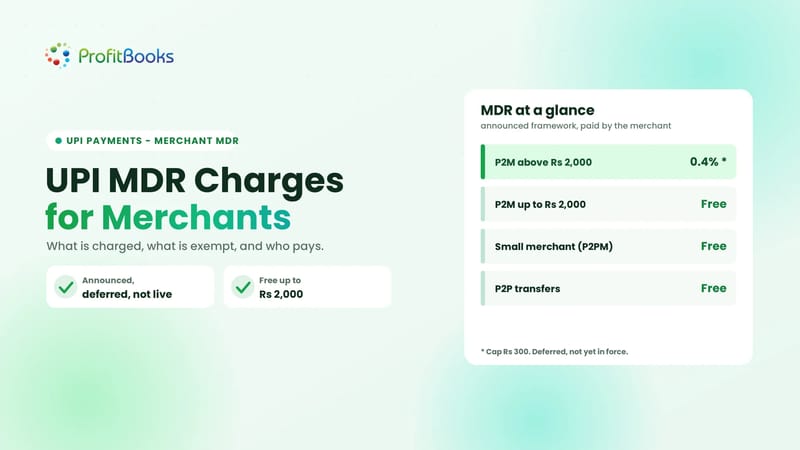
For a qualifying standard P2M transaction above ₹2,000, the announced rate is 0.4% of the transaction value, with a per-transaction cap of ₹300 (so transactions of ₹75,000 and above are charged a flat ₹300). On a ₹3,000 payment the fee would be ₹12; on a ₹50,000 payment it would be ₹200. The threshold applies to transactions above ₹2,000, and the category your business falls into is confirmed by your acquiring institution. This remains an announced rate, not a charge currently in force.
Special rates and transaction caps
The framework sets concessional treatment for specified categories: a flat ₹5 per transaction (instead of 0.4%) for notified sectors such as railways, telecom, insurance, and fuel, and a lower 0.02% rate (capped at ₹300) for eligible capital-market transactions such as mutual funds, securities, and stockbroking. Qualifying essential and educational categories may carry their own concessional or capped treatment. Category eligibility uses official classification, so it is confirmed with your acquirer rather than assumed from what you sell.
UPI MDR rates at a glance
| Transaction category | Announced rate or treatment | Threshold or cap | Key eligibility condition |
|---|---|---|---|
| Qualifying standard P2M | 0.4% of value | Above ₹2,000; capped at ₹300 (₹75,000+) | Merchant category confirmed by the acquirer |
| Notified essential sectors | Flat ₹5 per transaction | Above ₹2,000 | Category must match official classification (e.g. railways, telecom, insurance, fuel) |
| Eligible capital-market | 0.02% of value | Capped at ₹300 | Covered category (mutual funds, securities, stockbroking) |
| P2M up to ₹2,000 | Zero MDR | N/A | Transaction value at or below {RS}2,000 |
| Qualifying small merchant (P2PM) | Zero MDR | Up to ₹1 lakh/month via UPI QR | P2PM classification confirmed by the acquirer |
The table reflects the announced framework. Because it is not yet in force and the operational parameters are set by the UPI steering committee, confirm each figure against the official FAQs and your provider before applying it.
Worked example: how much could MDR cost?
On a qualifying ₹10,000 transaction at the announced 0.4% rate, the MDR would be ₹10,000 × 0.4% = ₹40, leaving a net settlement of ₹9,960 before any GST or other charges. This single-transaction example excludes other fees and does not represent the actual cost for every merchant; your effective cost depends on your category, your transaction mix, and the final notified rules.
Which UPI Transactions Remain Free?
Person-to-person UPI transfers
Money sent from one person to another (P2P) is outside the framework and carries no MDR. The framework concerns merchant (P2M) payments, not transfers between individuals.
Merchant payments up to ₹2,000
Under the announced framework, P2M transactions at or below ₹2,000 carry zero MDR. NPCI has noted that such small-value payments make up the large majority of UPI merchant transactions, so for a kirana store where most sales are a few hundred rupees, the MDR covers only the occasional larger bill. Confirm the exact threshold wording in the official FAQs.
Small-merchant exemption
There is an announced zero-MDR provision for eligible small merchants classified under the P2PM category who receive up to ₹1 lakh per month through UPI QR. A few distinctions matter:
- The exemption has eligibility conditions; it is not automatic.
- A merchant's monthly receipts alone may not establish eligibility.
- P2PM classification is a specific designation, not interchangeable with every merchant category.
- Confirm your classification and eligibility with your payment provider or the relevant authority.
Other UPI payment arrangements
Bank-account-funded UPI, RuPay credit-card-on-UPI, wallets, and credit lines routed over UPI are different instruments with their own economics, so they need to be looked at separately. A blanket "UPI is free" or "every merchant payment above a threshold attracts MDR" is not accurate; the instrument, the category, and the provider terms all matter.
Who Pays UPI MDR: The Merchant or the Customer?
Under the announced framework, the merchant bears the charge. MDR is deducted from the settlement amount rather than added to what the customer pays, which is why the amount a customer is debited can differ from the net amount credited to the merchant's bank account. The Government's published position is that merchants should not pass MDR to customers as a surcharge, and UPI app providers are not to levy a separate platform fee on these payments.
For example, if a customer pays ₹5,000 on a qualifying transaction at 0.4%, the MDR is ₹20 (plus GST where applicable), so the customer is debited ₹5,000 while the merchant's settlement is around ₹4,976 before other deductions. This MDR is the merchant's processing expense; it is not a discount offered to the customer. Before adding any customer-facing fee, check the applicable rules and your provider's terms.
How UPI MDR Affects Small Business Profits
Even a small percentage matters when a business processes a high volume of payments, because the fee is an operating cost that sits below the top line.
The difference between sales and net settlement
Your recorded gross sales, the payment-processing fees, any other verified deductions, and the net amount received in the bank are four different numbers. Recording only the net settlement as sales understates revenue and hides the expense; the fee should be recorded separately so your margins and GST treatment stay accurate.
Example of the monthly impact
| Particulars | Illustrative amount |
|---|---|
| Gross eligible collections | ₹5,00,000 |
| Hypothetical processing fees | ₹2,000 |
| Net settlement before other deductions | ₹4,98,000 |
These figures are illustrative; they do not mean every business pays 0.4% on all UPI receipts. Many receipts (those up to ₹2,000, and exempt small-merchant receipts) carry no MDR at all. Estimate your own cost from your provider statements and your actual transaction categories, not from a single percentage.
How to Record UPI MDR Charges in Your Accounting Books
Keep the accounting treatment separate from the policy. The entries below use an illustrative 0.4% rate that is not yet in force.
Step 1: Record the original sale
For an illustrative ₹10,000 sale collected through UPI, record the sale at its full value, with the amount temporarily held as a receivable from the settlement process:
| Account | Debit | Credit |
|---|---|---|
| UPI settlement receivable | ₹10,000 | |
| Sales revenue | ₹10,000 | |
| Total | ₹10,000 | ₹10,000 |
The exact entry may differ depending on whether you record sales through invoices, a point-of-sale system, or a direct bank receipt.
Step 2: Record the MDR deduction
On the same ₹10,000 transaction at an illustrative 0.4% rate, the MDR is ₹10,000 × 0.4% = ₹40, so the net settlement before any other deduction is ₹9,960:
| Account | Debit | Credit |
|---|---|---|
| Bank | ₹9,960 | |
| Payment processing / MDR expense | ₹40 | |
| UPI settlement receivable | ₹10,000 | |
| Total | ₹10,000 | ₹10,000 |
Record the fee separately rather than letting it quietly reduce recorded sales revenue. The fee is an expense; the sale stays at gross.
Step 3: Record GST on MDR, where applicable
GST on the payment-processing service is a separate matter from the MDR rate. Where GST applies, payment-processing services are generally taxed at 18%, and official clarifications confirm that GST of 18% applies on the MDR (not an extra tax on the transaction), with eligible merchants able to claim input tax credit. On the ₹40 MDR above, 18% GST would be ₹7.20, shown separately on the provider's tax invoice:
| Account | Debit | Credit |
|---|---|---|
| Input GST (on MDR) | ₹7.20 | |
| Bank / payable to provider | ₹7.20 | |
| Total | ₹7.20 | ₹7.20 |
Whether you can claim ITC on this GST depends on your registration status and the applicable provisions; do not assume eligibility. Do not treat the MDR rate as the GST rate, and keep the provider's tax invoice as support.
Step 4: Reconcile the provider's settlement
Providers usually settle several transactions together. A day's settlement reconciles like this (illustrative figures):
| Transaction | Gross | MDR (0.4%) | GST (18%) | Net settlement |
|---|---|---|---|---|
| Sale 1 | ₹5,000 | ₹20 | ₹3.60 | ₹4,976.40 |
| Sale 2 | ₹8,000 | ₹32 | ₹5.76 | ₹7,962.24 |
| Sale 3 (≤ ₹2,000) | ₹1,500 | ₹0 | ₹0 | ₹1,500.00 |
| Day total | ₹14,500 | ₹52 | ₹9.36 | ₹14,438.64 |
Sale 3 is at or below ₹2,000, so zero MDR under the announced framework. Your bank statement should show ₹14,438.64 for the day; if it shows a different figure, investigate before closing the books.
Common accounting errors
- Recording only the net amount received as sales.
- Failing to record the MDR expense separately.
- Treating the MDR fee as a customer discount.
- Recording the GST on MDR incorrectly, or confusing it with the MDR rate.
- Claiming input tax credit without checking eligibility.
- Failing to investigate differences between the settlement and the bank credit.
How to Reconcile UPI Payments and MDR Deductions
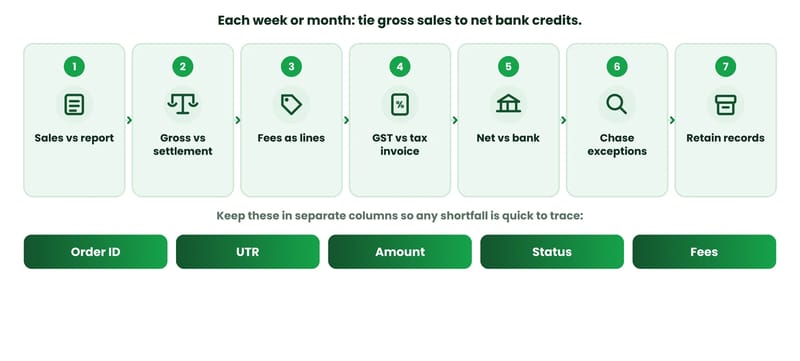
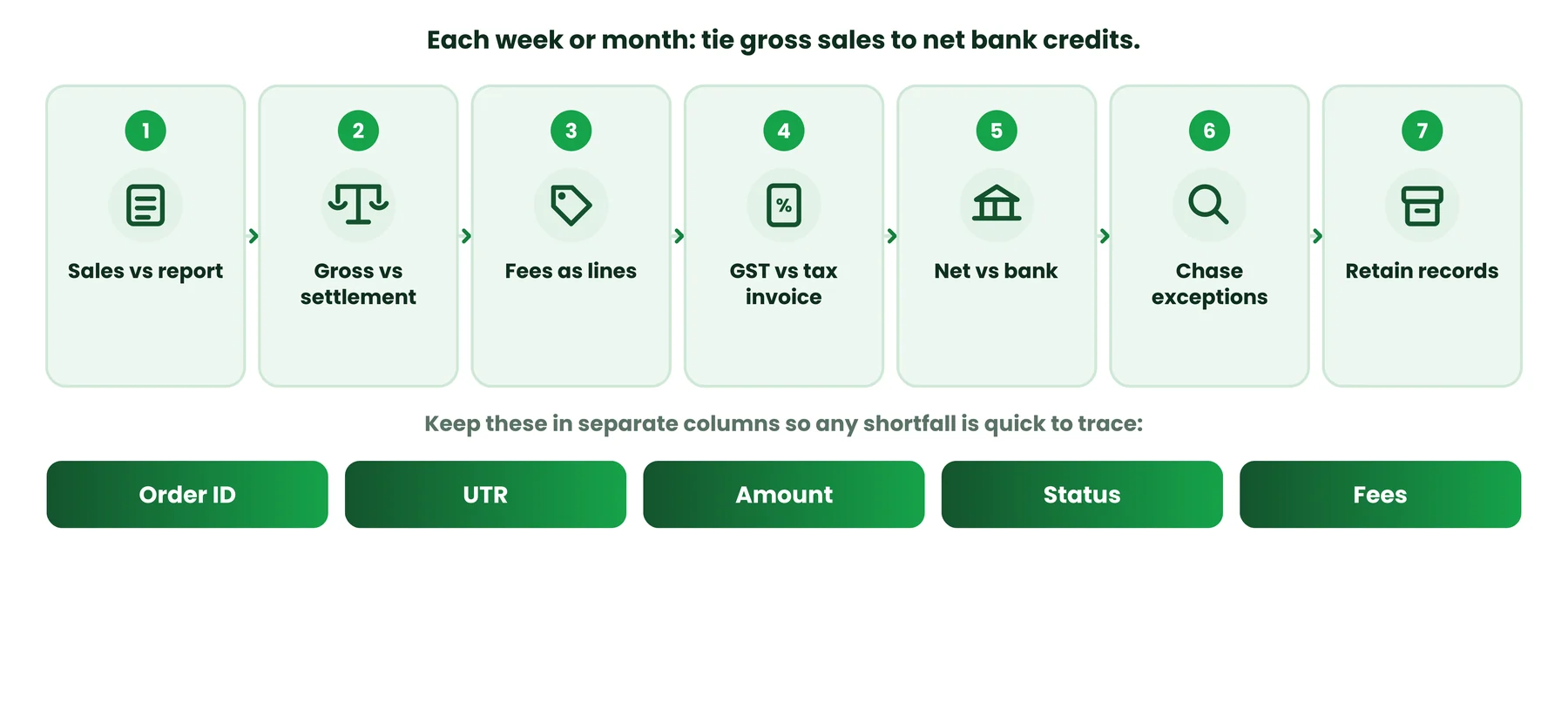
Run this check each week or month so gross sales and net bank credits always tie out:
- Match recorded sales to the payment provider's transaction report.
- Compare gross collections with the provider's settlement statement.
- Identify each fee or deduction as a separate line.
- Match the GST amounts against the provider's tax invoice.
- Match the final net settlement to the bank statement.
- Investigate refunds, reversals, failed payments, settlement-timing differences, and unmatched transactions.
- Retain the supporting records for accounting and tax purposes.
Reconciling gross sales against net bank credits prevents both revenue understatement and unexplained bank differences. A shortfall in the bank with no clear breakdown is usually gateway fees, GST, a refund netting, or a settlement adjustment, which is far easier to trace when order ID, UTR, amount, status, and fees sit in separate columns.
 How Accounting Software Helps Track UPI MDR
The practical work is separating gross revenue from net settlements and tracking processing fees with their GST components. Accounting software helps by recording payment-processing expenses, keeping gross sales intact, tracking provider invoices and applicable taxes, reconciling bank transactions, and maintaining a clear audit trail between sales, fee deductions, and bank credits. ProfitBooks lets you record sales at gross value, track processing fees and their GST as distinct lines, and match bank credits to your books, so the MDR accounting stays clean once the framework goes live.
Common Mistakes Merchants Should Avoid
- Assuming the framework took effect on 15 October 2026. It was deferred.
- Treating the announced rates as charges already in force.
- Assuming every UPI payment attracts MDR.
- Assuming every small merchant automatically qualifies for the exemption.
- Confusing MDR with the GST charged on the processing service.
- Recording only net settlements as revenue.
- Claiming input tax credit without checking eligibility.
- Failing to reconcile provider statements against bank credits.
- Passing a fee to customers without checking the applicable rules.
Frequently Asked Questions About UPI MDR Charges
What are UPI MDR charges for merchants?
MDR is the processing fee deducted from a merchant's settlement when a qualifying UPI person-to-merchant transaction is processed. Under the announced framework it applies to selected P2M transactions above ₹2,000, at rates that depend on the transaction category and value.
When will the UPI MDR framework take effect?
As of 22 October 2026, no revised date has been officially notified. The original 15 October 2026 date was deferred until after the festive season, and NPCI has said the new date will be notified separately. Check the official NPCI circulars for confirmation.
Are UPI payments below ₹2,000 exempt from MDR?
Under the announced framework, qualifying P2M transactions at or below ₹2,000 carry zero MDR, and person-to-person transfers are outside the framework entirely. Confirm the exact threshold wording in the official FAQs.
Which small merchants qualify for zero MDR?
Merchants classified under the P2PM category by their acquiring institution, receiving up to ₹1 lakh per month through UPI QR. Low turnover alone does not guarantee eligibility; confirm your classification with your acquirer.
Who pays MDR on a qualifying merchant transaction?
The merchant. MDR is deducted from the settlement rather than charged to the customer, and the framework's position is that it should not be passed to customers as a surcharge.
How do I calculate UPI MDR?
For a standard qualifying transaction, multiply the value by the announced 0.4% (so ₹10,000 × 0.4% = ₹40), subject to the ₹300 cap. The applicable rate depends on the verified transaction category, and some categories use a flat fee or a lower rate.
How should I record MDR in my accounting books?
Record the full sale as revenue. When the settlement arrives, record the net bank credit, debit the MDR to a payment-processing expense account, and record any GST on the fee separately, then reconcile the settlement to the bank statement.
Is GST charged on MDR?
GST on the payment-processing service is separate from the MDR rate. Where it applies, the service is generally taxed at 18%, shown on the provider's tax invoice, not as an additional tax on the transaction itself.
Can I claim ITC on GST paid on MDR?
Eligibility depends on your GST registration status, your business type, and whether the expense qualifies under the applicable input-credit provisions. Confirm it rather than assuming it.
Do all UPI payment methods have the same fee structure?
No. Bank-account UPI, RuPay credit-card-on-UPI, wallets, and credit lines over UPI are different instruments with different economics. The payment instrument, transaction category, and provider terms all have to be considered.
Conclusion: What Should Merchants Do Next?
The framework is announced, not yet live, so the most useful thing you can do now is get ready and verify, rather than assume:
- Check the latest official NPCI implementation notice for the confirmed date.
- Confirm your transaction category and exemption eligibility with your acquirer.
- Review your payment provider's fee and settlement documentation.
- Record processing fees separately from sales in your chart of accounts.
- Verify GST and input-tax-credit treatment with your accountant.
- Reconcile gross collections against net bank credits each month.
Accurate records and verified rules beat assumptions. Set the process up now, and it will already be working when the framework goes live.
Keep your UPI settlements clean
ProfitBooks records sales at gross value, tracks processing fees and GST as separate lines, and reconciles bank credits to your books, so your MDR accounting stays accurate from day one.