Presumptive taxation scheme under Section 44AD and 44ADA: a guide for small businesses and professionals
On this page 36 sections
Does an eligible small business owner or independent professional really need to work through every rent receipt, depreciation schedule and phone bill just to arrive at taxable business income? For many eligible taxpayers, the answer is no.
The presumptive taxation scheme lets qualifying taxpayers compute business or professional income at a prescribed percentage of turnover or gross receipts, instead of the regular method of deducting each allowable expense from income. Section 44AD covers eligible businesses. Section 44ADA covers specified professionals who meet the applicable conditions. Each has its own thresholds, rates and rules.
This guide covers eligibility, turnover and receipt limits, income calculations with worked examples, expense treatment, books and audit, advance tax, switching rules and common mistakes. It is useful context even if you rely on a CA, alongside good accounting for small businesses.
Sections 44AD and 44ADA of India's Income-tax Act provide presumptive methods of computing income for eligible businesses and specified professionals. The provisions have different eligibility rules, income-computation rates and compliance conditions. Choosing the correct scheme requires checking the taxpayer's activity, receipts and applicable statutory requirements.
Here is the whole idea before the detail.
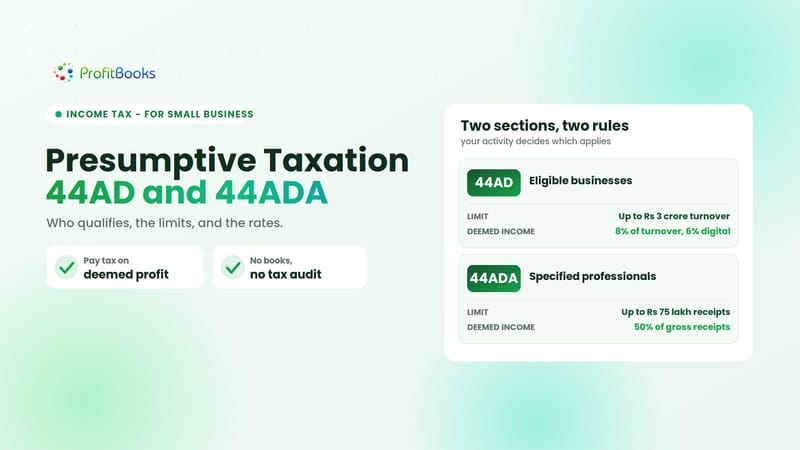
- Section 44AD: eligible businesses, generally 8% of turnover, or 6% for qualifying digital and banking receipts.
- Section 44ADA: specified professions, generally 50% of gross professional receipts.
- Limits for AY 2026-27: ₹2 crore (₹3 crore) under 44AD and ₹50 lakh (₹75 lakh) under 44ADA, with the higher limits only where cash receipts are within 5%.
- Presumptive income is business or professional income, not the final tax payable.
- Return filing, advance tax by 15 March and other compliance still apply.
Applicable year: This article discusses the Income-tax Act, 1961 as it applies to income of FY 2025-26 (Assessment Year 2026-27). From 1 April 2026, the Income-tax Act, 2025 applies, and these schemes move to Section 58 of the new Act. The rates and limits discussed here are broadly carried forward, but verify the provision that applies to your year before filing.
What Is the Presumptive Taxation Scheme?
Under the regular method, a business computes taxable profit from its books: income minus allowable expenses, depreciation and other deductions. Presumptive taxation replaces that computation with a statutory formula. An eligible taxpayer declares business or professional income at a prescribed percentage of turnover or gross receipts, and that figure is treated as the income from the activity.
The prescribed percentage works as a deemed profit margin. Your actual accounting profit could be higher or lower. The scheme simplifies the income computation for eligible taxpayers because they do not need to work out every deductible expense, and they get relief from maintaining detailed books under the income-tax provisions while they stay within the scheme.
Two points need to stay clear. First, eligibility comes first. The taxpayer's status, the nature of the activity and the receipt amounts all decide whether a provision is available at all. Second, presumptive income is not the same as income tax payable. It is one component of total income, which may also include salary, house property, capital gains or other sources.
How Does Presumptive Taxation Work?
1Establish eligibility
Check that the taxpayer and the activity qualify under the relevant section: residency, entity type, nature of business or profession and statutory exclusions.
2Determine turnover or gross receipts
Work out the relevant turnover or gross receipts for the previous year and confirm they are within the applicable limit.
3Apply the statutory rate
Apply the prescribed percentage (8% or 6% under Section 44AD, 50% under Section 44ADA) or declare a higher amount.
4Include it in total income
Add the resulting figure to income from other heads, apply eligible deductions and compute tax under the applicable regime.
Hypothetical illustration: if eligible receipts are ₹10 lakh and the applicable presumptive rate is 8%, the presumptive income is ₹10,00,000 × 8% = ₹80,000. This shows the arithmetic only. It does not establish eligibility or the final tax payable.
Who Should Consider Presumptive Taxation?
Eligible small traders, shopkeepers, manufacturers and service businesses can look at Section 44AD. Specified professionals, such as doctors, lawyers, architects and chartered accountants, can look at Section 44ADA. The scheme can reduce the burden of detailed income computation. Weigh it against your actual profitability, though. If your real margin is well below the prescribed rate, presumptive income may overstate what you earn. Low turnover alone does not make you eligible.
Section 44AD vs Section 44ADA: Key Differences
The direct distinction: Section 44AD concerns eligible businesses, while Section 44ADA concerns specified professions meeting the statutory requirements. They apply to different activities, use different rates and have different compliance rules.
| Feature | Section 44AD | Section 44ADA |
|---|---|---|
| Intended category | Eligible businesses | Specified professions referred to in Section 44AA(1) |
| Eligible taxpayers | Resident individual, HUF or partnership firm (not LLP) | Resident individual or partnership firm (not LLP) |
| Standard presumptive computation | 8% of total turnover or gross receipts | 50% of total gross receipts |
| Special rate | 6% for receipts by account-payee cheque or draft, bank ECS or other prescribed electronic modes, received within the specified time | No separate lower rate; 50% applies |
| Standard threshold | ₹2 crore | ₹50 lakh |
| Higher threshold | ₹3 crore, where cash receipts do not exceed 5% of total turnover or gross receipts | ₹75 lakh, where cash receipts do not exceed 5% of total gross receipts |
| Main eligibility check | Taxpayer status, eligible business, turnover and exclusions | Taxpayer status, specified profession, gross receipts and exclusions |
Figures apply for AY 2026-27 under the Income-tax Act, 1961, as amended by the Finance Act, 2023. For the higher thresholds, amounts received by a cheque or bank draft that is not account payee are treated as cash receipts. The higher limits are not universally available. They depend on the cash-receipt condition being met for that previous year. Confirm the position against the official Income Tax Department text of the Act.
Can You Choose Between Section 44AD and Section 44ADA?
No. You cannot simply pick the section with the more attractive percentage. The nature of your activity, your taxpayer status and the statutory conditions decide which provision may apply. A person carrying on a specified profession cannot use Section 44AD for that professional income, and a trader cannot use Section 44ADA.
Section 44AD Explained: Presumptive Taxation for Eligible Businesses
Section 44AD is the business-side scheme. It is worth separating eligibility from the calculation, because most errors happen at the eligibility stage.
Who Is Eligible Under Section 44AD?
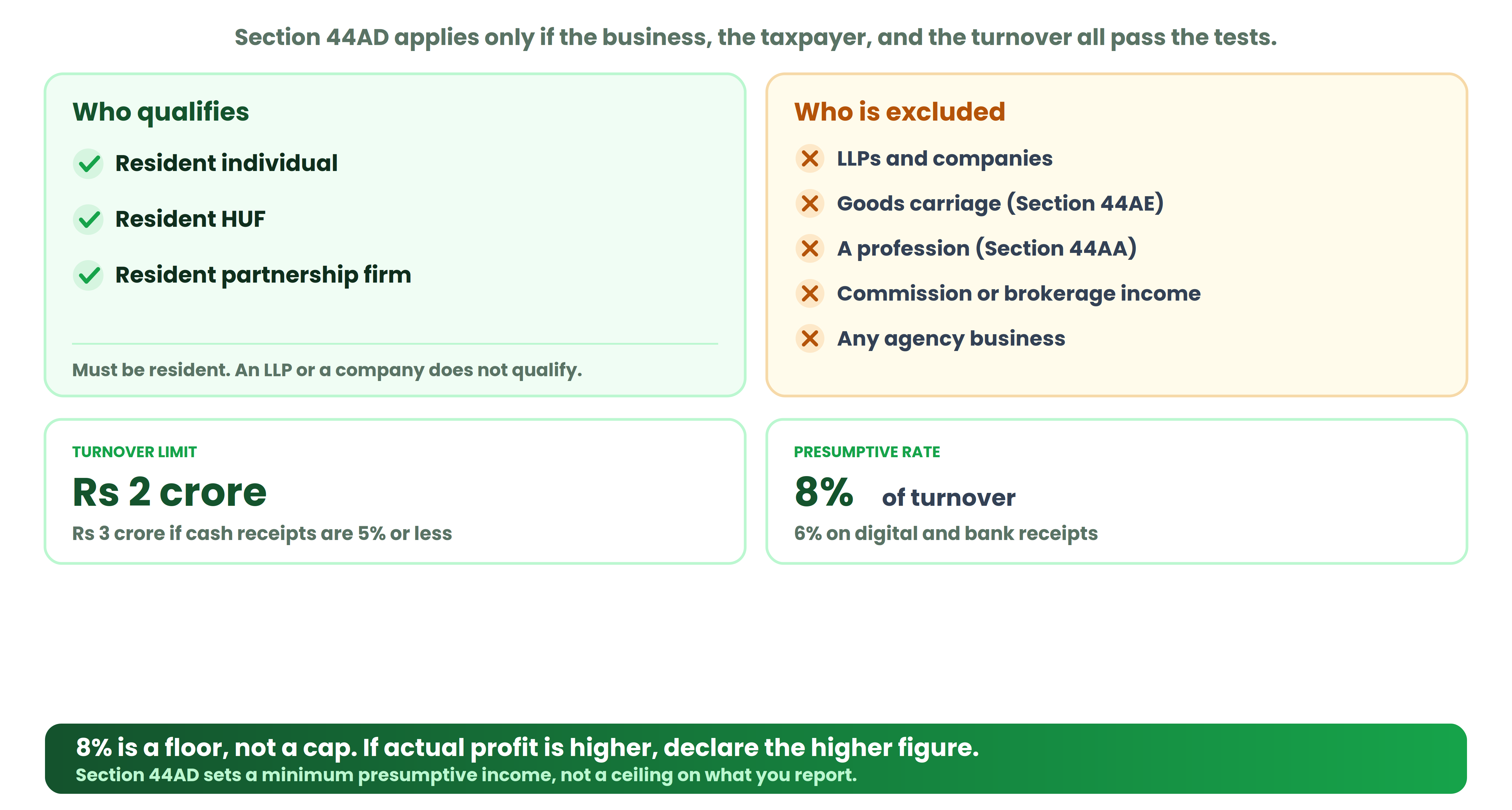
The section applies to a resident individual, a resident Hindu Undivided Family or a resident partnership firm, other than a limited liability partnership, carrying on an eligible business. LLPs and companies do not qualify.
Certain activities and persons are excluded:
- The business of plying, hiring or leasing goods carriages, which is covered by Section 44AE.
- Persons carrying on a profession referred to in Section 44AA(1).
- Persons earning income in the nature of commission or brokerage.
- Persons carrying on any agency business.
- Taxpayers who have claimed specified deductions, such as those under Sections 10A, 10AA, 10B, 10BA or 80HH to 80RRB, for the relevant year.
Not every small business automatically qualifies. The activity, the taxpayer and the turnover all need to pass the tests.
What Is the Turnover Limit Under Section 44AD?
The standard limit is ₹2 crore of total turnover or gross receipts in the previous year. A higher limit of ₹3 crore applies where the aggregate of amounts received in cash, including non-account-payee cheques and drafts, does not exceed 5% of total turnover or gross receipts. The test is based on how receipts were actually received under the statutory rules, not simply on the amount deposited into a bank account.
What Are the Presumptive Income Rates Under Section 44AD?
The general rate is 8% of total turnover or gross receipts. A 6% rate applies to the portion received by account-payee cheque, account-payee bank draft, use of the electronic clearing system through a bank account or other prescribed electronic modes, such as UPI, debit card, credit card, net banking or RTGS/NEFT, provided it is received during the previous year or before the due date for filing the return under Section 139(1).
The 6% rate does not apply automatically to every transaction. Each receipt stream needs to be classified correctly.
What If the Business Earns More Than the Presumptive Amount?
Section 44AD sets a minimum, not a cap. A taxpayer whose actual profit is higher can, and should, declare the higher figure. If the taxpayer declares a lower amount, other requirements may apply, including the Section 44AD(4) restriction and the related books and audit rules discussed below.
Section 44AD Calculation Example
Assume a hypothetical eligible retail business has ₹40 lakh in qualifying turnover for the previous year. Of this, ₹25 lakh was received through UPI, bank transfers and card payments within the specified time, so it qualifies for the 6% rate. The remaining ₹15 lakh was received in cash and is subject to the 8% rate.
| Receipt category | Amount | Rate | Presumptive income |
|---|---|---|---|
| Qualifying receipts | ₹25,00,000 | 6% | ₹1,50,000 |
| Other eligible receipts | ₹15,00,000 | 8% | ₹1,20,000 |
| Total | ₹40,00,000 | ₹2,70,000 |
The arithmetic:
- ₹25,00,000 × 6% = ₹1,50,000
- ₹15,00,000 × 8% = ₹1,20,000
- Total presumptive income = ₹1,50,000 + ₹1,20,000 = ₹2,70,000
₹2.70 lakh is the illustrative presumptive business income, not the final income tax payable. Tax depends on the taxpayer's total income, eligible deductions and chosen regime. Here, cash receipts are 37.5% of turnover, so the higher ₹3 crore limit would not be available. The ₹40 lakh turnover is within the standard ₹2 crore limit anyway. The example assumes all eligibility and receipt-classification conditions are satisfied.
Section 44ADA Explained: Presumptive Taxation for Specified Professionals
Section 44ADA is the professional-side scheme. It uses a single, much higher rate because professional services typically carry higher margins than trading, and its eligibility depends on the profession itself.
Which Professions Qualify Under Section 44ADA?
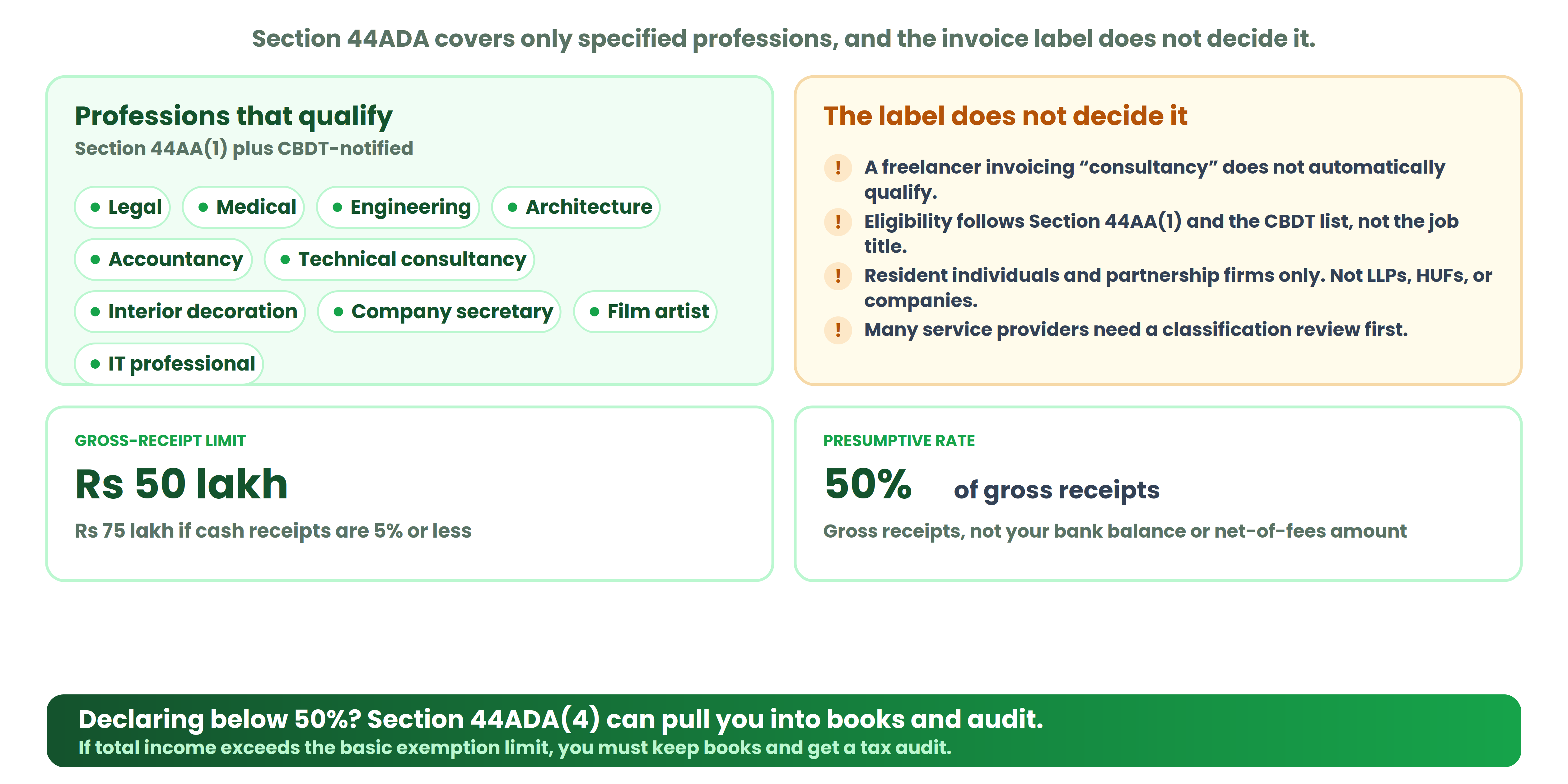
The section covers professions referred to in Section 44AA(1): legal, medical, engineering, architectural, accountancy, technical consultancy and interior decoration, plus other professions notified by the CBDT, such as company secretary, film artist, authorised representative and information technology. It applies to resident individuals and resident partnership firms other than LLPs. HUFs and companies are not covered.
Be careful with freelancers, digital marketers, software professionals and consultants. A freelancer calling an invoice "consultancy fees" does not automatically qualify. Eligibility turns on the nature of the work under Section 44AA(1) and the notified list, not on the invoice label or job title. Many independent service providers need a proper classification review before using this section.
What Is the Gross-Receipt Limit Under Section 44ADA?
The standard limit is ₹50 lakh of total gross receipts from the profession. It rises to ₹75 lakh where amounts received in cash, including non-account-payee cheques and drafts, do not exceed 5% of total gross receipts for the previous year.
How Is Presumptive Income Calculated Under Section 44ADA?
Presumptive professional income is 50% of total gross receipts, or a higher amount if the professional declares it. Gross receipts means the total professional receipts. It is not your bank balance, the net amount after platform or payment-gateway fees, or what is left after personal spending.
What If Actual Professional Income Is Lower Than 50%?
A professional can claim income lower than 50% of gross receipts, but Section 44ADA(4) attaches conditions. If the claimed income is lower and total income exceeds the basic exemption limit, books must be maintained under Section 44AA(1) and audited under Section 44AB. Whether audit applies therefore depends on the taxpayer's total income, so not everyone reporting lower income is in the same position.
Section 44ADA Calculation Example
Take a hypothetical chartered accountant in independent practice with ₹30 lakh in qualifying gross professional receipts for the previous year, all received through banking channels.
| Particular | Amount |
|---|---|
| Gross professional receipts | ₹30,00,000 |
| Presumptive rate | 50% |
| Presumptive professional income | ₹15,00,000 |
The calculation: ₹30,00,000 × 50% = ₹15,00,000.
Under the example's assumptions, ₹15 lakh is the presumptive professional income. It is not automatically the final tax liability, which depends on total income, deductions and the tax regime. Ordinary professional expenses, such as office rent, staff salaries and software subscriptions, are not deducted again from this ₹15 lakh. The 50% computation already stands in for them. The example assumes the professional and all receipts satisfy the eligibility conditions.
Which Expenses Can You Deduct Under Section 44AD and 44ADA?
Under both sections, deductions allowable under Sections 30 to 38, such as rent, repairs, insurance, depreciation, salaries and other business expenditure, are deemed to have already been given full effect in the presumptive income. You compute the presumptive amount and stop. You cannot subtract the same ordinary expenses again.
Depreciation is treated in a similar way. The written-down value of assets is calculated as if depreciation had been claimed and allowed for each year under the scheme. That matters if you later move to regular taxation or sell the asset.
For eligible partnership firms, salary and interest paid to partners are not separately deductible from presumptive income under either section. The earlier provision allowing that deduction under Section 44AD was removed from AY 2017-18 onwards. Section 44ADA follows the same deemed-deduction approach.
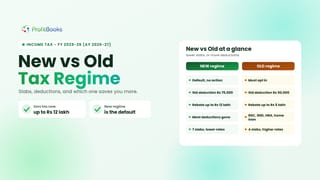
This does not mean every deduction under the Income-tax Act disappears. Deductions in computing total income, such as those under Chapter VI-A (for example, Section 80C), are a separate stage of the computation and remain available where your tax regime allows them. Most of them are not available under the new tax regime.
The presumptive rate replaces ordinary business-expense deductions. It does not replace the rest of your tax computation.
Who Cannot Use Section 44AD or Section 44ADA?
Both provisions have eligibility requirements and exclusions, and they are not the same for each section.
Businesses That May Not Qualify Under Section 44AD
Companies, LLPs and non-residents fall outside Section 44AD. So do goods-carriage businesses covered by Section 44AE, agency businesses, persons earning commission or brokerage income, specified professionals and taxpayers claiming the specified profit-linked deductions for that year.
Professionals Who May Not Qualify Under Section 44ADA
Section 44ADA is limited to professions referred to in Section 44AA(1) and the notified list. A consultant, freelancer or service provider whose work is not a specified profession cannot use it, however professional the work may feel. HUFs, companies, LLPs and non-residents are also outside its scope.
What Happens if Turnover or Gross Receipts Exceed the Limit?
If turnover or gross receipts exceed the applicable threshold for the previous year, that presumptive provision cannot be used for that year. Income is then computed under the regular provisions. That does not mean every such taxpayer automatically needs a tax audit. Audit under Section 44AB depends on its own turnover and receipt thresholds and the taxpayer's circumstances.
Books of Accounts and Tax Audit Under Presumptive Taxation
Presumptive taxation simplifies the income computation. It does not remove every record-keeping or compliance obligation.
Do You Need to Maintain Books of Accounts?
Eligible taxpayers who declare income at or above the presumptive rate generally get relief from maintaining the detailed books of accounts required under Section 44AA. That relief is limited to income-tax book-keeping. GST records, invoices, bank statements, payment evidence and other legal or business records still need to be kept. You also need reliable turnover and receipt-mode data to apply the right rate and threshold, and to prepare your financial statements if a lender or partner asks for them.
When Can a Tax Audit Become Relevant?
The rules differ by section:
- Section 44AD: books and audit become relevant where the Section 44AD(4) restriction applies (the taxpayer opted out within the five-year window) and total income exceeds the basic exemption limit, under Sections 44AD(5), 44AA(2)(iv) and 44AB(e).
- Section 44ADA: where the professional claims income lower than 50% of gross receipts and total income exceeds the basic exemption limit, Section 44ADA(4) requires books under Section 44AA(1) and an audit under Section 44AB.
Other audit triggers under Section 44AB, based on turnover or receipts, apply independently. This area needs close review against the current statutory text for your year.
Does Presumptive Taxation Remove All Tax Compliance?
No. You still need to file your income-tax return where required, typically ITR-4 (Sugam) for eligible individuals, HUFs and firms within its conditions, or ITR-3 where ITR-4 does not apply. Advance tax still applies, and GST obligations are independent of how income tax is computed.
Advance Tax Under Sections 44AD and 44ADA
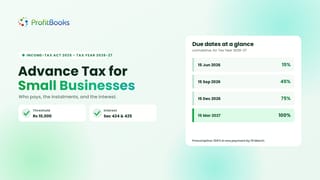
Presumptive taxpayers do not escape advance tax. They get a simpler schedule. Under Section 211(1)(b), a taxpayer who declares income under Section 44AD(1) or Section 44ADA(1) must pay the whole amount of advance tax for the year on or before 15 March of the financial year, instead of the four quarterly instalments that apply to most other taxpayers. Paying earlier is allowed.
That does not mean tax is payable only when the return is filed. If the advance-tax liability is not paid by 15 March, interest under Sections 234B and 234C can apply. The advance tax itself is based on the estimated tax on your total income for the year, not just the presumptive figure.
Can You Switch Out of Presumptive Taxation?
Moving from presumptive to regular taxation is possible, but it needs planning, especially under Section 44AD.
Switching Out of Section 44AD
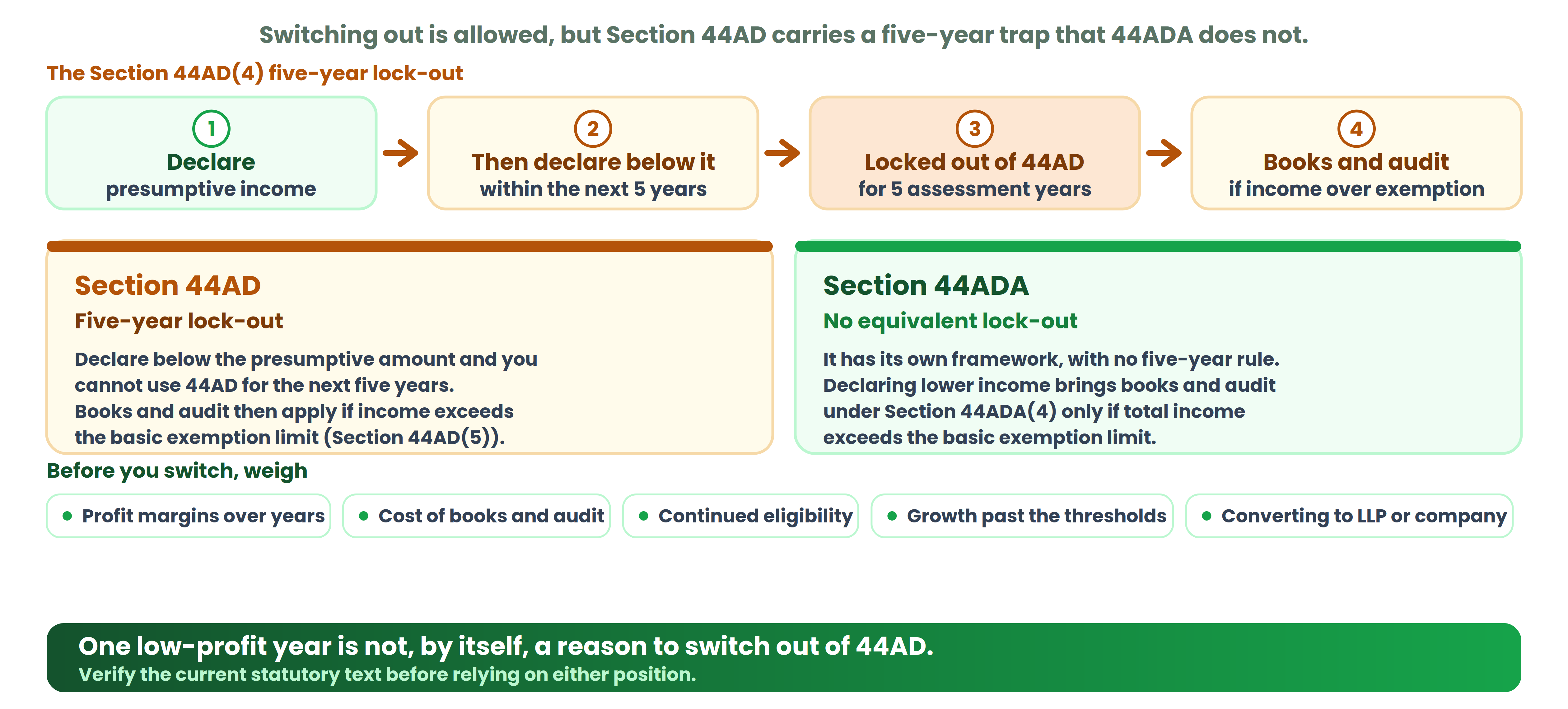
Under Section 44AD(4), if an eligible taxpayer declares profit under the presumptive scheme for a year and then, in any of the next five assessment years, declares profit lower than the presumptive amount, the taxpayer is not eligible for Section 44AD for the five assessment years following the year of opting out. During that period, if total income exceeds the basic exemption limit, books must be maintained and audited under Section 44AD(5).
Does the Same Restriction Apply to Section 44ADA?
Not automatically. Section 44ADA has its own framework. It does not contain an equivalent of the Section 44AD(4) five-year lock-out. Instead, declaring lower income brings the books and audit requirement under Section 44ADA(4) where total income exceeds the basic exemption limit. Check the current statutory text before relying on either position.
What Should You Consider Before Switching?
Look at your expected profit margins over several years, the cost of maintaining books and an audit, your continued eligibility and your future business plans, such as growth past the thresholds or conversion to an LLP or company. One year of lower actual profit is not, by itself, a sound reason to switch out of Section 44AD.
Section 44AD vs Section 44ADA: Which Scheme May Apply to You?
Work through these questions in order before choosing a provision.
| Question | What to verify |
|---|---|
| What type of activity do you carry on? | Eligible business or specified profession |
| What is your taxpayer status? | Resident and eligible category requirements |
| What is your turnover or gross receipt amount? | Applicable statutory threshold |
| How much of your receipts meets the relevant cash condition? | Eligibility for a higher threshold or specified rate |
| Have you used a presumptive scheme in earlier years? | Applicable restrictions and switching rules |
Three hypothetical examples:
- A textile trader with ₹1.5 crore turnover, mostly through UPI and bank transfers, would evaluate Section 44AD and split receipts between the 6% and 8% rates.
- A doctor in private practice with ₹45 lakh in gross receipts would evaluate Section 44ADA under the standard ₹50 lakh limit.
- A management consultant billing ₹60 lakh needs two checks first: whether the work is a specified profession, and whether cash receipts stay within 5% so the ₹75 lakh limit is available.
The nature of the activity and statutory eligibility decide the relevant provision, not which percentage looks more favourable.
Common Mistakes to Avoid Under Presumptive Taxation
| Mistake | Why it matters | Correct approach |
|---|---|---|
| Applying the 6% rate to all Section 44AD receipts | Understates income on cash receipts | Apply 6% only to qualifying banking and digital receipts received within the specified time; 8% to the rest |
| Assuming every freelancer qualifies under Section 44ADA | The return may use the wrong section | Check the work against Section 44AA(1) and the notified professions |
| Confusing turnover with profit | Wrong base, wrong income figure | Apply the rate to turnover or gross receipts, not to profit |
| Treating presumptive income as final tax payable | Misjudges tax and advance tax | Add it to total income, apply deductions and slab rates |
| Ignoring the cash-receipt condition | The ₹3 crore or ₹75 lakh limit may not be available | Measure cash and non-account-payee receipts against 5% of the total |
| Assuming no records are needed | GST, bank and invoice records are still required | Keep organised sales, receipt and payment records |
| Applying the Section 44AD lock-out to Section 44ADA | Each section has its own rules | Read each provision separately |
| Using thresholds from a previous assessment year | Limits have changed over time | Confirm figures for the AY you are filing for |
How Accounting Software Can Help Small Businesses and Professionals
Presumptive taxation depends on reliable numbers. You need your total turnover or gross receipts, how much came through banking channels versus cash, and whether you are within the threshold. Organised sales records, invoices, payment histories, expense records and financial reports make that information easier to check when the return is prepared.
ProfitBooks accounting software for small businesses helps you create invoices, record payments and expenses, reconcile bank accounts and generate financial reports from the same records. It does not decide whether you qualify for Section 44AD or 44ADA, and it does not replace advice from a qualified tax professional. It keeps the underlying data organised so that you and your CA can make that call with confidence.
Keep your turnover and receipt records organised all year
Record invoices, payments and expenses in ProfitBooks and pull up your reports when it is time to work out presumptive income with your CA.
Frequently Asked Questions About Sections 44AD and 44ADA
What is the presumptive taxation scheme?
It is a simplified method under the Income-tax Act, 1961 that lets eligible businesses and specified professionals compute business or professional income at a prescribed percentage of turnover or gross receipts, instead of deducting each actual expense. Section 44AD covers eligible businesses and Section 44ADA covers specified professions, each with its own conditions.
What is the turnover limit under Section 44AD?
The standard limit is ₹2 crore of total turnover or gross receipts. It rises to ₹3 crore where cash receipts, including receipts by non-account-payee cheque or bank draft, do not exceed 5% of total turnover or gross receipts for the previous year. Both limits apply for AY 2026-27.
What is the gross-receipt limit under Section 44ADA?
The standard limit is ₹50 lakh of gross professional receipts. It rises to ₹75 lakh where cash receipts, including non-account-payee cheques or drafts, do not exceed 5% of total gross receipts for the previous year. If receipts cross the applicable limit, Section 44ADA cannot be used for that year.
Is presumptive income the same as taxable income?
No. Presumptive income is only the income computed under the business or profession head. Total income also includes salary, house property, capital gains and other sources, less eligible deductions. Tax is then calculated on that total under the applicable regime, so presumptive income is not the final tax payable.
Can a freelancer use Section 44ADA?
Only if the freelancer's work falls within a profession referred to in Section 44AA(1), such as legal, medical, engineering, architecture, accountancy, technical consultancy, interior decoration or a notified profession, and the residency, entity and receipt conditions are met. The nature of the work decides eligibility, not a job title or invoice label.
Is a tax audit required under presumptive taxation?
Not if income is declared at or above the presumptive rate and the conditions are met. Under Section 44ADA, declaring lower income with total income above the basic exemption limit requires books and an audit. Under Section 44AD, the audit link arises mainly where the Section 44AD(4) opt-out restriction applies.
Can I deduct business expenses separately under Sections 44AD or 44ADA?
No. Deductions under Sections 30 to 38, such as rent, salaries and depreciation, are deemed to have been allowed in the presumptive computation, so they cannot be claimed again. Partner salary and interest are not separately deductible either. Chapter VI-A deductions, where your tax regime allows them, are a separate stage.
When should advance tax be paid under presumptive taxation?
Under Section 211(1)(b), a taxpayer declaring income under Section 44AD(1) or 44ADA(1) must pay the whole advance tax for the year on or before 15 March of the financial year. Paying earlier is allowed. Missing the date can attract interest under Sections 234B and 234C.
Can I switch from Section 44AD to regular taxation?
Yes, but under Section 44AD(4), if you opt in and then declare lower profit within the next five assessment years, you lose eligibility for the following five assessment years and may need books and an audit. This lock-out is specific to Section 44AD and does not automatically apply to Section 44ADA.
Final Takeaway: Check Eligibility Before Choosing Presumptive Taxation
Section 44AD is for eligible businesses. Section 44ADA is for specified professions. They are not interchangeable, and their rates are not a menu to choose from. Before filing, verify your activity, taxpayer category, turnover or gross receipts, receipt modes and previous-year tax treatment against the rules for your assessment year.
Build your tax-season numbers on clean books
Explore ProfitBooks' accounting and financial reporting features to keep invoices, receipts and payment data organised throughout the year.
Disclaimer: This article provides general information about presumptive taxation under Sections 44AD and 44ADA of the Income-tax Act, 1961 for Assessment Year 2026-27. It is not individual tax advice. Tax rules change through Finance Acts and notifications, and the Income-tax Act, 2025 applies from 1 April 2026. Consult a qualified tax professional about your circumstances.