PAN, CIN, GST, LEI: A Field Guide to the Identifiers Every Indian Business Needs
On this page 14 sections

It's a Tuesday, and a wire transfer from your new overseas client is sitting in limbo. The bank won't release it until you hand over your LEI. Your what? You have a PAN. You have a GSTIN. You're fairly sure there's a CIN somewhere in your incorporation papers. But an LEI is a new one, and now a four-day-old payment is stuck behind a code you've never registered.
If you run a business in India, you collect identifiers like loyalty cards, and it's easy to lose track of which one does what. This guide lays them out in plain language: what each code is for, who issues it, and the moment it actually starts to matter.
The quick verdict
Before the detail, here's the short version. Almost every business needs a PAN. Most need a GSTIN. Incorporate, and you get a CIN. Start deducting tax at source, and you need a TAN. And the day you borrow big or start dealing across borders, you need an LEI. That's the whole map. The rest of this guide fills it in, with a cheat sheet and an FAQ at the end so you can find your answer fast.
What this guide covers
- PAN, your tax identity
- TAN, for deducting tax at source
- GSTIN, your GST registration
- CIN, proof you've incorporated
- DIN and Udyam, two you'll meet along the way
- LEI, the global one your bank keeps asking about
- A one-glance cheat sheet, plus a quick FAQ
PAN: your tax identity
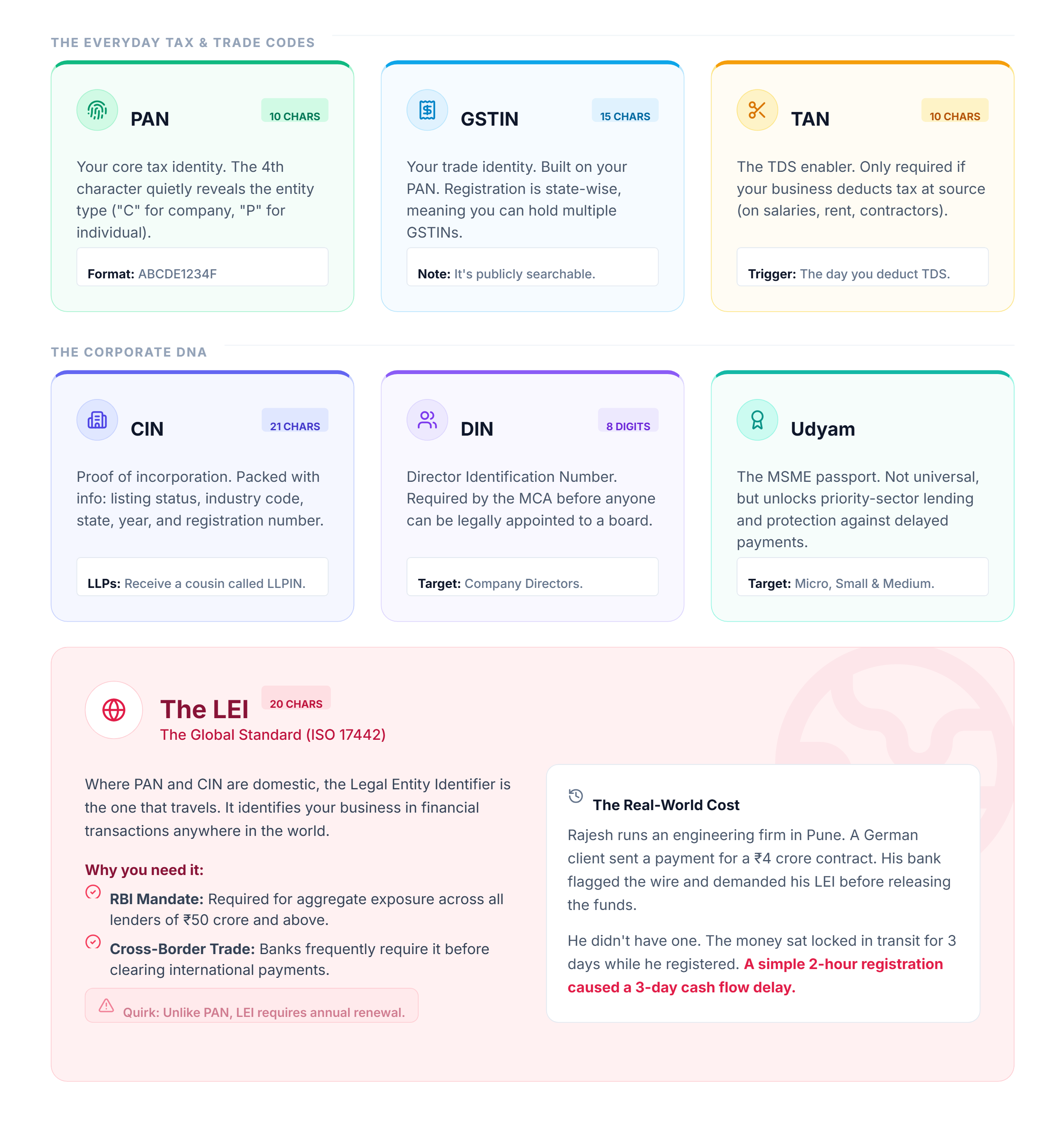
If your business has only one identifier, it's this one. The Permanent Account Number is a ten-character code from the Income Tax Department, and it follows you everywhere money and tax are involved. You need it to file returns, open a current account, deduct tax, and transact above fairly small thresholds.
A PAN looks like ABCDE1234F: five letters, four digits, and a letter to finish. The fourth character quietly tells you what kind of holder it is, with "C" for a company, "P" for an individual, and "F" for a firm. Sole proprietors usually run the business on their personal PAN. The moment you form a company or an LLP, that entity gets its own, separate from yours.
TAN: for deducting tax at source
Closely related, and often confused with PAN, is the Tax Deduction and Collection Account Number. If your business deducts tax at source, say on salaries, rent, or contractor payments, you need a TAN to deposit that tax and file your TDS returns. It's also ten characters, also from the Income Tax Department, but it's a separate registration. Plenty of small businesses never need one. The day you start deducting TDS, you do.
GSTIN: your GST registration
Once your turnover crosses the GST threshold, or you start supplying across state lines, or you sell online, you register for GST and receive a GSTIN. It's a fifteen-character number, and here's the neat part: it's built on your PAN. A two-digit state code sits at the front, your ten-character PAN sits in the middle, and a few characters for entity and check digits finish it off.
Two things catch people out. First, GST registration is state-wise, so if you operate in three states you'll hold three GSTINs, all sharing the same PAN. Second, the GSTIN is public. Customers and suppliers can look it up, which is exactly why a valid one signals that you're a real, compliant business. If you run your books on accounting software, this is the number doing quiet work on every invoice you raise.
CIN: proof you've incorporated
Sole proprietorships and ordinary partnerships don't get a CIN. The Corporate Identification Number shows up the moment you incorporate, whether that's a private limited, a public limited, or a one-person company. The Registrar of Companies, under the Ministry of Corporate Affairs, assigns it, and it's a twenty-one character code that turns out to be surprisingly chatty once you know how to read it.
Packed into those characters: whether the company is listed, an industry code, the state of registration, the year you incorporated, whether you're public or private, and your registration number. You'll quote it on annual filings, board resolutions, and official letters. Run an LLP instead of a company? You get a close cousin called an LLPIN.
DIN and Udyam: two more you'll meet
Two others worth recognising. Every company director needs a DIN, an eight-digit Director Identification Number from the MCA, before they can be appointed to a board. And if you qualify as a micro, small, or medium enterprise, Udyam registration gives you a number that unlocks MSME benefits like priority-sector lending and some protection against delayed payments. Neither is universal, but both come up often enough that you'll want to know what they are when someone mentions them.
LEI: the global one your bank keeps asking about
Here's the identifier that catches businesses off guard, because it isn't really an Indian code at all. The Legal Entity Identifier is a twenty-character number built on a global standard, ISO 17442, and it identifies your business in financial transactions anywhere in the world. Where PAN and CIN are domestic, the LEI is the one that travels.
It exists because regulators, after the 2008 financial crisis, wanted one reliable way to tell who was trading with whom across borders. The system is overseen by GLEIF, the Global Legal Entity Identifier Foundation, which doesn't issue codes itself. Instead it accredits the issuers that do. So in India you register an LEI through an accredited issuer rather than approaching GLEIF directly, and the registration itself is an online job that can be done in a couple of hours.
So why would your business need one? Two reasons, mostly. The first is regulation. The Reserve Bank of India has made the LEI mandatory for large borrowers, currently those with aggregate exposure of 50 crore rupees and above, and for large-value transactions. The second is everyday practicality. Banks and counterparties increasingly ask for an LEI before they'll clear a cross-border payment or onboard you for trade.
A quick example
Take Rajesh, who runs a thirty-person engineering firm in Pune. For years he needed only a PAN, a GSTIN, and his company's CIN. Then a German client signed a contract worth 4 crore rupees, his bank flagged the incoming wire, and the relationship manager asked for his LEI before releasing the funds. He didn't have one. The payment sat for three days while he registered. A two-hour job turned into a three-day delay, all because nobody mentioned the LEI until the money was already in transit. The fix was simple. The timing was the expensive part.
Does it apply to you yet?
A fair question is whether any of this even reaches you today. If you're a small business running domestic sales and a modest overdraft, the RBI mandate probably doesn't, and you can park the LEI for the day you grow into it. Watch one detail, though. The threshold is about your aggregate exposure across all your lenders, not any single loan, so growing companies cross it sooner than they expect. If you're close to it, or if one big overseas client could push your banking international, it's cheaper to have an LEI sitting ready than to stall a payment while you arrange one.
One quirk belongs on your compliance calendar. Unlike PAN, which is permanent, an LEI has to be renewed every year. Let it lapse and it shows as inactive in the public register, which can hold up the very transaction you needed it for. Good issuers handle renewal and transfer as a standing service, so for most businesses it becomes a set-and-forget item rather than a yearly scramble.
The cheat sheet
When you need a quick answer, this is the short version:
| Identifier | What it's for | Issued by | Who needs it | Renewal |
|---|---|---|---|---|
| PAN | Tax identity | Income Tax Department | Almost every business | Permanent |
| TAN | Deducting tax at source (TDS) | Income Tax Department | Anyone deducting TDS | Permanent |
| GSTIN | GST registration | GST system, state-wise | Businesses over the GST threshold, interstate, or online | While registered |
| CIN | Company incorporation | Registrar of Companies (MCA) | Incorporated companies | Permanent |
| LEI | Identity in financial transactions | GLEIF-accredited issuer | Large borrowers, cross-border, RBI-mandated entities | Every year |
Where you'll actually use each one
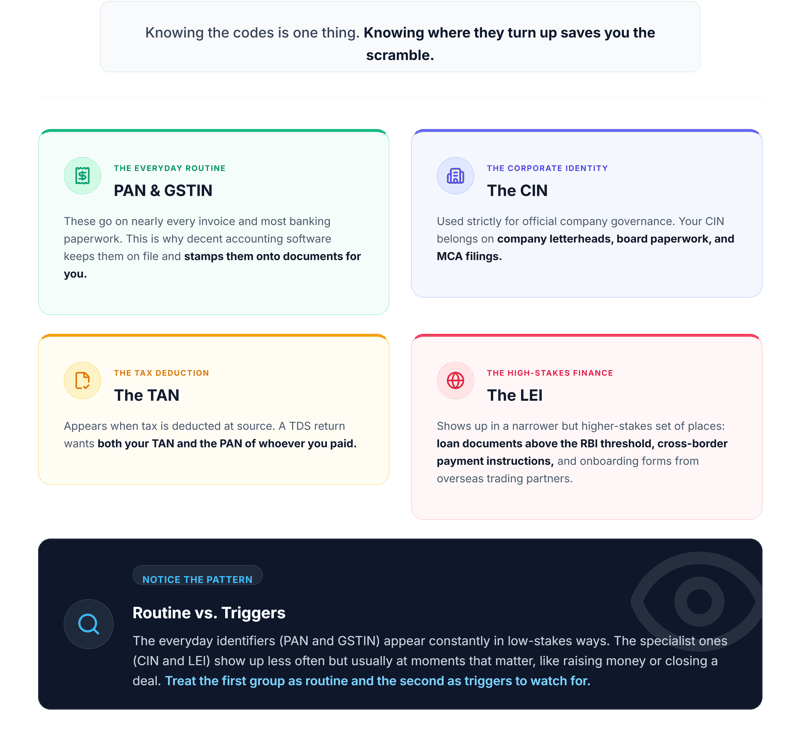
Knowing the codes is one thing. Knowing where they turn up saves you the scramble. Your PAN and GSTIN go on nearly every invoice and most banking paperwork, which is why decent accounting software keeps them on file and stamps them onto documents for you. Your CIN belongs on company letterheads, board paperwork, and MCA filings. A TDS return wants both your TAN and the PAN of whoever you paid. The LEI shows up in a narrower but higher-stakes set of places: loan documents above the RBI threshold, cross-border payment instructions, and onboarding forms from overseas banks and trading partners.
Notice the pattern. The everyday identifiers, PAN and GSTIN, appear constantly in low-stakes ways. The specialist ones, CIN and LEI, show up less often but usually at moments that matter, like raising money, closing a deal, or satisfying a regulator. Treat the first group as routine and the second as triggers to watch for.
 So which do you actually need?

If you're a small proprietor, you might run perfectly well on a PAN and a GSTIN. Incorporate, and a CIN plus director DINs come with the territory. Start deducting TDS, and TAN joins the list. Then the day you borrow big or go cross-border, the LEI lands on your desk.
The honest takeaway is that you don't need all of these on day one, and chasing codes you don't yet require is a waste of a busy week. What helps is knowing which trigger brings which identifier, so when a bank or a form asks, you reach for the right one instead of opening another browser tab.
Frequently asked questions
Is an LEI the same as a PAN or GSTIN?
No. PAN and GSTIN are domestic tax identifiers issued by Indian authorities. An LEI is a global identifier for financial transactions, issued under a worldwide standard. They do different jobs, and you can need all three at once.
Do I need an LEI if I only sell within India?
Usually not yet. The LEI bites when you cross the RBI's borrowing threshold or start moving money across borders. A purely domestic small business can wait until one of those triggers shows up.
How long does it take to get an LEI, and does it cost anything?
Registration is an online process that can be completed in a couple of hours through an accredited issuer. There's a modest annual fee, since the LEI is renewed each year rather than issued once for life.
What happens if my LEI expires?
It gets marked as "lapsed" in the public register. The number still exists, but a lapsed status can stall transactions that require an active LEI, so it's worth renewing before the due date rather than after a payment is already held up.
Who is allowed to issue an LEI in India?
Only issuers accredited by GLEIF, the body that governs the global LEI system. You register through one of them rather than with GLEIF directly.
Christian writes on LEI compliance and cross-border finance at GlobalLEI, the Indian subsidiary of NordLEI, which GLEIF named the world's best LEI issuer in 2023 and 2025.