New Tax Regime vs Old Tax Regime (FY 2025-26 / AY 2026-27)
On this page 22 sections
This article covers FY 2025-26 (AY 2026-27). Tax rules change annually. Verify figures against the Income Tax Department website before filing. This is general educational information, not personalised tax advice.
Choosing between the New Tax Regime vs Old Tax Regime for FY 2025-26 (AY 2026-27) confuses most taxpayers, because the two systems differ on slab rates, deductions, exemptions and rebates all at once. The new regime is now the default, with lower slabs but almost no deductions. The old regime keeps higher slabs but lets you claim ₹80C, ₹80D, HRA and home loan interest.
The important point is this: comparing slab rates alone tells you nothing. What decides your bill is the final tax payable after every applicable deduction, rebate and cess. This article walks through the slabs, the deductions, the Section 87A rebate, three fully worked calculations, the switching rules and the mistakes that cost people money.
Neither regime is automatically better for every taxpayer. The new regime usually wins when you have few deductions, because of its lower slabs, higher standard deduction and the rebate that makes income up to ₹12 lakh tax-free. The old regime can win when your eligible deductions (HRA, 80C, 80D, home loan interest) are large. The only reliable answer comes from calculating your own tax under both.
The headline differences before the detail:
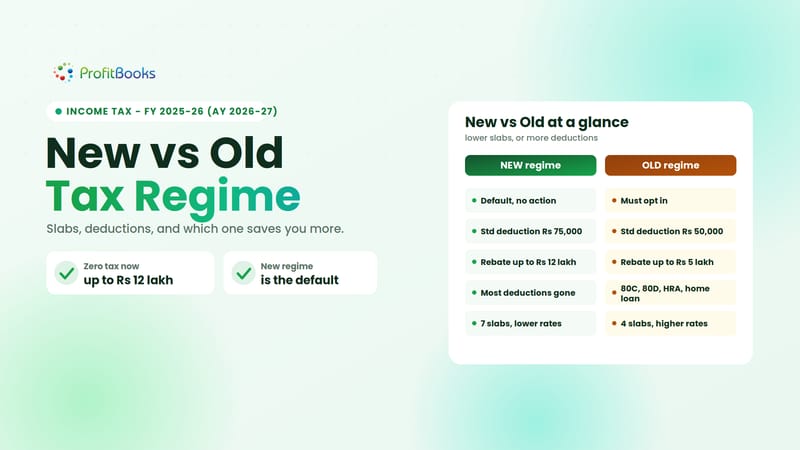
- The new regime is the default. You are in it unless you actively opt into the old regime.
- New regime: 7 slabs, lower rates, ₹75,000 standard deduction, but most deductions removed.
- Old regime: 4 slabs, higher rates, ₹50,000 standard deduction, but 80C, 80D, HRA and home loan interest available.
- Under the new regime, the Section 87A rebate makes tax nil for resident individuals with total income up to ₹12 lakh.
- Salaried taxpayers can choose the regime each year. Those with business income face switching restrictions.
New Tax Regime vs Old Tax Regime: Key Differences
The core difference is a trade. The new regime gives you lower slab rates but strips away most deductions and exemptions. The old regime keeps higher rates but lets you reduce taxable income through a wide range of deductions. Here is the summary before the detail.
| Feature | New Regime | Old Regime |
|---|---|---|
| Default status | Default (no action needed) | Must opt in |
| Tax slabs | 7 slabs, lower rates | 4 slabs, higher rates |
| Standard deduction (salaried) | ₹75,000 | ₹50,000 |
| Section 80C (up to 1.5L) | Not available | Available |
| Section 80D (health insurance) | Not available | Available |
| HRA exemption | Not available | Available if eligible |
| Home loan interest (Sec 24b, self-occupied) | Not available | Up to ₹2,00,000 |
| Employer NPS (Sec 80CCD(2)) | Available (up to 14% of salary) | Available (up to 14% of salary) |
| Section 87A rebate | Up to ₹60,000 (income ≤ ₹12L) | Up to ₹12,500 (income ≤ ₹5L) |
| Switching | Yearly for salaried; restricted for business | Yearly for salaried; restricted for business |
The table is only a summary. The detailed conditions and the actual calculation decide the result, so treat this as a map, not the answer.
New Tax Regime Slabs for FY 2025-26 (AY 2026-27)
New Tax Regime Slab Rates
These are the new regime slab rates for AY 2026-27 (Source: Income Tax Department):
| Total Taxable Income | Tax Rate |
|---|---|
| Up to ₹4,00,000 | Nil |
| ₹4,00,001 to ₹8,00,000 | 5% |
| ₹8,00,001 to ₹12,00,000 | 10% |
| ₹12,00,001 to ₹16,00,000 | 15% |
| ₹16,00,001 to ₹20,00,000 | 20% |
| ₹20,00,001 to ₹24,00,000 | 25% |
| Above ₹24,00,000 | 30% |
How the New Tax Slabs Work
These are progressive rates. If your taxable income is ₹10,00,000, you do not pay 10% on the whole amount. The first ₹4 lakh is taxed at nil, the next ₹4 lakh at 5%, and the remaining ₹2 lakh at 10%. Your effective rate stays well below the top slab you fall into.
The final figure also depends on the Section 87A rebate, surcharge (for income above ₹50 lakh) and the 4% health and education cess. Because of the rebate, a salaried person earning up to ₹12,75,000 in gross salary can pay zero tax: the ₹75,000 standard deduction brings total income to ₹12,00,000, which qualifies for the full rebate on ordinary income.
Old Tax Regime Slabs for FY 2025-26 (AY 2026-27)
Old Regime Slab Rates for Individuals Below 60
| Total Taxable Income | Tax Rate |
|---|---|
| Up to ₹2,50,000 | Nil |
| ₹2,50,001 to ₹5,00,000 | 5% |
| ₹5,00,001 to ₹10,00,000 | 20% |
| Above ₹10,00,000 | 30% |
Old Regime Slabs for Senior Citizens
The basic exemption limit is higher for eligible resident senior and super senior citizens. These limits apply only to residents. Non-resident individuals use the general slabs regardless of age.
Resident senior citizens (60 to below 80): nil up to ₹3,00,000, then 5% from ₹3,00,001 to ₹5,00,000, 20% from ₹5,00,001 to ₹10,00,000, and 30% above ₹10,00,000.
Resident super senior citizens (80 and above): nil up to ₹5,00,000, then 20% from ₹5,00,001 to ₹10,00,000, and 30% above ₹10,00,000.
Why the Old Regime Slabs Are Only Part of the Story
Under the old regime, deductions and exemptions reduce your taxable income before these rates apply. So the slab table alone cannot tell you which regime produces a lower bill. The deductions section below is where the real comparison happens.
New vs Old Tax Regime: Deductions and Exemptions Compared
This is where the regimes diverge most. The old regime rewards disciplined investment and specific expenditures. The new regime removes most of those levers in exchange for lower rates.
| Deduction / Exemption | New Regime | Old Regime |
|---|---|---|
| Standard deduction (salaried/pension) | ₹75,000 | ₹50,000 |
| Section 80C (PPF, ELSS, LIC, etc.) | Not available | Up to ₹1,50,000 |
| Section 80CCD(1B) (NPS self-contribution) | Not available | Up to ₹50,000 |
| Section 80CCD(2) (Employer NPS) | Available (up to 14%) | Available (up to 14%) |
| Section 80D (health insurance) | Not available | Up to ₹25,000 (₹50,000 seniors) |
| HRA exemption | Not available | Available if eligible |
| Home loan interest, self-occupied (Sec 24b) | Not available | Up to ₹2,00,000 |
| Education loan interest (Sec 80E) | Not available | Available (no cap) |
| Donations (Sec 80G) | Not available | Available, subject to limits |
| Leave Travel Concession | Not available | Available, subject to conditions |
Three points that trip people up. HRA is not a flat deduction: it depends on actual rent paid, your salary structure and whether you live in a metro, so not every salaried person qualifies. Employer NPS under 80CCD(2) is available in both regimes, but your own NPS contribution under 80CCD(1B) is deductible only under the old regime. Home loan interest under Section 24(b) for a self-occupied property (up to ₹2,00,000) is available only under the old regime.
Section 87A Rebate: Why It Matters When Comparing Regimes
Section 87A provides a rebate that directly reduces your tax payable. It is not a deduction (which reduces income) but a rebate (which reduces the calculated tax). It is often the single factor that decides the comparison at lower incomes.
Under the new regime for AY 2026-27, a resident individual with total income up to ₹12,00,000 gets a rebate of up to ₹60,000, which makes the tax on ordinary income nil. Under the old regime, the rebate is up to ₹12,500 for total income up to ₹5,00,000.
New regime (AY 2026-27): if your total income does not exceed ₹12,00,000, the rebate of up to ₹60,000 can reduce the tax on ordinary income to nil. This applies to income taxed at normal slab rates. Tax on special-rate income, such as certain short-term or long-term capital gains, is generally not offset by this rebate.
Marginal relief: if your total income is slightly above ₹12 lakh, marginal relief limits your tax so it does not exceed the amount by which income crosses ₹12 lakh. For example, at ₹12,10,000 total income, the tax on ordinary income is limited to roughly ₹10,000 (plus cess) rather than the full slab tax.
Old regime (AY 2026-27): the rebate is up to ₹12,500 for resident individuals with total income up to ₹5,00,000.
Do not assume everyone earning below these thresholds pays zero tax. Eligibility depends on residency, income composition and whether the income includes special-rate components.
New vs Old Tax Regime: Worked Tax Calculation Examples
These are the decision-support sections. Each uses the same salary assumption across both regimes, and every figure is computed transparently. All examples assume a resident individual below 60 with no surcharge (income below ₹50 lakh).
Example 1: Salary of ₹10 Lakh, Limited Deductions
Assumptions: only salary income, no HRA or home loan, no 80C or 80D investments.
| Component | New Regime | Old Regime |
|---|---|---|
| Gross salary | ₹10,00,000 | ₹10,00,000 |
| Standard deduction | (₹75,000) | (₹50,000) |
| Taxable income | ₹9,25,000 | ₹9,50,000 |
| Tax on slabs | ₹32,500 | ₹1,02,500 |
| Section 87A rebate | (₹32,500) | Not eligible |
| Tax after rebate | ₹0 | ₹1,02,500 |
| Cess (4%) | ₹0 | ₹4,100 |
| Total tax payable | ₹0 | ₹1,06,600 |
New regime: taxable income ₹9,25,000 is below ₹12 lakh, so the Section 87A rebate wipes out the ₹32,500 slab tax. Final tax is ₹0. Old regime: ₹2.5L at nil, ₹2.5L at 5% = ₹12,500, ₹4.5L at 20% = ₹90,000, total ₹1,02,500 plus cess. At this income with no deductions, the new regime saves the full ₹1,06,600.
Example 2: Salary of ₹15 Lakh, Substantial Deductions
Assumptions (old regime): HRA exemption ₹1,80,000, Section 80C ₹1,50,000, Section 80D ₹25,000, home loan interest ₹2,00,000.
| Component | New Regime | Old Regime |
|---|---|---|
| Gross salary | ₹15,00,000 | ₹15,00,000 |
| Standard deduction | (₹75,000) | (₹50,000) |
| HRA exemption | Not available | (₹1,80,000) |
| Section 80C | Not available | (₹1,50,000) |
| Section 80D | Not available | (₹25,000) |
| Home loan interest (Sec 24b) | Not available | (₹2,00,000) |
| Taxable income | ₹14,25,000 | ₹8,95,000 |
| Tax on slabs | ₹93,750 | ₹91,500 |
| Section 87A rebate | Not eligible | Not eligible |
| Cess (4%) | ₹3,750 | ₹3,660 |
| Total tax payable | ₹97,500 | ₹95,160 |
New regime: ₹20,000 + ₹40,000 + (₹2,25,000 at 15% = ₹33,750) = ₹93,750 slab tax. Old regime: ₹12,500 + (₹3,95,000 at 20% = ₹79,000) = ₹91,500 slab tax. With ₹6.05 lakh of deductions, the old regime wins, but by only about ₹2,340. The margin is thin, and reducing any single deduction can flip the result.
Example 3: Salary of ₹20 Lakh, Minimal Deductions
Assumptions: only the standard deduction, no other claims.
| Component | New Regime | Old Regime |
|---|---|---|
| Gross salary | ₹20,00,000 | ₹20,00,000 |
| Standard deduction | (₹75,000) | (₹50,000) |
| Taxable income | ₹19,25,000 | ₹19,50,000 |
| Tax on slabs | ₹1,85,000 | ₹3,97,500 |
| Cess (4%) | ₹7,400 | ₹15,900 |
| Total tax payable | ₹1,92,400 | ₹4,13,400 |
New regime: ₹20,000 + ₹40,000 + ₹60,000 + (₹3,25,000 at 20% = ₹65,000) = ₹1,85,000. Old regime: ₹12,500 + ₹1,00,000 + (₹9,50,000 at 30% = ₹2,85,000) = ₹3,97,500. With few deductions at this income, the new regime saves about ₹2,21,000.
Which Tax Regime May Suit Your Financial Situation?
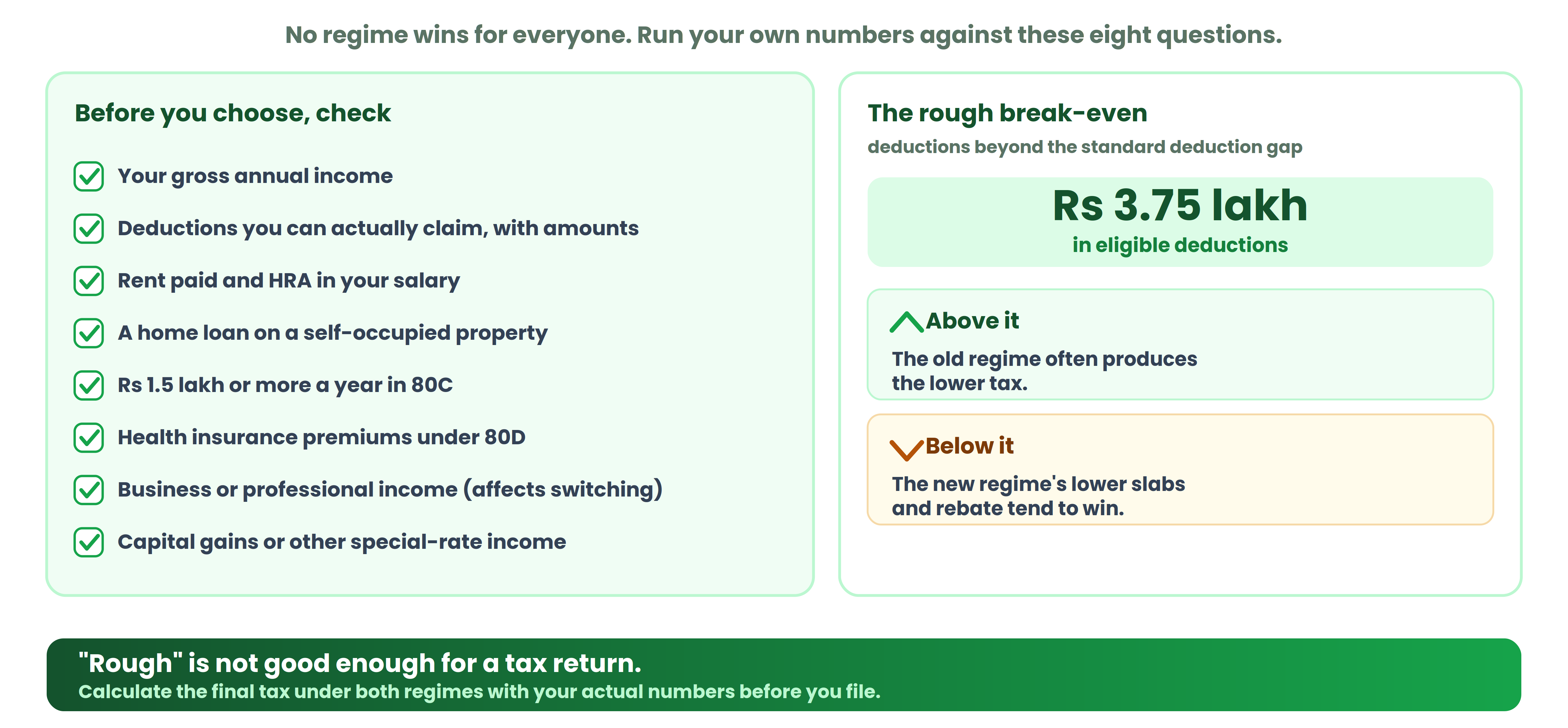
No single regime wins for everyone. Work through this checklist with your own numbers:
- What is your gross annual income?
- Which deductions are you actually eligible to claim? List them with amounts.
- Do you pay rent and receive HRA as part of your salary?
- Do you have an active home loan on a self-occupied property?
- Do you invest ₹1.5 lakh or more annually in 80C instruments?
- Do you have health insurance premiums qualifying under 80D?
- Do you have business or professional income? This affects switching rules.
- Does your income include capital gains or other special-rate components?
As a rough guide, when your eligible deductions under the old regime exceed about ₹3.75 lakh (beyond the standard deduction difference), the old regime often produces lower tax. Below that, the new regime's lower slabs and rebate tend to win. But "rough" is not good enough for a tax return. Calculate both sides with your actual numbers.
How to Compare Both Regimes Using an Income Tax Calculator
- Gather your total salary, interest income, rental income and any other income.
- List every deduction and exemption you are eligible to claim under the old regime.
- Calculate taxable income under each regime separately.
- Apply the correct AY 2026-27 slab rates.
- Check Section 87A rebate eligibility and marginal relief where relevant.
- Add the 4% health and education cess (and surcharge if applicable).
- Compare the final tax payable.
The Income Tax Department provides an official online tax calculator on its e-filing portal. Use it to validate your manual calculations, and make sure you select the correct assessment year (AY 2026-27).
Can You Switch Between the New and Old Tax Regimes?
The new regime is the default, so you do not file any form to stay in it.
Salaried Individuals Without Business Income
Salaried taxpayers without business or professional income can generally choose between the regimes each year when filing their ITR. You can inform your employer of a preferred regime for TDS during the year, then make the final choice at filing.
Business or Professional Income
Taxpayers with business or professional income face restrictions. Once you opt out of the new regime by filing Form 10-IEA, you can switch back only once in your lifetime. That is a significant constraint. Verify the current Form 10-IEA requirements and deadlines on the Income Tax Department portal before deciding.
Do not assume every taxpayer can switch freely each year. The rules differ based on income type.
Common Mistakes to Avoid When Comparing Tax Regimes
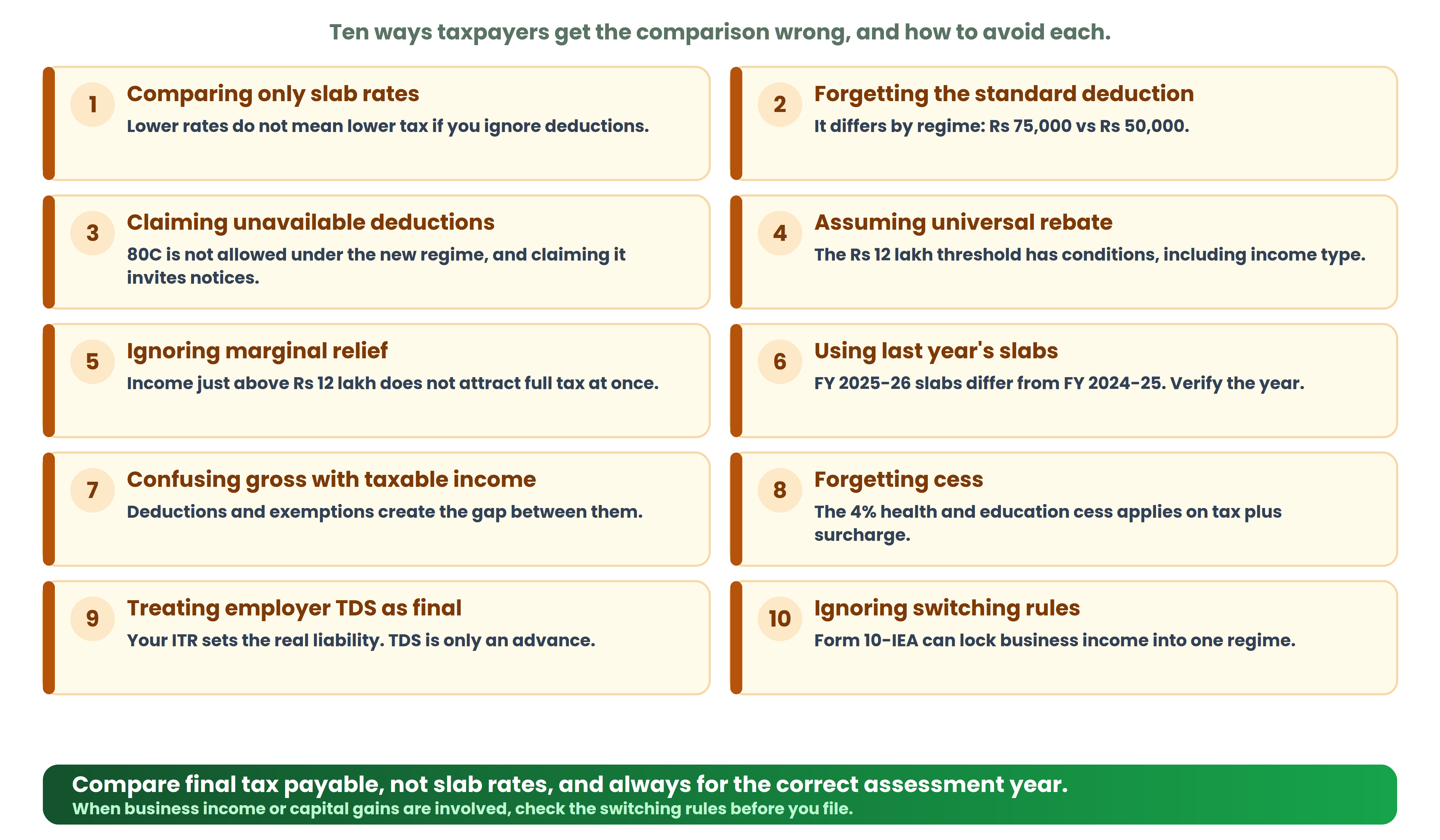
- Comparing only slab rates. Lower rates do not mean lower tax if you ignore deductions that reduce taxable income.
- Forgetting the standard deduction. It differs between regimes (₹75,000 vs ₹50,000).
- Claiming unavailable deductions. Section 80C is not available under the new regime, and claiming it creates notices.
- Assuming universal rebate eligibility. The ₹12 lakh threshold has conditions, including income type.
- Ignoring marginal relief. Income slightly above ₹12 lakh does not suddenly attract full tax.
- Using last year's slabs. FY 2025-26 slabs differ from FY 2024-25. Verify the year.
- Confusing gross salary with taxable income. Deductions and exemptions create the gap between them.
- Forgetting cess. The 4% health and education cess applies on tax plus surcharge.
- Relying on employer TDS as final. Your ITR determines the actual liability; TDS is an advance collection.
- Ignoring business switching rules. Form 10-IEA restrictions can lock you into a regime.
Frequently Asked Questions
Which is the default tax regime for FY 2025-26?
The new tax regime is the default for all taxpayers from FY 2023-24 onward. If you do not actively choose the old regime while filing your ITR (or file Form 10-IEA where you have business income), your income is assessed under the new regime for AY 2026-27.
What is the income tax limit for the new regime in FY 2025-26?
The basic exemption limit is ₹4,00,000 (the nil-rate slab). Separately, the Section 87A rebate can reduce tax to nil for eligible total income up to ₹12,00,000.
Is income up to ₹12 lakh tax-free under the new regime?
For resident individuals with only ordinary income up to ₹12 lakh, the Section 87A rebate can make the tax effectively nil. It does not apply to specified special-rate income such as certain capital gains, and the rebate has eligibility conditions.
What is the standard deduction under the new and old tax regimes?
₹75,000 under the new regime and ₹50,000 under the old regime. Both apply to salaried individuals and pensioners.
Can I claim Section 80C deductions under the new tax regime?
No. Section 80C deductions (PPF, ELSS, life insurance, and similar) are not available under the new regime. They remain available under the old regime.
Can I claim HRA under the new tax regime?
No. HRA exemption is not available under the new regime. It remains available under the old regime for eligible salaried individuals who pay rent.
Which regime is better if I have a home loan?
It depends on your interest amount, income level and other deductions. The old regime allows up to ₹2,00,000 on self-occupied property interest under Section 24(b). Calculate both sides with your actual figures.
Can salaried employees change their tax regime every year?
Yes. Salaried employees without business or professional income can generally choose their regime each year when filing the ITR for that assessment year.
Does the old tax regime still apply for AY 2026-27?
Yes. The old regime remains available. Eligible taxpayers can opt into it, subject to applicable filing rules and deadlines.
Final Takeaway: Compare Your Actual Tax Liability
The New Tax Regime vs Old Tax Regime decision for FY 2025-26 (AY 2026-27) comes down to slab rates versus deductions. Neither is universally better. Your actual liability depends on your income composition, eligible deductions and rebate qualification. Calculate your tax under both using your real figures, validate it against the Income Tax Department's official calculator, and if your situation involves business income, capital gains or complex deductions, consider a qualified professional before filing.
Keep your books ready for tax season
ProfitBooks helps small business owners keep income, expenses and records organized all year, so gathering the figures to compare tax regimes takes minutes, not days.