Advance tax for small businesses and professionals (Tax Year 2026–27): due dates, calculation and interest
On this page 41 sections
Last verified: 27 October 2026, against the Income-tax Act, 2025 and current Income Tax Department guidance. Rates and provisions change by Finance Act and notification, so confirm the position for your facts before paying.
This is general information on advance tax under the Income-tax Act, 2025 as of 27 October 2026, not individualized tax advice. The worked examples are illustrative, use the Tax Year 2026-27 new-regime slab rates, and exclude surcharge and case-specific adjustments. Confirm the current rates, your taxpayer category, and your own figures, and refer to the official Income Tax Department resources or a qualified tax professional before relying on any calculation.
On this page
Many small business owners and freelancers earn income through the year and assume the income tax can be settled in one go when they file their return. For most, it cannot. The law expects the tax to be paid as the income is earned, in instalments, through advance tax.
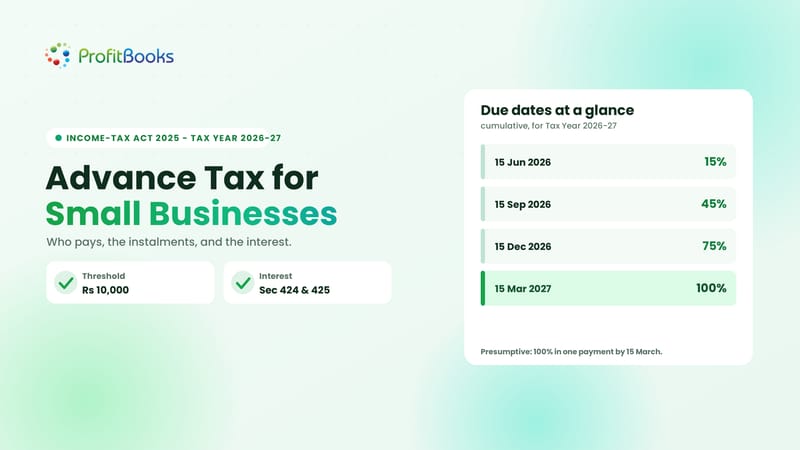
Under the Income-tax Act, 2025, any taxpayer whose estimated tax liability for Tax Year 2026-27, after reducing TDS and TCS credits, is ₹10,000 or more must generally pay advance tax. Regular taxpayers pay in four cumulative instalments: 15% by 15 June, 45% by 15 September, 75% by 15 December, and 100% by 15 March. Qualifying presumptive taxpayers pay 100% in a single instalment by 15 March. Paying late or short can attract interest under Sections 424 and 425.
Tax Year 2026-27 falls under the Income-tax Act, 2025, which replaces the older “assessment year” framework with the tax year concept. This guide uses the current terminology and section numbers, and shows the calculation transparently so you can apply it to your own figures. For the primary keyword in plain terms, this is advance tax for small businesses and professionals, explained for the current law.
What Is Advance Tax and Why Does It Matter?
How advance tax works
Advance tax is income tax paid during the tax year based on your estimated annual liability, so the government collects revenue through the year rather than only at return filing. It is the same income tax you would owe anyway, not a separate levy: you estimate your total taxable income, calculate the tax, subtract TDS and TCS credits, and pay the remaining amount in instalments.
Advance tax vs TDS vs self-assessment tax
These are three different ways of meeting the same annual liability, not three taxes on the same income. They stack as credits, they do not multiply.
| Tax payment | Meaning |
|---|---|
| Advance tax | Tax paid during the tax year against your estimated liability, in instalments |
| TDS / TCS | Tax deducted or collected at source by the payer under the applicable provisions |
| Self-assessment tax | Balance tax paid when computing the final liability, before filing the return |
Who Must Pay Advance Tax in Tax Year 2026-27?

The Rs 10,000 threshold
Section 403 of the Income-tax Act, 2025 charges advance tax on current income, and Section 404 sets the trigger: advance tax is payable where the estimated tax for the year is ₹10,000 or more after reducing expected TDS and TCS. The figure is estimated tax liability, not turnover and not gross receipts. A business with ₹50 lakh of revenue can owe no advance tax if expenses, deductions, and TDS bring the net below ₹10,000, while a freelancer with modest receipts and little TDS can owe a meaningful amount.
Which taxpayers may need to pay?
The obligation is not created by legal form; it is created by the estimated liability crossing the threshold. Sole proprietors, freelancers and consultants, independent professionals, partnership firms and LLPs, and companies all fall within scope if they cross it. What differs by taxpayer type is the computation and the applicable rates: individual slab rates, firm rates, and corporate rates are not interchangeable.
Who is exempt?
A resident senior citizen (aged 60 or above) who has no income chargeable under “Profits and Gains of Business or Profession” is generally not required to pay advance tax. The exemption is tied to the absence of business or professional income, not to age alone, so a 62-year-old running a consulting practice still has the obligation.
| Taxpayer category | Advance tax applicable? | Key condition |
|---|---|---|
| Sole proprietor | Yes, if liability is ₹10,000 or more | Assessed after TDS/TCS credits |
| Freelancer or consultant | Yes, if liability is ₹10,000 or more | TDS may not cover the full liability |
| Partnership firm or LLP | Yes, if liability is ₹10,000 or more | Firm-level rates apply |
| Company | Yes, if liability is ₹10,000 or more | Corporate tax rates apply |
| Resident senior citizen (60+), no business income | Generally exempt | Must have no business or professional income |
Advance Tax Due Dates for Tax Year 2026-27
Section 408 sets the schedule. The percentages are cumulative, not amounts for each quarter on their own.
| Due date | Cumulative amount payable |
|---|---|
| 15 June 2026 | At least 15% |
| 15 September 2026 | At least 45% |
| 15 December 2026 | At least 75% |
| 15 March 2027 | 100% |
How the instalment schedule works
Because the targets are cumulative, each date tops up the running total. On an estimated advance tax of ₹1,00,000:
| Due date | Cumulative amount | Additional amount due |
|---|---|---|
| 15 June | ₹15,000 | ₹15,000 |
| 15 September | ₹45,000 | ₹30,000 |
| 15 December | ₹75,000 | ₹30,000 |
| 15 March | ₹1,00,000 | ₹25,000 |
What if an instalment date has already passed?
This guide is being read in late 2026, so the 15 June and 15 September instalments for Tax Year 2026-27 have already passed. If you have not been paying, assess your current estimated liability and the cumulative shortfall now, and clear it with the next instalment rather than waiting, because interest accrues on the gap.
Can you pay after 15 March?
Advance tax paid between 16 March and 31 March is still treated as advance tax for the year, but paying after 15 March does not undo a missed 15 March target, and interest under Section 425 can still apply for the instalment shortfall. The scheduled final instalment and a late top-up are not the same thing.
How to Calculate Advance Tax
The most common mistake is treating revenue as profit. A business collecting money is taxed on its taxable income, not its receipts, so the calculation runs in five steps.
Step 1: Estimate your total income
Add up income across all heads for the year: business or professional profit, any salary, interest, rent, capital gains, and other taxable income.
Step 2: Calculate taxable income
Apply allowable expenses, eligible deductions, and set-offs to reach taxable income. Accounting profit, turnover, and taxable income are not the same figure. Which deductions are available depends on the tax regime you choose, since the new regime allows fewer deductions than the old one.
Step 3: Calculate income tax
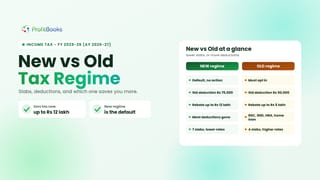
Apply the rates for your taxpayer type and regime, then add any surcharge (for higher incomes) and the 4% health and education cess, and reduce by any eligible rebate. Under the new regime for Tax Year 2026-27, the slab rates are: nil up to ₹4 lakh, 5% from ₹4 to 8 lakh, 10% from ₹8 to 12 lakh, 15% from ₹12 to 16 lakh, 20% from ₹16 to 20 lakh, 25% from ₹20 to 24 lakh, and 30% above ₹24 lakh, with a rebate that makes taxable income up to ₹12 lakh effectively tax-free. Confirm the current rates before relying on them.
Step 4: Subtract relevant TDS/TCS and other credits
Reduce the estimated tax by the TDS and TCS already deducted or collected, and any other eligible credits. What remains is your advance tax liability for the year.
Step 5: Calculate the instalments
Apply the cumulative percentages (15%, 45%, 75%, 100%) to that advance tax liability to get each instalment target.
Worked example (illustrative): an individual sole proprietor under the new regime for Tax Year 2026-27. Figures are rounded and exclude surcharge; confirm your own numbers and the current rates.
| Item | Amount |
|---|---|
| Estimated business profit | ₹14,00,000 |
| Interest income | ₹60,000 |
| Total estimated income | ₹14,60,000 |
| Taxable income (new regime, no deductions claimed) | ₹14,60,000 |
| Tax: nil to ₹4L | ₹0 |
| Tax: ₹4L to 8L at 5% | ₹20,000 |
| Tax: ₹8L to 12L at 10% | ₹40,000 |
| Tax: ₹12L to 14.6L at 15% | ₹39,000 |
| Tax before cess | ₹99,000 |
| Health and education cess (4%) | ₹3,960 |
| Total estimated tax | ₹1,02,960 |
| Less: expected TDS | ₹42,000 |
| Advance tax liability | ₹60,960 |
The instalments on ₹60,960:
| Due date | Cumulative target | Amount due |
|---|---|---|
| 15 June | ₹9,144 | ₹9,144 |
| 15 September | ₹27,432 | ₹18,288 |
| 15 December | ₹45,720 | ₹18,288 |
| 15 March | ₹60,960 | ₹15,240 |
Firms and companies use different rates, so do not apply individual slab rates to a partnership firm or a private company; run each taxpayer type on its own rules.
Advance Tax for Freelancers and Professionals
How to estimate income when earnings vary
Irregular income makes estimation harder, not optional. Build a reasonable annual estimate from confirmed contracts, recurring retainers, completed and invoiced work, expected renewals, and recurring business expenses, and revise it as the year unfolds.
How TDS affects advance tax
Clients often deduct TDS on professional fees, which reduces the remaining advance tax but rarely eliminates it: if the total estimated tax exceeds the TDS, the balance is still payable as advance tax. The practical trap is over-relying on expected TDS. A client may deduct late, use an incorrect PAN, or report in a later quarter, so the credit may not appear in Form 26AS or the AIS when you expect it. Reconcile against the TDS actually credited rather than the TDS you assume.
What if you receive unexpected income?
If a large project or receipt lands mid-year, revise the annual estimate and adjust the remaining instalments to reflect the higher liability. The law expects you to reforecast, and the later instalments should carry the catch-up.
Advance Tax Under Presumptive Taxation
What is presumptive taxation?
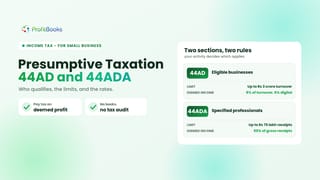
Under the presumptive provisions (Section 58 of the Income-tax Act, 2025, covering the schemes previously known as 44AD, 44ADA, and 44AE), eligible taxpayers compute income at a prescribed percentage of turnover or gross receipts instead of maintaining detailed books and claiming actual expenses. It does not tax the whole turnover: an eligible business computes presumptive income at a prescribed percentage (for example 8%, or 6% for qualifying digital receipts), not at 100%.
Advance tax due date for eligible presumptive taxpayers
Under Section 408(2), a qualifying presumptive taxpayer pays 100% of the advance tax in a single instalment by 15 March, with no quarterly instalments. Paying even a little later, by 31 March, can still attract a short spell of Section 425 interest.
Worked example (illustrative)
An eligible professional under the new regime, figures rounded and excluding surcharge:
| Item | Amount |
|---|---|
| Gross professional receipts | ₹40,00,000 |
| Presumptive income (50%) | ₹20,00,000 |
| Tax: ₹4L to 8L at 5% | ₹20,000 |
| Tax: ₹8L to 12L at 10% | ₹40,000 |
| Tax: ₹12L to 16L at 15% | ₹60,000 |
| Tax: ₹16L to 20L at 20% | ₹80,000 |
| Tax before cess | ₹2,00,000 |
| Health and education cess (4%) | ₹8,000 |
| Total tax | ₹2,08,000 |
| Less: TDS credits | ₹1,80,000 |
| Advance tax payable by 15 March | ₹28,000 |
Regular vs presumptive schedule
| Feature | Regular taxpayer | Qualifying presumptive taxpayer |
|---|---|---|
| Instalments | Four (June, September, December, March) | One (March) |
| Cumulative targets | 15%, 45%, 75%, 100% | 100% by 15 March |
| Books of account | Required | Generally not required (conditions apply) |
Not every freelancer or business qualifies. Eligibility depends on the activity, the turnover or receipts thresholds, the digital-receipt conditions, and the filing history, and presumptive taxation is not automatically beneficial because it limits the ability to claim actual expenses. Verify the applicable scheme and thresholds before relying on it.
Interest on Advance Tax: Sections 424 and 425
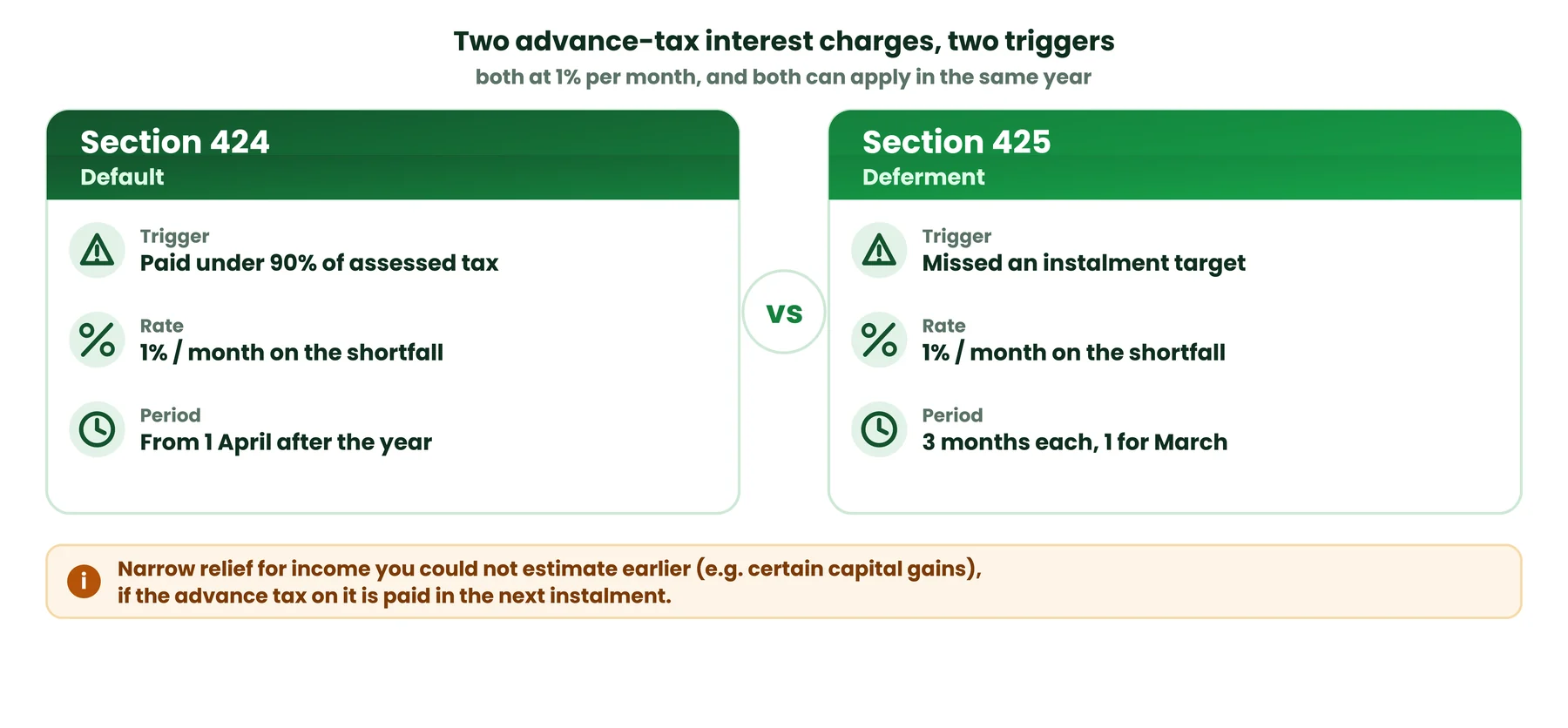
Two different provisions with two different triggers, which is where most of the confusion starts. Both charge interest at 1% per month (or part of a month), and both can apply to the same taxpayer in the same year.
Section 424: interest for default
Section 424 (the provision that replaced Section 234B) applies when the total advance tax paid is less than 90% of the assessed tax. Interest runs at 1% per month on the shortfall, from 1 April after the tax year ends until the tax is paid or assessed.
Example (illustrative): assessed tax ₹1,50,000; total advance tax paid ₹1,20,000, which is 80%, below the 90% threshold. The shortfall is ₹1,50,000 minus ₹1,20,000 = ₹30,000. If the tax is settled five months into the next year, interest is ₹30,000 × 1% × 5 = ₹1,500.
Section 425: interest for deferment
Section 425 (which replaced Section 234C) applies when you miss a cumulative instalment target. Interest is 1% per month on the instalment shortfall, generally for three months per missed instalment and one month for the 15 March instalment. For the first two instalments, a tolerance applies: if you have paid at least 12% by 15 June and 36% by 15 September, no deferment interest arises for those instalments even though the targets are 15% and 45%.
| Instalment | Cumulative target | Tolerance (no interest if paid) | Interest period if short |
|---|---|---|---|
| 15 June | 15% | At least 12% | 3 months |
| 15 September | 45% | At least 36% | 3 months |
| 15 December | 75% | Full 75% | 3 months |
| 15 March | 100% | Full 100% | 1 month |
Example (illustrative): estimated liability ₹1,00,000, nothing paid by 15 June. The June shortfall is 15% = ₹15,000, so interest is ₹15,000 × 1% × 3 = ₹450.
Exceptions for certain income
For income that could not reasonably be estimated earlier, such as certain capital gains, dividends, or income from a business or profession started during the year, the law provides that if the advance tax on that income is paid in the instalment immediately following its receipt, deferment interest may not apply to it. This is a narrow relief with conditions, not a blanket exemption for every unexpected receipt.
How to Pay Advance Tax Online
Step-by-step payment process
Pay through the official Income Tax e-Filing Portal using e-Pay Tax. In outline: sign in or enter your PAN, open e-Pay Tax, select the correct tax year and the advance tax payment category, enter the amount, complete the payment by net banking, UPI, or another available method, and save the challan and the CIN. Confirm the current screens on the portal, since the interface changes.
How to verify the payment
A payment receipt is not the same as a correctly credited payment. Selecting the wrong tax year or payment category is a common mistake that creates reconciliation work, so retain the bank debit proof and the challan acknowledgement until the credit appears against your PAN in Form 26AS, and match the challan to your records.
Accounting Entries for Advance Tax
How to record advance tax paid
For a company, advance tax paid is recorded as an asset: debit Advance Tax (asset), credit Bank, and it is later set against the final tax liability. The exact entry depends on the entity and its chart of accounts.
Is advance tax a deductible business expense?
No, income tax is not an ordinary deductible operating expense. For a company, income tax is a charge against profit, carried as an asset when paid in advance and settled against the year's liability, not a business expense that reduces taxable profit. For a sole proprietor, the income tax is a personal liability of the owner rather than a business expense at all. Treat the two cases differently.
Reconciling payments with accounting records
Match each advance tax challan to the corresponding bank debit and to your books, so the amounts, dates, and tax year line up. If you track invoices, expenses, and bank transactions in ProfitBooks, reconciling the challans against bank debits during your monthly close helps catch a wrong tax year or a missing credit before it compounds at year-end.
Common Advance Tax Mistakes
- Confusing turnover with taxable income. Estimate tax on profit after expenses and deductions, not on receipts.
- Ignoring TDS and TCS. Reduce the estimated tax by credits actually available, and reconcile against Form 26AS.
- Using the wrong rates or old terminology. Use Tax Year 2026-27 rates and the Income-tax Act, 2025 sections, not old assessment-year figures.
- Misreading cumulative instalments. The 15/45/75/100 targets are running totals, not separate quarterly amounts.
- Assuming presumptive taxation applies. Check eligibility; it is not available to everyone.
- Not revising the estimate. Update the forecast and later instalments when income changes materially.
- Ignoring interest. Check the Section 424 and 425 exposure before final settlement.
- Not retaining challans. Keep every challan and CIN and reconcile them with your books.
Advance Tax Checklist for 2026-27
- Estimate total taxable income, not turnover.
- Identify the correct taxpayer category and tax regime.
- Calculate the estimated tax using the applicable rates.
- Account for relevant TDS/TCS and other credits.
- Check whether the liability reaches the ₹10,000 threshold.
- Confirm the applicable schedule: four instalments, or single by 15 March for presumptive.
- Review any missed instalments and the potential interest.
- Pay through the official portal using the correct tax year.
- Save the challans and reconcile the payments with your bank records.
- Update the estimate if income changes materially.
Frequently Asked Questions
Is advance tax mandatory for small businesses?
Only when the estimated tax liability after TDS and TCS credits reaches ₹10,000 or more for the tax year, under Section 404. The obligation is tied to the net estimated tax payable, not to registration, turnover, or headcount, so a business with high expenses and sufficient TDS can fall below the threshold.
What are the advance tax due dates for 2026-27?
15 June (15%), 15 September (45%), 15 December (75%), and 15 March (100%). The percentages are cumulative. Qualifying presumptive taxpayers instead pay 100% by 15 March in a single instalment.
Can freelancers pay advance tax quarterly?
Yes. Freelancers and professionals who are not under the presumptive scheme follow the same four cumulative instalments as other regular taxpayers. Those covered by the presumptive provisions pay once, by 15 March.
Do presumptive taxpayers pay advance tax every quarter?
No. Under Section 408(2), a qualifying presumptive taxpayer pays the full advance tax by 15 March in a single instalment, with no June, September, or December instalments.
Is advance tax calculated on turnover or profit?
On taxable income, which is profit after allowable expenses, deductions, and adjustments, not on gross receipts. A business with high turnover but high expenses pays tax on the net figure.
What happens if I miss an advance tax instalment?
Section 425 interest can apply at 1% per month on the instalment shortfall, generally for three months (one month for the 15 March instalment). Calculate the cumulative shortfall and clear it as soon as possible to limit the interest.
Can I pay advance tax after 15 March?
Tax paid between 16 March and 31 March still counts as advance tax for the year, but it does not undo a missed 15 March target, and Section 425 interest can still apply for the shortfall.
What if TDS already covers part of my tax?
TDS reduces the remaining liability. If the total estimated tax still exceeds the TDS credited, the balance is payable as advance tax. Reconcile against the TDS actually credited in Form 26AS, not the TDS you expect.
What is the difference between Sections 424 and 425?
Section 424 addresses the overall shortfall, where total advance tax paid is less than 90% of the assessed tax. Section 425 addresses instalment-level deferment, where you miss an individual cumulative target. Both can apply to the same taxpayer in the same year.
Conclusion
Advance tax under the Income-tax Act, 2025 comes down to a few points: it is based on your estimated tax liability, not your turnover; the ₹10,000 threshold is checked after TDS and TCS; the 15/45/75/100 instalment targets are cumulative; qualifying presumptive taxpayers pay once by 15 March; and interest under Sections 424 and 425 applies when the overall or instalment requirements are not met.
With the June and September instalments for Tax Year 2026-27 already behind us, the useful next step is a short review: estimate your taxable income for the year, check how much TDS has actually been credited, and compare your cumulative advance tax paid against the target for the next deadline, so any shortfall is cleared before it grows.
Disclaimer: This article is general information as of 27 October 2026 and is not individualized tax advice. Advance tax rates, thresholds, and provisions change by Finance Act and notification. Confirm the current statutory position and your own figures with a qualified tax professional before paying.
Keep your tax records ready through the year
ProfitBooks helps small businesses track income, expenses, and bank transactions with an audit trail, so estimating advance tax and reconciling challans against bank debits is a routine check rather than a year-end scramble.