

Your transactions are recorded. The invoices went out, the payments came in, rent was paid, and salaries were debited. But before any of that feeds into your financial statements, there is a basic question: do the numbers in your ledger actually agree with each other? That is the problem a trial balance solves.
This article covers the format, a fully reconciled worked example, the step-by-step preparation, the types of trial balance, the errors it can and cannot catch, and how to investigate when the columns do not match.
A trial balance is a statement listing the balances of all ledger accounts, arranged in debit and credit columns, as of a specific date. It checks whether total debits equal total credits. It helps identify certain bookkeeping errors, but a balanced trial balance does not guarantee that every transaction is correct.
Here is the whole idea before the detail.
- It lists every ledger account’s closing balance in a debit or a credit column on a chosen date.
- Total debits should equal total credits, because double-entry records equal debits and credits for every transaction.
- It catches some errors (one-sided postings, wrong totals, a figure in the wrong column) but not others.
- A balanced trial balance is necessary, not sufficient. The books can still be wrong while the columns agree.
- It is a working tool that feeds the balance sheet and profit and loss statement, not a financial statement itself.
What is a trial balance in accounting?
The mechanism is straightforward. In double-entry bookkeeping, every transaction posts equal amounts to a debit side and a credit side. Buy equipment for ₹50,000 in cash, and the equipment account receives a ₹50,000 debit while cash receives a ₹50,000 credit. If every transaction follows this rule, the sum of all debit balances across every ledger account should equal the sum of all credit balances.
The trial balance extracts those closing balances and tests that equality. Transactions flow from journals to ledger accounts, and the trial balance sits at the end of that chain, pulling each account’s net position into a single schedule.
Why is a trial balance prepared?
Three practical reasons. First, it confirms debit and credit agreement across the general ledger. Second, when the totals do not match, it gives you a starting point for tracking down arithmetic or posting mistakes. Third, it provides the working schedule from which you review accounts before preparing financial statements.
It does none of those things perfectly. A trial balance will not catch every error, and it will not tell you whether transactions were recorded in the right accounts. More on that below.

Who should care about this (and who shouldn’t)
If you run a small business, manage the books yourself, or work with a part-time bookkeeper, understanding the trial balance matters. It is the checkpoint between “transactions are entered” and “reports are reliable.” Owners who rely on a full-time accountant or CA firm may never prepare one manually, but knowing what it tests, and what it does not, helps you ask better questions when reviewing monthly reports.
If you want step-by-step guidance on posting entries or setting up your books, start with the accounting workflow for a small business instead. The trial balance assumes those entries are already posted.
Trial balance format with an example
A trial balance has a heading (business name and reporting date), a list of accounts, and two amount columns. Each account appears once. If the account carries a debit balance, that figure goes in the debit column. Credit balance, credit column. Here is the standard layout for a fictional business, ABC Traders, as at 31 March 2026.
| Account | Debit (₹) | Credit (₹) |
|---|---|---|
| Cash | 10,000 | |
| Bank | 40,000 | |
| Accounts receivable | 20,000 | |
| Inventory | 30,000 | |
| Equipment | 50,000 | |
| Purchases | 60,000 | |
| Rent expense | 12,000 | |
| Salaries expense | 18,000 | |
| Drawings | 10,000 | |
| Accounts payable | 25,000 | |
| Bank loan | 35,000 | |
| Capital | 1,00,000 | |
| Sales | 90,000 | |
| Total | 2,50,000 | 2,50,000 |
Debit column: 10,000 + 40,000 + 20,000 + 30,000 + 50,000 + 60,000 + 12,000 + 18,000 + 10,000 = 2,50,000. Credit column: 25,000 + 35,000 + 1,00,000 + 90,000 = 2,50,000. The totals agree.
Which accounts normally carry debit or credit balances?
| Account category | Usual balance |
|---|---|
| Assets (cash, bank, receivables, inventory, equipment) | Debit |
| Expenses (purchases, rent, salaries) | Debit |
| Drawings (owner withdrawals) | Debit |
| Liabilities (payables, loans) | Credit |
| Owner’s capital or equity | Credit |
| Income and revenue (sales) | Credit |
These are patterns, not rules you apply blindly. The balance comes from the ledger, and unusual circumstances (a customer’s credit balance from an overpayment, for instance) can flip the expected side. Always check the underlying ledger rather than assuming.
How to prepare a trial balance step by step
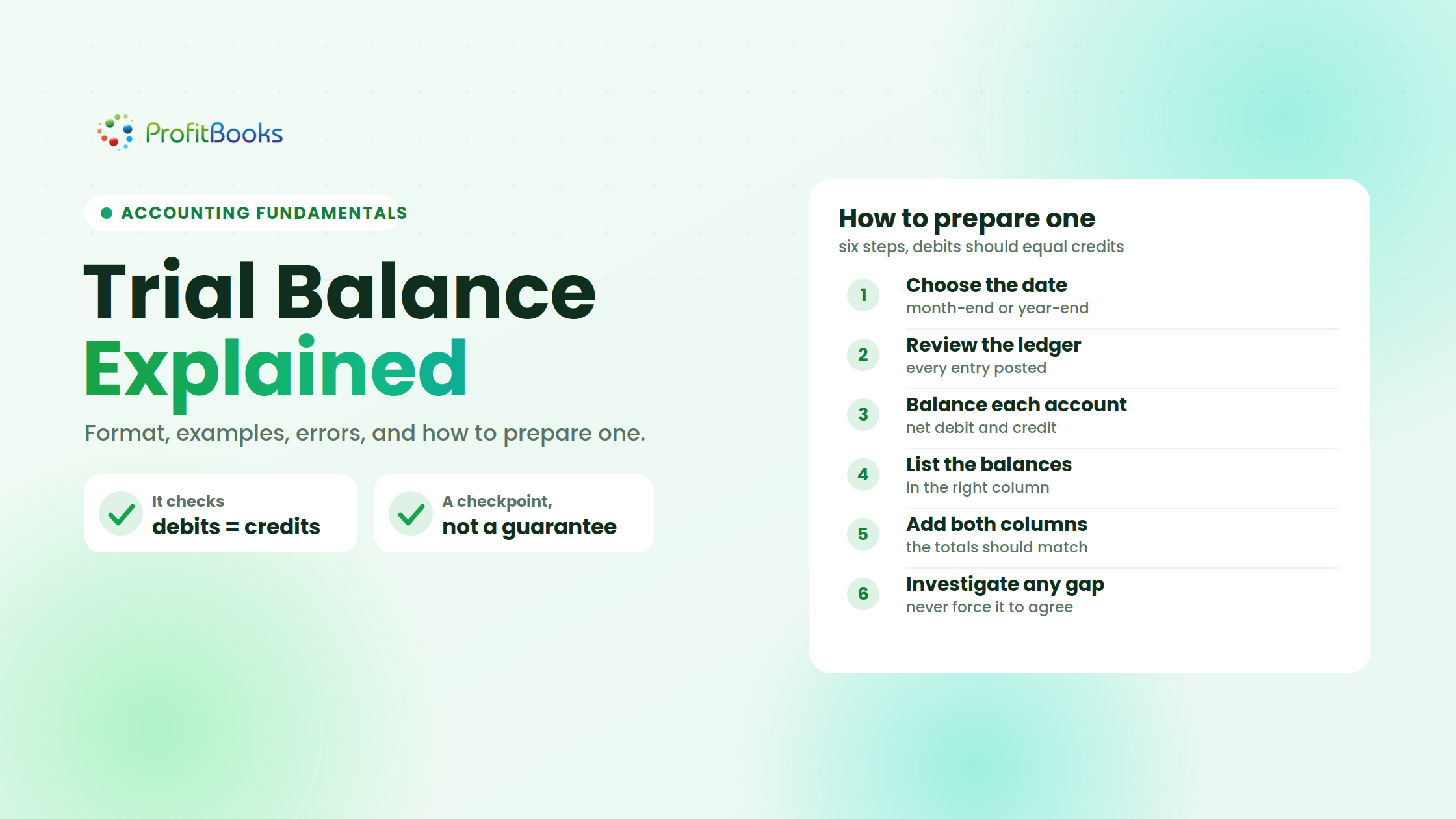
Preparing a trial balance by hand is a short, ordered workflow. Follow these six steps in sequence.
1Choose the reporting date
A trial balance shows account balances as of a specific date, usually month-end or year-end. Fix that date first, because every balance you extract must be as of the same moment.
2Review the ledger entries
Make sure every relevant transaction for the period has been recorded and posted to its account. Balances extracted from an incomplete ledger will not reflect the real position.
3Calculate each ledger account’s balance
For every account, total the debit side and the credit side, then take the difference. That net figure is the account’s closing balance, carrying the side (debit or credit) that is larger.
4List the ledger balances
Write each account into the trial balance and place its closing balance in the matching column, debit balances on the left, credit balances on the right. Follow your system’s convention for zero-balance accounts.
5Add both columns
Total the debit column and the credit column. When the double-entry records have been posted correctly and the balances extracted correctly, the two totals should be equal.
6Investigate any difference
If the totals do not match, review the arithmetic, the source ledger balances, the postings, and the column placement. Never insert an unexplained adjustment just to force the totals to agree.
The formula is simple: total debits should equal total credits. The work is in extracting each balance correctly and placing it in the right column.
How a trial balance actually works
The trial balance is not a financial statement. It is a diagnostic tool. The constraint it tests is narrow: did every debit find a matching credit, and were the amounts extracted correctly? That narrow test is useful precisely because it is fast. You can spot a one-sided posting or an arithmetic slip before it contaminates your profit and loss statement or balance sheet.
But here is where published guidance and daily practice diverge. The ICAI’s study materials and most textbooks describe the trial balance as a verification step. In practice, especially in small businesses using accounting software, the trial balance often balances automatically because the software enforces double entry. The real problem is not getting the totals to match. It is that the totals match while transactions sit in the wrong accounts, opening balances carry forward incorrectly, or a whole invoice was never recorded.
Retained earnings is a frequent failure point. Discussions on accounting forums consistently flag incorrect opening or closing retained earnings as a cause of unexplained differences. A company imports a prior-year balance sheet, duplicates equity, or omits a historical liability, and the trial balance still balances because the error was posted to both sides.
The gap between “the columns agree” and “the books are correct” is the single most important thing to understand about a trial balance.

The worked example, explained
Using the ABC Traders table above, here is what the numbers tell us and what they do not. Cash (₹10,000), bank (₹40,000), receivables (₹20,000), inventory (₹30,000), and equipment (₹50,000) are debit balances that represent what the business owns or is owed. Purchases (₹60,000), rent (₹12,000), salaries (₹18,000), and drawings (₹10,000) are debit balances because they represent outflows or reductions in equity.
On the credit side, accounts payable (₹25,000) and the bank loan (₹35,000) are obligations. Capital (₹1,00,000) is the owner’s investment. Sales (₹90,000) is revenue earned.
The matching totals of ₹2,50,000 confirm debit and credit agreement. They do not confirm that every sale was invoiced, that purchases were coded to the right account, or that the inventory figure reflects actual stock on hand. You cannot calculate net profit from this trial balance alone without closing adjustments for inventory, accruals, and depreciation. This example assumes the listed balances are extracted ledger balances before any period-end adjustments.
What are the different types of trial balance?
| Type | When it is prepared | Purpose | Typical accounts shown |
|---|---|---|---|
| Unadjusted | Before period-end adjustments | Review raw ledger balances | All accounts with balances |
| Adjusted | After adjusting journal entries | Confirm balances after accruals, depreciation, prepayments | All accounts, updated |
| Post-closing | After closing entries | Verify only permanent accounts remain | Assets, liabilities, equity only |
The unadjusted trial balance is your first look. The adjusted version reflects accrued expenses, depreciation, and similar entries. The post-closing version shows what carries forward into the next period after temporary accounts (revenue and expenses) have been closed into equity. An adjusted trial balance is not a balance sheet. It still lists every account, including revenue and expenses. The balance sheet is a formal financial statement derived from it.
What errors can a trial balance detect?
An imbalance signals that something went wrong mechanically. These are the error types that usually push the two totals apart.
| Error | Illustration | Effect on trial balance |
|---|---|---|
| One-sided posting | Debit recorded, credit omitted | Totals differ by the omitted amount |
| Unequal posting | ₹5,000 debit, ₹4,500 credit | Totals differ by ₹500 |
| Wrong balance calculation | Ledger balance added incorrectly | Totals differ by the calculation error |
| Balance in wrong column | A ₹3,000 debit placed in the credit column | Totals differ by twice the balance |
| Omitted account | A ledger balance left off the schedule | Totals differ by the missing balance |
Whether a specific error causes a mismatch depends on the exact mistake. A posting error that affects both sides equally will not show up here.
Errors a trial balance cannot detect
This is the section that matters most. Several errors leave total debits equal to total credits, so the trial balance stays balanced while the books are wrong.
| Error type | What happened | Why the trial balance still balances |
|---|---|---|
| Complete omission | Transaction never recorded at all | No debit or credit exists, so nothing is missing from either column |
| Error of commission | ₹8,000 posted to the wrong customer’s account | The debit total is unchanged |
| Error of principle | Equipment purchase recorded as an expense | Equal debit and credit, just in the wrong category |
| Error of original entry | ₹4,500 recorded as ₹5,400 on both sides | Both columns are equally wrong |
| Complete reversal | Debit and credit accounts swapped | Totals still match |
| Compensating errors | Two separate errors cancel each other out | The net effect on each column is zero |
A balanced trial balance is necessary for a properly maintained double-entry ledger. It is not sufficient evidence that the accounts are correct, a distinction the ICAI’s study materials on accounting principles make clearly, and one worth confirming against a standard definition of the trial balance.
The ghost errors: what forums flag but textbooks skip
Some differences come up again and again in real bookkeeping but get little space in textbooks. These are the practical ones, with the fix for each.
| Symptom | Root cause | The practical fix |
|---|---|---|
| Difference is divisible by 9 | Digit transposition (540 entered as 450) | Recheck original entries; treat divisibility by 9 as a clue, not proof |
| Difference equals current-year profit | Retained earnings or closing entries mishandled | Remove duplicated profit from equity; verify opening retained earnings |
| Cash on trial balance does not match bank | Unreconciled items, timing, duplicate imports | Perform a bank reconciliation; do not force the trial balance to match the statement |
| Suspense account persists across periods | Unknown transaction parked and never resolved | Identify the source, post a correcting entry, clear the suspense balance |
A suspense account can be used temporarily while you investigate a difference. It should never become a permanent parking spot for amounts you cannot explain, and it must not replace finding and correcting the underlying error.
Where practitioners disagree
There is an ongoing debate about whether small businesses using cloud accounting software even need to review a trial balance manually. One position: the software handles double entry, so the trial balance always balances, and reviewing it is a waste of time. The other: automated posting does not prevent wrong account mapping, and the trial balance is the fastest way to spot a ₹2,00,000 equipment purchase sitting in office supplies.
Both positions are defensible. The practical view is the second one. Software calculates correctly, but it does not know whether your chart of accounts is a mess, so a quick trial balance review still earns its place.
Trial balance vs balance sheet vs profit and loss statement
| Report | Main purpose | What it shows |
|---|---|---|
| Trial balance | Check debit and credit agreement | All ledger account balances |
| Balance sheet | Show financial position on a date | Assets, liabilities, and equity |
| Profit and loss statement | Show financial performance over a period | Income, expenses, profit or loss |
The trial balance feeds the other two. It is not a substitute for either. The balance sheet and the profit and loss statement are formal reports derived from the balances the trial balance verifies.
How often should a business prepare a trial balance?
Monthly is common. During year-end close, it is essential. Businesses with high transaction volumes or multiple people entering data benefit from more frequent reviews, because discrepancies are easier to trace when fewer transactions have occurred since the last check. No law mandates a specific frequency. The right cadence depends on your volume, your team, and how quickly you need reliable numbers.
How accounting software changes the workflow
Accounting software maintains the general ledger, calculates account balances automatically, and generates trial balance reports on demand. That removes the manual extraction and addition that cause arithmetic errors in spreadsheet-based bookkeeping. It will not fix a miscoded transaction, but it removes the mechanical work so you can focus on reviewing what the numbers actually say.
Generate a trial balance straight from your ledger
ProfitBooks maintains your ledger and produces Trial Balance, Balance Sheet, and Profit and Loss reports directly from your entries, so the arithmetic is always right and you can focus on reviewing the numbers.
Frequently asked questions about trial balance
What is a trial balance in simple terms?
A trial balance is a list of all your ledger account balances on a specific date, split into debit and credit columns. If the two column totals are equal, your double-entry postings are arithmetically consistent. It is a checkpoint, not a complete audit of your books.
What are the main columns in a trial balance?
The account name, the debit amount, and the credit amount. Some formats add an account number column. Each account appears once, in whichever column matches its closing balance.
Why should total debits equal total credits?
Because double-entry bookkeeping records every transaction as an equal debit and credit. If the totals do not match, at least one posting, calculation, or extraction went wrong somewhere in the ledger.
Can a trial balance balance and still contain errors?
Yes. Errors of omission, commission, principle, original entry, reversal, and compensating errors all leave the totals equal. A balanced trial balance only confirms arithmetic equality, not correctness.
What is the difference between an unadjusted and adjusted trial balance?
The unadjusted version is prepared before period-end adjusting entries. The adjusted version includes accruals, depreciation, and other adjustments. Both should balance, but they show different figures for the affected accounts.
Is a trial balance the same as a balance sheet?
No. A trial balance lists every ledger account and is a working tool. A balance sheet is a formal financial statement showing only assets, liabilities, and equity. The balance sheet is derived from the trial balance.
When should a business prepare a trial balance?
At minimum, before preparing financial statements. Monthly reviews are practical for most small businesses, and more frequent checks help when transaction volume is high or several people post entries.
A trial balance is a checkpoint, not a guarantee
The trial balance confirms one thing: your debits and credits add up to the same number. Everything beyond that, whether transactions are complete, correctly classified, and properly valued, requires review, reconciliation, and professional judgement. Treat it as the starting line for that review, not the finish.
Spend less time on the mechanics, more on the review
Let ProfitBooks handle the ledger maths and report generation, and keep your attention on whether the numbers are telling the right story. Try it free on your own books.