Days Sales Outstanding (DSO): Formula, Example and 8 Ways to Reduce It
On this page 30 sections
Days Sales Outstanding (DSO) measures the average number of days a business takes to collect payment after making credit sales. It is an accounts receivable efficiency metric: it shows how quickly credit sales are converted into cash, which makes it especially relevant for businesses that offer customers credit terms.
By Mohnish Katre, Co-founder, ProfitBooks
Last reviewed: 18 November 2026. Figures are illustrative examples in Indian rupees, not benchmarks for any industry. This is general guidance on accounts receivable and cash flow, not financial advice.
The DSO values and calculations in this article are illustrative, not industry benchmarks. DSO is one measure of collection efficiency, not a complete measure of cash-flow health, and the right method and interpretation depend on your business. Keep receivables and sales figures on a consistent basis and apply the same method when comparing periods.
A distributor books ₹10 lakh of credit sales in a month. On paper the business looks healthy. But 45 or 60 days later, a large part of that money is still sitting with customers, and in the meantime there are suppliers to pay, salaries to run, and operating costs that do not wait. Strong sales and tight cash can exist in the same business at the same time, and the gap between them is collection.
Days Sales Outstanding (DSO) is the metric that measures that gap: the average number of days a business takes to collect payment after making credit sales. Sales do not automatically become available cash, delayed customer payments tie up working capital, and DSO is how you monitor whether collections are keeping pace. This guide covers the DSO formula, a full worked calculation, how to interpret the result, and eight practical ways to reduce it.
What Is Days Sales Outstanding (DSO)?
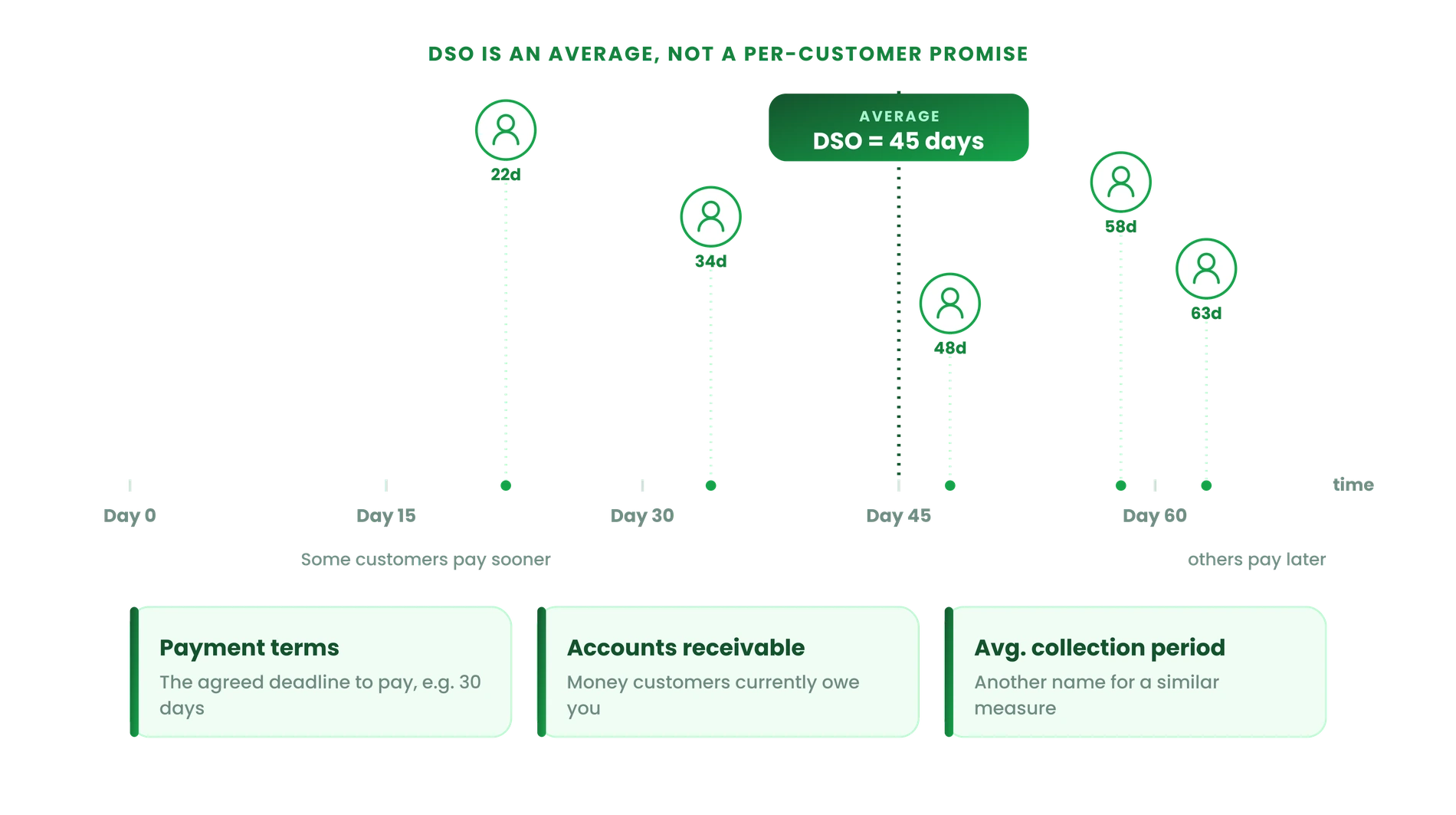
If a business has a DSO of 45 days, it generally takes around 45 days, on average, to collect its credit sales, based on the calculation method and the measurement period used. Tracking DSO over time helps an owner spot changes in collection performance before they become a cash problem.
One thing to be clear about: DSO is an average. A DSO of 45 days does not mean every customer pays within 45 days; some pay early, some pay late, and the average sits in between. A few related terms are worth separating:
- Payment terms: the agreed deadline for a customer to pay, such as 30 days.
- Accounts receivable: the money customers currently owe the business.
- Average collection period: another commonly used term for a similar measurement.
Days Sales Outstanding Formula
The standard DSO formula is:
DSO = (Average Accounts Receivable ÷ Net Credit Sales) × Number of Days
Average Accounts Receivable
Average accounts receivable is the average of the outstanding customer balances during the period:
Average AR = (Opening AR + Closing AR) ÷ 2
Using the average rather than only the closing balance usually gives a more representative picture, because a single month-end figure can be unusually high or low and skew the result.
Net Credit Sales
Net credit sales are the credit sales after accounting for relevant sales returns and allowances, using a consistent definition. Two cautions matter here: do not include cash sales in the denominator when you are using the standard credit-sales method, and do not confuse total revenue with net credit sales. DSO is about money owed on credit, so cash sales do not belong in it.
Number of Days
The number of days should match the measurement period: 30 days for a monthly period, 90 days for a quarterly period, or 365 days for an annual period. Whatever you choose, use the same method consistently when comparing DSO across periods, otherwise the comparison is not like for like.
How to Calculate Days Sales Outstanding: Example
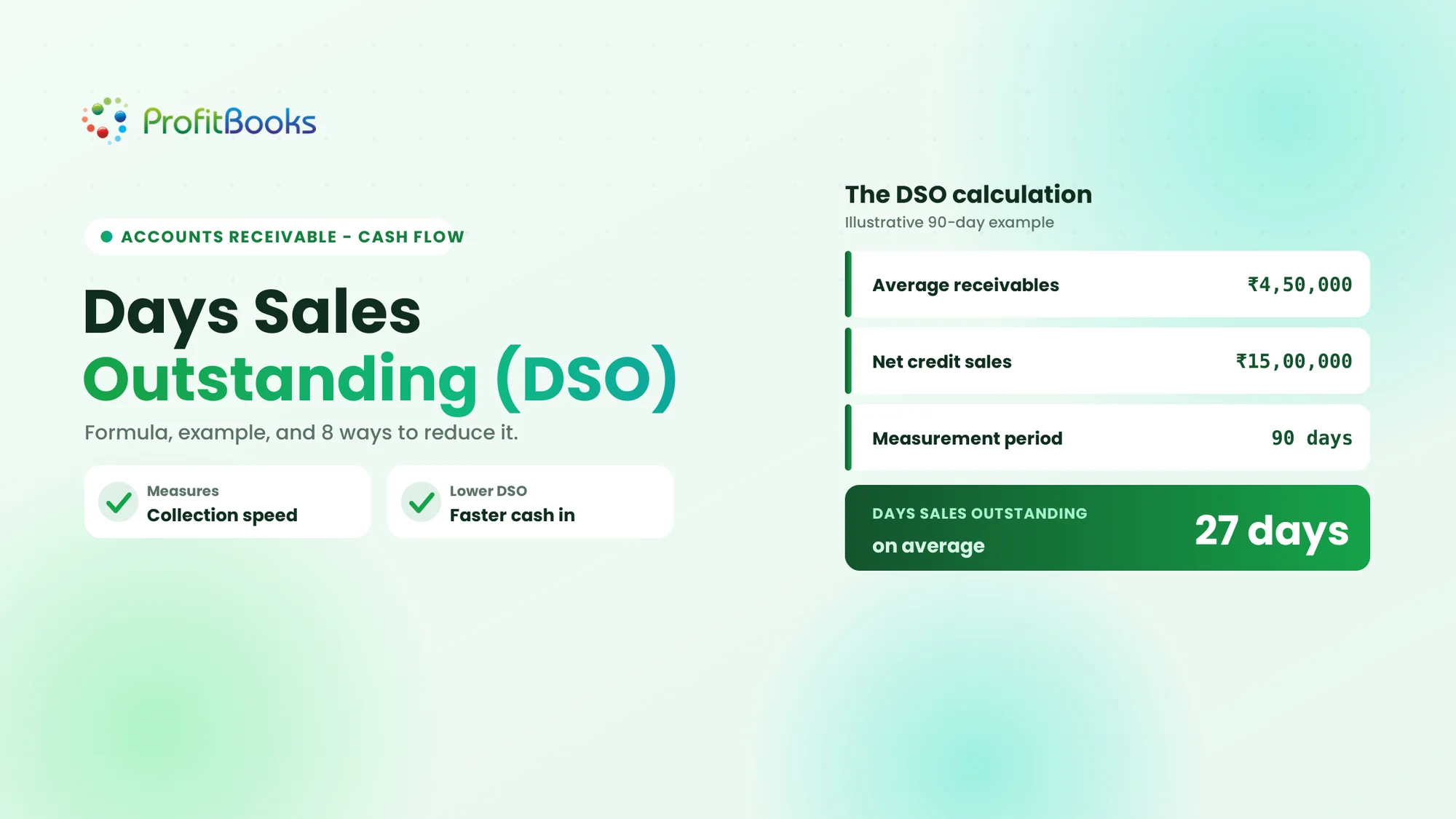
Take a small wholesale business calculating its DSO for a 90-day period:
| Particulars | Amount |
|---|---|
| Opening accounts receivable | ₹4,00,000 |
| Closing accounts receivable | ₹5,00,000 |
| Net credit sales | ₹15,00,000 |
| Measurement period | 90 days |
Step 1. Calculate Average Accounts Receivable
(₹4,00,000 + ₹5,00,000) ÷ 2 = ₹4,50,000
The business had average outstanding receivables of ₹4,50,000 during the period, using the opening-and-closing-balance method.
Step 2. Apply the DSO Formula
DSO = (₹4,50,000 ÷ ₹15,00,000) × 90
Step 3. Interpret the Result
The business takes approximately 27 days to collect its credit sales on average under this calculation. If its standard payment terms are 30 days, 27 days looks reasonable. Even so, the owner should still examine individual overdue invoices and customer payment behaviour, because an aggregate average can hide problems.
A DSO of 27 days does not prove that every customer paid within 30 days. The average can hide overdue balances, so read it alongside the detail of who still owes what.
What Is a Good Days Sales Outstanding (DSO)?
There is no universal ideal DSO that fits every business. What counts as reasonable depends on several things: your customer payment terms, your industry and business model, your customer mix, your credit policies, seasonal sales patterns, and your own historical collection performance.
As an illustration only, not an industry benchmark:
| DSO | Possible interpretation |
|---|---|
| 20 days | Relatively fast collection |
| 30 days | May align with 30-day payment terms |
| 45 days | May indicate slower collection where terms are 30 days |
| 60 days | Could create collection and cash-flow pressure |
| 90 days | May indicate significant delays, depending on the business |
Rather than chasing a single target number, assess DSO by comparing it against meaningful references: your current DSO against previous periods, against your agreed payment terms, against relevant industry benchmarks, and against your own internal collection targets. A DSO is not automatically good just because it is below 30 days, and not automatically bad because it is above.
What Causes High Days Sales Outstanding?
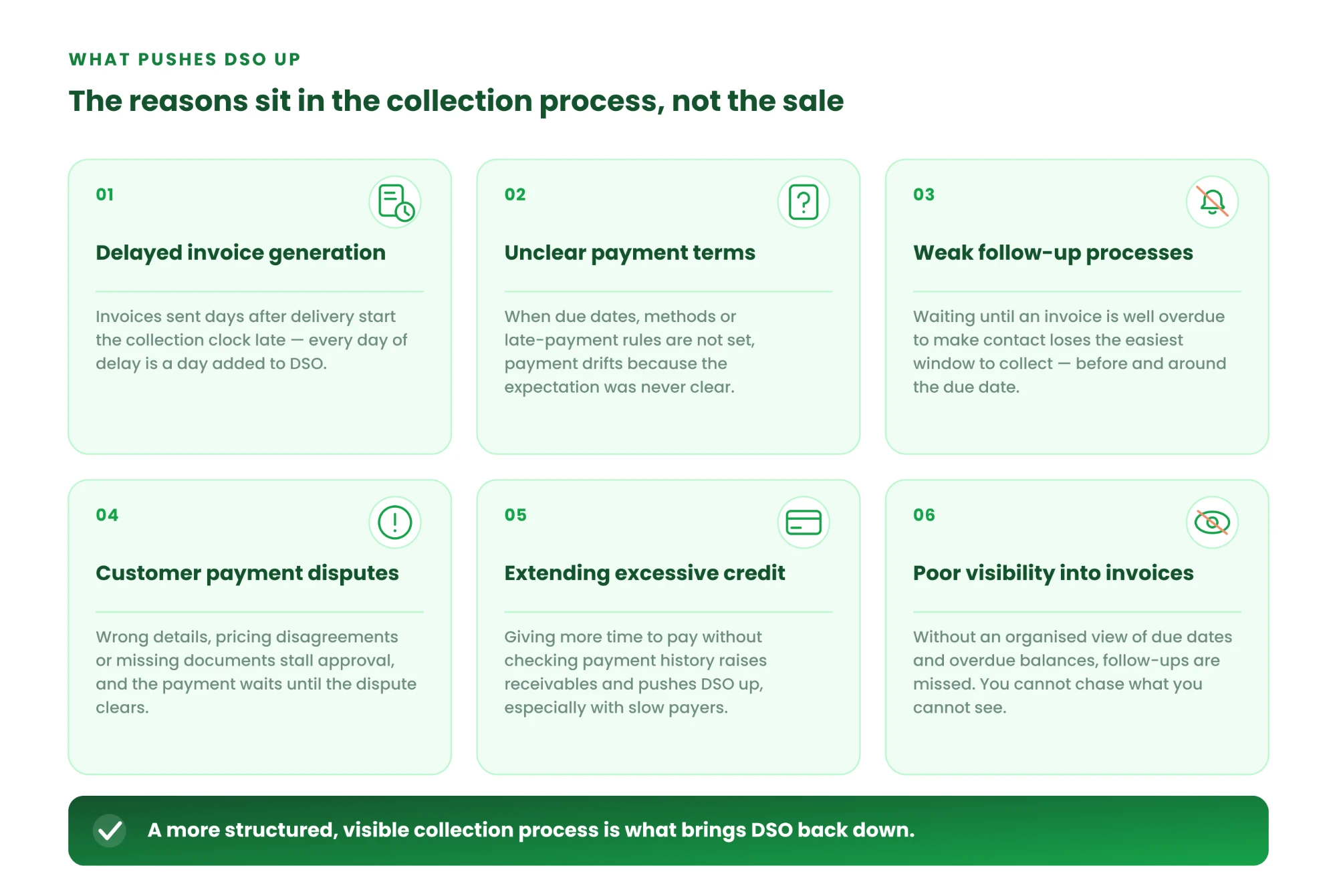
When DSO creeps up, the reasons usually sit in the collection process rather than in the sales.
Delayed invoice generation
If invoices go out days after goods or services are delivered, the collection clock starts late, and every day of delay is a day added to DSO.
Unclear payment terms
When customers are not clear on the due date, the payment methods, or the late-payment conditions, payment drifts simply because the expectation was never set.
Weak follow-up processes
Businesses that wait until an invoice is well overdue before contacting the customer lose the easiest window to collect, which is before and around the due date.
Customer payment disputes
Incorrect invoice details, pricing disagreements, or missing documents stall approval on the customer's side, and the payment waits until the dispute is resolved.
Extending excessive credit
Giving customers more time to pay without reviewing their payment history increases outstanding receivables and pushes DSO up, especially with customers who are already slow.
Poor visibility into outstanding invoices
Without an organised view of due dates and overdue balances, collection opportunities are simply missed. You cannot follow up on what you cannot see. A more structured approach to collection is what brings DSO back down.
8 Ways to Reduce Days Sales Outstanding
1. Send invoices immediately after delivering goods or services
A delay in invoicing postpones the entire collection process. Generate the invoice as soon as goods or services are delivered, verify the customer and billing details before sending, include the invoice date, due date, and payment instructions, and set a standard invoicing process your staff follow. Example: if a business waits five days after delivering an order to issue the invoice, it loses five days before the customer even receives the payment request.
2. Set clear and consistent payment terms
Customers should understand the payment expectation before the transaction, not after. Use clear arrangements such as 7-day, 15-day, or 30-day terms, display the due date plainly on every invoice, communicate late-payment conditions where applicable, and make sure sales and finance quote the same terms. Payment terms should reflect the customer relationship, your business margins, and your cash-flow needs.
3. Follow up before invoices become overdue
Proactive reminders prevent a lot of avoidable delay. A suggested reminder schedule, not a mandatory rule:
| Timing | Suggested action |
|---|---|
| 3 to 5 days before due date | Send a friendly payment reminder |
| On the due date | Notify the customer that payment is due |
| 3 to 7 days overdue | Follow up through email or phone |
| 15 days overdue | Conduct a direct collection follow-up |
| 30+ days overdue | Escalate according to the credit policy |
Keep a record of follow-ups and customer responses, so nothing is chased twice and nothing slips.
4. Offer convenient payment options
Payment friction delays collection. Make it easy to pay through bank transfers, UPI, and payment links where available, share clear bank-account and payment instructions, and give customers a simple way to send the transaction reference. The customer should know exactly how to pay and where to confirm it.
5. Review customer credit limits regularly
Assess payment behaviour before offering or increasing credit: review previous payment history, set credit limits based on customer risk, watch customers with repeated overdue balances, revisit terms when behaviour changes, and coordinate credit decisions with the sales team. There is no arbitrary right limit; the appropriate limit depends on the customer's financial position, the relationship, and the business risk.
6. Resolve invoice disputes quickly
Disputes over quantities, pricing, tax details, or missing documents hold up payment. Verify invoices before sending, keep delivery records and supporting documents, respond quickly to customer queries, assign clear responsibility for resolving billing disputes, and issue corrected documentation where needed. Example: a customer delays payment because the invoice quantity does not match the delivery record; resolving that one mismatch quickly releases the whole payment.
7. Monitor accounts receivable regularly
Review outstanding balances regularly rather than waiting for month-end: total outstanding invoices, overdue amounts, upcoming due dates, customers with repeated delays, and the change in DSO over time. An accounts receivable ageing report, which groups balances as current, 1 to 30 days overdue, 31 to 60 days overdue, and 61 to 90 days overdue, helps you prioritise which collections to chase first.
8. Use accounting software to manage invoices and collections
Accounting software supports a more organised collection process: creating and maintaining sales invoices, tracking due dates, viewing outstanding receivables, reviewing customer payment histories, identifying overdue invoices, and accessing receivables reports. ProfitBooks is an accounting and invoicing solution for small businesses that keeps this in one place. Confirm the specific capabilities your business needs against the current product documentation rather than assuming automated DSO dashboards, scheduled reminders, or collection workflows.
How to Track and Monitor DSO Over Time
Calculating DSO once is a snapshot, not the full picture. The value comes from watching it over time to see whether collections are improving or slipping. Calculate it monthly or quarterly, compare the current figure with previous periods and with your payment terms, review high-value overdue invoices, and investigate any sudden increase. A trend might look like this:
| Period | DSO |
|---|---|
| April | 42 days |
| May | 39 days |
| June | 35 days |
| July | 31 days |
This downward trend suggests the business is collecting faster over time. One caution: changes in sales volume, customer mix, seasonality, and credit terms can also move DSO, so a falling number should not automatically be credited to one collection change. Read the trend alongside what else changed in the business.
How ProfitBooks Helps Businesses Manage Accounts Receivable
Most of what keeps DSO under control comes down to organised invoicing and clear visibility into who owes what. ProfitBooks is an accounting and invoicing solution for small businesses that supports this: creating and managing sales invoices, maintaining customer records, tracking outstanding payments, and reviewing receivables and financial reports.
With invoicing and outstanding balances in one place, it is easier to see which customers owe what and which invoices are overdue, which is the foundation of better collection management. Confirm the specific features your business needs against the current documentation, and treat DSO measurement as something you track with your own figures rather than assume is automated. Tying each collected payment back to its invoice, which bank reconciliation helps with, keeps the receivables picture accurate.
Keep collections and cash flow in view
ProfitBooks helps small businesses create and manage invoices, track outstanding customer payments, and review receivables in one place, so you can stay on top of collections and your DSO.
Explore ProfitBooks →
Frequently Asked Questions About Days Sales Outstanding
What is the formula for Days Sales Outstanding?
DSO = (Average Accounts Receivable ÷ Net Credit Sales) × Number of Days. Average accounts receivable is the opening plus closing receivables divided by two, net credit sales are credit sales after returns and allowances, and the number of days matches the measurement period, such as 30, 90, or 365.
What does a high DSO indicate?
A high DSO may indicate slow customer payments, loose credit policies, or collection challenges. It is not conclusive on its own, so assess it against your payment terms and industry context before acting. A rise over previous periods is usually a clearer signal than the absolute number.
What is a good DSO for a small business?
There is no universal benchmark. A reasonable DSO depends on your payment terms, industry, customer mix, and credit policy. Compare your DSO against your agreed terms, your past performance, and relevant industry references rather than aiming for a single fixed number.
What is the difference between DSO and accounts receivable turnover?
DSO measures the average collection period in days. Accounts receivable turnover measures how many times receivables are collected during a period. They describe the same collection efficiency from two angles: DSO in days, turnover as a frequency, and the two are mathematically related.
Can DSO be higher than the payment terms offered to customers?
Yes. A DSO above your payment terms often points to delayed collections. That said, the timing of sales within the period, the calculation method, and customer mix can also push the number above the stated terms, so investigate before concluding customers are simply paying late.
How often should a business calculate DSO?
Monthly monitoring is a practical starting point for many small businesses, because it matches the usual reporting cycle. Businesses with high invoice volumes, or with tight cash flow, may calculate it more frequently to catch changes in collection performance sooner.
Does a lower DSO always mean better cash flow?
A lower DSO generally means faster collection, which helps cash flow. But very restrictive credit terms can cut DSO while also costing sales and straining customer relationships. DSO should be read alongside other measures, not treated as a complete picture of cash-flow health on its own.
Improve Collections by Keeping a Close Eye on DSO
Sales alone do not determine a business's financial health. Collecting payments on time is just as important for keeping working capital available and meeting regular obligations, and Days Sales Outstanding is the simplest way to measure how well you are doing it. Accurate and timely invoicing, clear payment terms, proactive follow-ups, regular receivables monitoring, and consistent DSO measurement are what move the number in the right direction. Managing invoicing and receivables together, in a tool like ProfitBooks, makes that routine easier to sustain as the business grows.