How to Choose a Business Credit Card Based on Your Company’s Spending
On this page 10 sections
Most business owners pick a card backwards: they start with the flashiest offer, then try to make their spending fit it. Flip the order and the decision gets faster, cheaper, and far less of a guess.
The card with the biggest headline reward isn't necessarily the best card for your business. A generous travel rate won't help much if most of your budget goes to software and advertising. A rich welcome offer can also distract from an annual fee or borrowing cost that lasts long after the bonus is gone.
Your accounting records give you a better place to start. They show where the company actually spends, when cash needs peak, and how many people need to make purchases. Once you know those things, you can compare cards against real requirements instead of marketing claims.
Here's a practical way to do it.
The short version
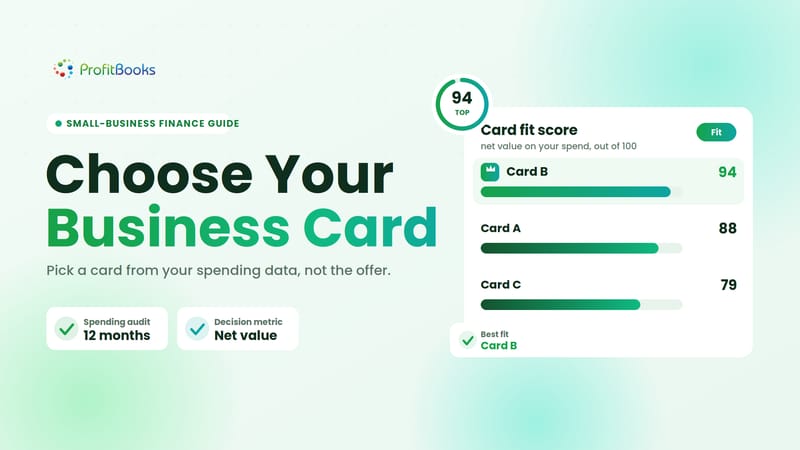
Choose a business credit card from your own spending data, not the card's marketing. Pull 12 months of expenses, turn your biggest spending patterns into a short list of required features, then compare cards on net annual value after fees, payment terms, spending controls, and accounting fit.
- Start with 12 months of spending, not card offers.
- Turn your two or three biggest spending patterns into must-have features.
- Compare net annual value (rewards + usable benefits − fees − interest), not the advertised rate.
- If you might carry a balance, weigh APR and fees before rewards.
- Check spending controls and accounting fit before perks, then review the choice once a year.
Start with 12 months of spending, not card offers
Open your books before you open a comparison page. A full year is useful because six quiet months may hide an annual software renewal, a busy travel season, or the inventory build-up that happens before your largest sales period.
If your records need tidying first, work through a basic business expense-tracking process. Then export the past 12 months of expenses from your accounting software, bank account, and any cards the company already uses.
Build a simple worksheet with these columns:
Next, total each category and calculate its share of card-eligible spending. Don't assume your accounting categories will line up perfectly with a card issuer's reward categories. "Marketing," for example, might include ad-platform charges, an agency retainer, event sponsorship, and printing. A card may treat those merchants differently.
You also need to record the shape of the spending, not only the annual total. Mark your highest and lowest months, large recurring payments, and unusual one-off purchases. A company that spends $15,000 every month has a different capacity need from one that usually spends $5,000 but reaches $50,000 before the holiday season.
Finally, answer three operational questions:
Those answers will often matter more than a small difference in reward rate.
Turn each spending pattern into a card requirement
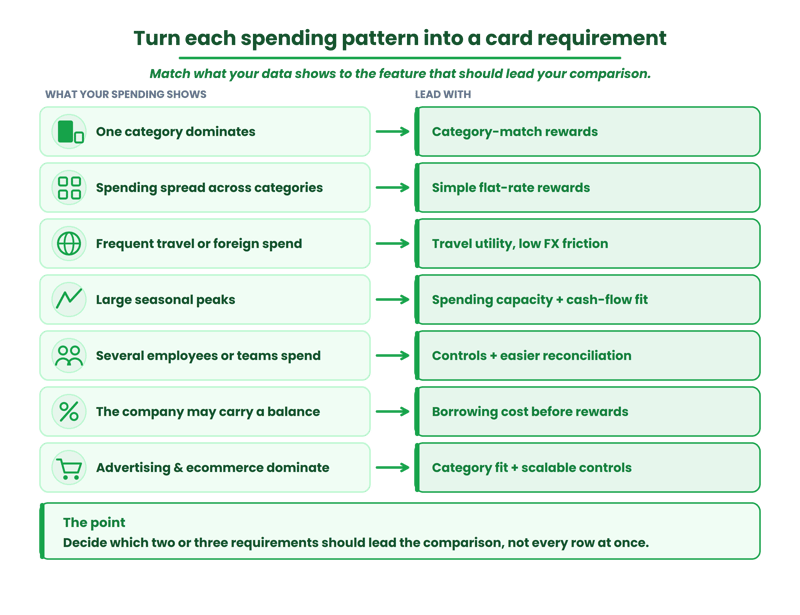
Your worksheet should now show which features deserve priority. This table provides a starting point.
| What your spending data shows | Lead with | Verify before applying |
|---|---|---|
| One category clearly dominates | Rewards that match that category | Merchant coding, reward caps, excluded transactions, and annual fee |
| Spending is spread across many categories | Simple flat-rate rewards | Effective reward rate, redemption restrictions, and caps |
| Frequent travel or foreign purchases | Travel utility and low cross-border friction | Foreign transaction fees, acceptance, protections, and redemption value |
| Large seasonal peaks | Spending capacity and cash-flow fit | Limit flexibility, payment timing, and the process for temporary increases |
| Several employees or teams spend | Controls and easier reconciliation | User limits, virtual cards, receipt workflows, and accounting integration |
| The company may carry a balance | Borrowing cost before rewards | APR, grace period, late fees, and payment terms |
| Advertising and ecommerce costs dominate | Category fit and scalable controls | Eligible merchants, reward caps, virtual cards, and integration needs |
These aren't rigid rules. A business may fit several rows. The point is to decide which two or three requirements should lead the comparison.
Suppose a consulting firm spends evenly across software, travel, meals, training, and office costs. It may earn more usable value from a straightforward flat-rate card than from trying to route every purchase to a different category. A growing online retailer may make the opposite choice if advertising represents a large and predictable part of card spend.
Complex rewards have a management cost too. If the owner has to monitor category rules, move purchases between cards, and explain the system to five employees, a theoretically higher reward may not produce more value in practice.
 Calculate real annual value, not the advertised rate
Once you have a shortlist, model a normal year for each card. Use the spending from your worksheet, the issuer's current terms, and a conservative estimate of the rewards you would actually redeem.
A useful equation is:
Net ongoing annual value = usable rewards + benefits you would otherwise buy − annual fee − expected interest and transaction costs
"Usable" is the important word. Airport lounge access isn't worth its advertised price to a team that rarely flies. A software credit has no value if the company doesn't use that software. Points aren't equivalent to cash unless you know how the company will redeem them.
Leave the welcome bonus out of this ongoing calculation. You can assess it separately, but it shouldn't make a weak long-term fit look strong.
A simple worked example
Imagine a company has $120,000 in annual card-eligible spending. Half falls into a category that would earn 3% on Card A, while the rest earns 1%. Card B earns a flat 2%.
If Card A also has a $150 annual fee and the company won't use its other benefits, Card B produces more ongoing value in this simplified example. If the company spends $90,000 in Card A's higher-rate category, the result changes, but only if the purchases qualify and remain below any reward cap.
Run the calculation with your own figures. It takes a few minutes and can expose a mismatch that a comparison table won't.
Your card is only as good as the books behind it
ProfitBooks categorizes every business expense automatically, so the 12-month spending picture you need to compare cards is ready whenever you are.
Let payment behavior decide what leads the shortlist
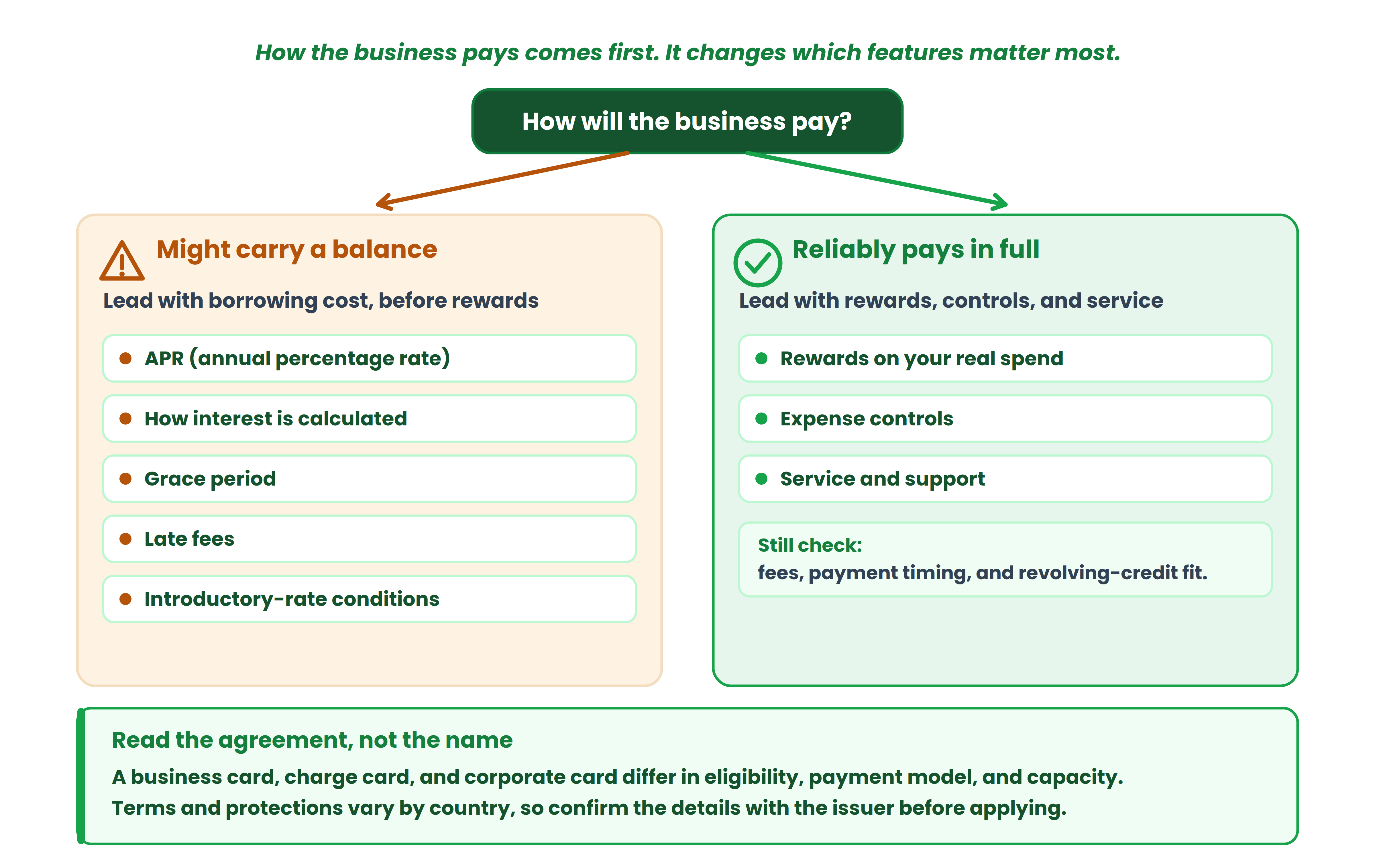
Rewards matter most when the business can avoid interest. If you expect to carry a balance, compare the annual percentage rate, how interest is calculated, the grace period, late fees, and any introductory-rate conditions before looking at points or cash back. A modest interest charge can erase a year's rewards surprisingly quickly.
If the company reliably pays in full, you can give more weight to rewards, expense controls, and service. You should still check fees and payment timing. A card that requires frequent or full repayment may not suit a business that needs revolving credit, even if its rewards match the spending perfectly.
This is also where the distinction between a business credit card, a charge card, and a corporate card becomes useful. Products can differ in eligibility, payment model, spending capacity, personal-guarantee requirements, and the way they evaluate the business. Names alone don't tell you how an account works, so read the current agreement before applying.
Card availability, terms, and legal protections vary by country and product. Treat general comparison guides as a starting point, then confirm the details with the issuer and your financial adviser if the decision could affect cash flow materially.
Check controls and bookkeeping before perks
A business card is part of your expense system. If it makes purchases easy but month-end reconciliation painful, the reward rate tells only half the story.
For a one-person business, a clean statement and reliable accounting export may be enough. As the team grows, look for controls that fit how the company operates:
Ask the person who closes the books to test the proposed workflow before you choose. Which fields will import? How are refunds handled? Can a virtual card be tied to one subscription? What happens when an employee forgets a receipt?
You also need a written card policy. Define who can spend, what they can buy, which purchases require approval, when receipts are due, and who reviews exceptions. Good controls reduce the amount of detective work required when you account for credit-card transactions.
Operational value is hard to express as a reward percentage, but it is real. Saving a finance lead several hours of cleanup each month may be worth more than a slightly higher earning rate.
Use industry-specific comparisons after defining your requirements
Generic comparison pages are useful for learning the vocabulary. Industry-specific research becomes more helpful once your worksheet has shown what makes your spending unusual.
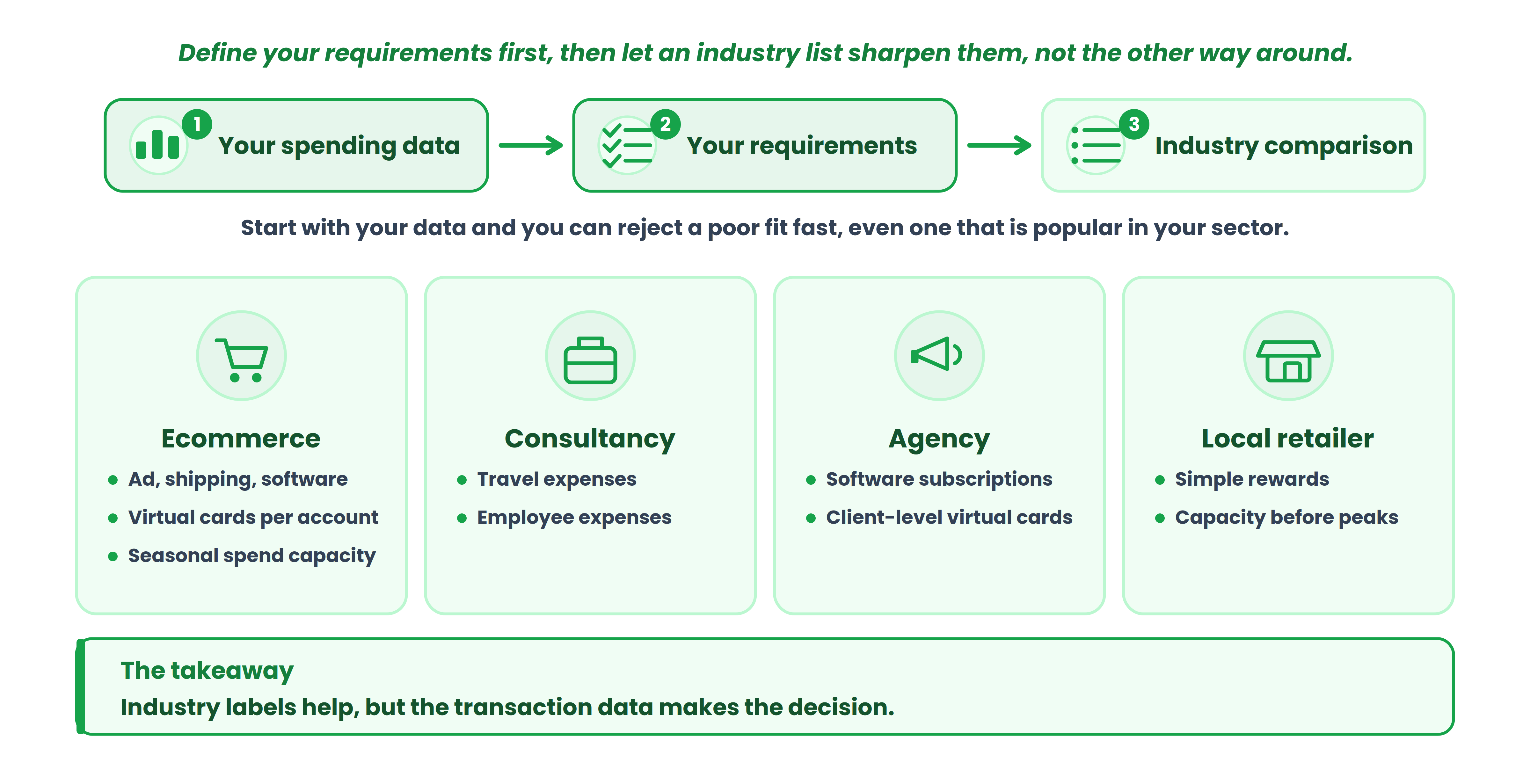
For example, an ecommerce company may have a high concentration of digital advertising, shipping, software, and inventory-related costs. It may also need separate virtual cards for advertising accounts or vendors, along with enough spending capacity for seasonal peaks. If those patterns appear in your audit, compare business credit card options for ecommerce companies against the requirements you've already written down.
This order matters. Starting with an industry list can make every listed feature feel important. Starting with your own data lets you reject a poor fit quickly, even when the product is popular in your sector.
The same logic applies to other businesses. A consultancy may prioritize travel and employee expenses. An agency may care about software subscriptions and client-level virtual cards. A local retailer may focus on simple rewards and the capacity to buy stock before a busy period. Industry labels help, but the transaction data makes the decision.
Score the shortlist before applying
Reduce the list to two or three realistic options and score each one with the same criteria. A simple one-to-five scale works well.
| Criterion | Question to answer |
|---|---|
| Eligibility and payment model | Can the business qualify, and does the repayment structure fit its cash flow? |
| Ongoing cost | What could the annual fee, interest, foreign transaction fees, and other charges cost? |
| Reward value | What would the company earn on its actual spending after caps and exclusions? |
| Usable benefits | Which benefits replace something the business would otherwise pay for? |
| Spending capacity | Can the account handle normal months and realistic peaks? |
| Controls | Can the company set appropriate access, limits, and approvals? |
| Accounting fit | Will transaction data, receipts, and exports simplify reconciliation? |
| Service and security | Can the team get help and stop suspicious spending quickly? |
Weight the criteria if some matter more than others. A business that occasionally carries a balance might give ongoing cost twice the weight of rewards. A company with 30 cardholders might give controls and reconciliation the highest weight. Write down the reasoning so the final choice can be reviewed instead of becoming a debate about which offer looks most attractive.
Before applying, verify the issuer's current terms directly. Check the reward definitions, caps, expiration rules, fees, payment schedule, eligibility criteria, and any personal guarantee. If several people will use the account, review the employee-card and unauthorized-use terms too.
Choose for the business you have and review as it changes
The right business card isn't the one with the longest list of benefits. It's the one whose economics, payment model, capacity, and controls fit the way your company actually spends.
Start with a year of records. Turn the largest patterns and operational problems into requirements. Model the ongoing value after fees and likely financing costs. Then score a short list using the same criteria.
Repeat the review once a year, or sooner if the company enters a new market, adds a team, changes its payment behavior, or develops a new major expense category. Your card should follow the business, not the other way around.
Frequently asked questions
How do I choose a business credit card based on my spending?
Start with 12 months of your own expense data rather than card offers. Total each category to see what dominates, turn your two or three biggest spending patterns into required features, then compare cards on net annual value after fees, payment terms, spending controls, and accounting fit.
Should I choose a card based on its welcome bonus?
Assess the welcome bonus separately from ongoing value. Model a normal year first, using usable rewards plus benefits you would otherwise buy, minus the annual fee and expected interest, and don't let a one-time bonus make a weak long-term fit look strong.
What is the real annual value of a business card?
It is the value you actually keep: usable rewards plus benefits you would otherwise pay for, minus the annual fee and expected interest and transaction costs. "Usable" is the key word, because rewards and perks only count if the business will really redeem or use them.
What is the difference between a business credit card, a charge card, and a corporate card?
They can differ in eligibility, payment model, spending capacity, and personal-guarantee requirements. The names alone don't tell you how an account works, so read the current agreement before applying.
How often should I review my business card choice?
Review it at least once a year, or sooner if the company enters a new market, adds a team, changes its payment behavior, or develops a new major expense category.
Start with clean books, then choose the card
ProfitBooks gives small businesses categorized expense records and simple reconciliation, the foundation for choosing and managing any business card. It's free to get started.