
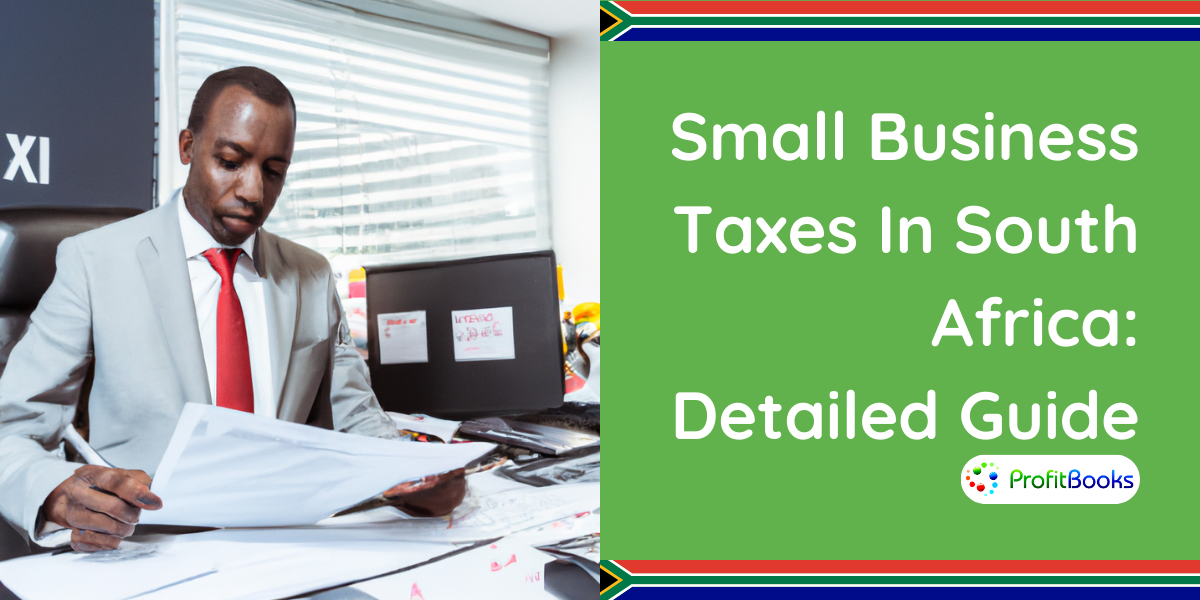
Are you a small business owner in South Africa, trying to wrap your head around the complex world of taxes?
Well, you’re in the right place! In this article, we’re going to break it down for you in plain, easy-to-understand terms.
Across Africa, small business owners are struggling with complex tax requirements that can make or break their ventures.
Did you know that small businesses represent about 95% of all registered businesses in Africa and contribute roughly 50% to the GDP of sub-Saharan countries? Despite this economic significance, they often struggle with tax compliance, which can seriously hamper their growth potential.

In this comprehensive guide, I’ll walk you through everything you need to know about taxes for small businesses across Africa.
Whether you’re running a startup in South Africa, a growing enterprise in Nigeria, or a tech company in Kenya, you’ll find practical advice based on my decade of experience working with African entrepreneurs.
What Is A Small Business?
A small business is like the friendly neighborhood shop, the cozy cafe around the corner, or the family-run enterprise. It’s a compact operation, often managed by a few individuals or a single entrepreneur.
These businesses usually have limited resources, a relatively small number of employees, and modest annual revenue. They are the heart of the local economy, contributing to job opportunities and community vitality.
So, if you’re picturing a small-scale store, a boutique service provider, or a one-person show, you’re thinking of a small business.
What Are Small Business Taxes In South Africa?

Small businesses are the engine of our economy.
They make stuff, offer services, give folks jobs, and help our economy grow. But for them to shine, they need a business-friendly environment. And that’s where fair, competitive, and growth-focused tax policies come into play.
When we talk about small business taxes in South Africa, it falls under Corporate Income Tax (CIT). SARS tells us it’s a tax for companies that call South Africa home or are run from here, and they make money from inside or outside our borders.
If you’re a non-resident company with a branch or permanent spot in SA, you’ll get taxed on all the income you rake in on our turf.
In plain terms, if you’re running a business in SA, whether it’s a local or international gig, you’ll owe some tax on all your earnings.
And if you’re an SME playing by the regular small business tax rules, get ready for provisional tax, which spreads out your tax bill over a certain period (more on that in a bit).
Now let’s get into the main part of the guide: the types of small business taxes.
Key Tax Regimes Across Africa
Africa is incredibly diverse, with each country having its tax systems. Let’s look at some major economies and their small business tax approaches:
South Africa’s Small Business Tax Framework
South Africa offers several tax options tailored for small businesses:
Small Business Corporations (SBC)
If your company’s annual turnover is up to R20 million, you can qualify for these progressive tax rates:
- 0% on the first R95,750 of taxable income
- 7% on income between R95,751 and R365,000
- 21% on income between R365,001 and R550,000
- 27% on income above R550,000

This system offers significant savings compared to the standard corporate tax rate of 27%.
To qualify, your business must be entirely owned by natural persons (individuals), and the owners cannot hold interests in other companies (with some exceptions).
When I helped Thabo, a manufacturing business owner in Cape Town, switch to SBC status, his tax bill dropped by nearly 40%! This freed up crucial capital that he reinvested in new equipment.
Turnover Tax (TOT)
This is my favorite option for micro-businesses with an annual turnover below R1 million. It’s a simplified system that replaces multiple taxes (Income Tax, VAT, Provisional Tax, Capital Gains Tax, and Dividends Tax) with a single tax based on your gross turnover.
The best part? You only begin paying tax when your annual turnover exceeds R335,000. Even then, the rates are quite reasonable:
- R0 – R335,000: 0%
- R335,001 – R500,000: 1% of each R1 above R335,000
- R500,001 – R750,000: R1,650 + 2% of the amount above R500,000
- R750,001 – R1,000,000: R6,650 + 3% of the amount above R750,000

Value Added Tax (VAT)
In South Africa, businesses must register for VAT when turnover exceeds R1 million in 12 months, with the standard rate at 15%.
You can voluntarily register if your turnover is over R50,000, which sometimes makes sense if you can claim significant input VAT.
Nigeria’s Tiered Tax System
Nigeria implements a multi-layered taxation system that can be quite complex for small businesses:
Company Income Tax (CIT):
- 0% for companies with a turnover below 25 million Naira
- 20% for companies with turnover between 25-100 million Naira
- 30% for companies with a turnover above 100 million Naira

One particularly challenging aspect of Nigeria’s system is the multi-level tax collection. Taxes are collected at the federal, state, and local levels by different authorities:
- Federal Inland Revenue Service (FIRS): Collects CIT, VAT, and other federal taxes
- State Inland Revenue Service (SIRS): Collects Personal Income Tax and Business Premises Tax
- Local Government Revenue Committees: Collect shop rates and other local levies
I once worked with a client in Lagos who was paying 14 different taxes across these levels!
We streamlined his approach using digital tracking tools, which saved him countless hours and reduced his compliance risk.
Kenya’s Business Tax Framework
Kenya has established several tax frameworks specifically designed for small businesses:
Turnover Tax: Applied at 1% of gross sales for businesses with annual turnover under KSh 50 million
Value Added Tax (VAT): 16% for businesses with annual turnover exceeding KSh 5 million
Digital Service Tax (DST): 1.5% of gross transaction value for non-resident businesses offering digital services to Kenyan users
What Are The Types Of Small Business Taxes In SA?

South African Revenue Service: SARS Home Page
There are a total of six types of small business taxes in the country that we have identified from various sources, primarily the official SARS website. This includes Provisional or Income tax, Turnover Tax, Capital Gains Tax, VAT, Employee Tax or PAYE, and Dividends Tax.
Let’s discuss them all one by one.
1. Provisional Tax or Income Tax
What’s Provisional Tax?
Provisional tax isn’t a whole new tax party; it’s like a preview of the main income tax show. The idea is to help you avoid a big, scary tax bill at the end of the year. Instead, you spread your tax payments out over the year.
Who has to pay provisional tax?
Both companies and individuals are eligible for provisional or income tax.
Companies:
Every business has to join the provisional tax club. You send in your dues twice a year – one at the six-month mark into your financial year and another when your financial year wraps up. Sometimes, there’s a third top-up, just to make sure you’re not hit with a mega tax bill.
Remember, these payments are based on predictions, which is where your financial plan comes in. You don’t want to overpay or come up short. Our financial planning guide, “Supercharge your start-up with a strong financial plan,” can be your sidekick.
Individuals:
If you’re employed or pay yourself a salary from your business, and that’s your only income source, you’re all good – no need to register for provisional tax. You’re already paying PAYE.
But wait, there’s more.
If you’re employed but have extra income streams (like a side hustle or rental income), you do need to jump on the provisional tax train.
If you’re a business owner getting dividends and investment income that’s separate from your salary, provisional tax is your ticket. It helps you settle the extra tax outside of the regular PAYE setup.
What about startups?
Startup owners often can’t afford a regular salary early on. Instead, they pump all their money into the business. During this phase, they might set up a loan account to cover personal expenses paid by the company or to pay themselves back for loans they gave to the company.
2. Turnover Tax
a) What’s the deal: If your business pulls in less than R1 million in a year, you’re considered a microbusiness. Being in this category makes you eligible for turnover tax, a simplified small business tax system.
b) Who gets in on the action?
In plain speak, to qualify for this small business tax, just add up all the money your business makes through its activities for the year.
Remember that the 1 million limit for turnover tax doesn’t include:
- Money from selling big-ticket items
- Certain government grants, according to the Income Tax Act
c) Turnover tax versus VAT
Your business only needs to sign up for VAT if it’s clocking more than R1 million in 12 months. Since microbusinesses usually earn less than that, VAT isn’t a must.
But sometimes, businesses can score some decent VAT credits, making it smarter to go with the VAT system instead of turnover tax. Many accounting firms can help you figure out which tax path suits you best.
d) When should you care about turnover tax?
“If your business makes less than R1 million a year, you should hop on the turnover tax train with SARS,” says Madelein van der Watt, Development Manager at Sage Pastel Payroll & HR.
In this case, the first R335,000 of your annual earnings won’t be taxed, and after that, you’ll owe 3% of your total earnings as tax. This beats juggling various tax tasks like VAT, income tax, provisional tax, or capital gains tax.
e) When to dig into your pockets?
Once you’re in for turnover tax, you’ll need to send in two provisional returns. Small business tax rules say you’ve got to file a TT02 twice a year:
- The first one is due six months into your current financial year
- The second comes in at the end of your financial year
- There’s a third option to top up any shortfall six months after year-end (that’s the TT03 form)
f) Why does it matter?
Don’t assume you’ll always be a microbusiness, especially if your earnings are on the upswing. Get cozy with the tax codes to steer your small business toward success.
3. VAT

If your company rakes in more than R1 million every year, VAT registration is a must. But if you’re not hitting that mark, you can still sign up, but it’s your call. VAT is a tax on stuff you buy or services you use.
We have explained the South African VAT system in detail, so you can refer to our guide on it to learn more about VAT.
4. Capital Gains Tax (CGT)
As many people get confused between GST and CGT in Australia, the same goes for Income and Capital Gains Tax in SA.
Small business taxes can also kick in when you decide to sell or get rid of stuff your company owns, like property, especially if you make a profit on the sale. This money-gobbling tax goes by the name of capital gains tax, and it’s like a distant cousin of regular income tax.
Capital gains tax, as part of small business taxes, is the fee you pay when you make a sweet deal selling company assets, like property, and the profit exceeds what you originally paid for them. It’s like the government’s way of taking a slice of your earnings from these sales to help fund public services.
So, when you score big on asset sales, be ready to share the joy with the taxman.
5. Employee Tax (PAYE) – Small Business Taxes
What is PAYE?
The law mandates every employer to register for Pay-As-You-Earn tax, commonly known as PAYE. It’s essentially a withholding tax on your employees’ income, functioning as an advance payment of their income tax. If your employee has paid more tax than they owe, the excess will be refunded to them during assessment.
When Does PAYE Apply?
As a business owner and employer, you’re responsible for deducting UIF (Unemployment Insurance Fund) and PAYE tax from your employees’ salaries every month. It’s crucial to submit your monthly PAYE, UIF, and SDL (Skills Development Levy) declaration (EMP201) on time to avoid fines from SARS. Remember, UIF is your contribution to the Unemployment Insurance Fund, while SDL goes into the Skills Development Levy.
When is PAYE Due?
PAYE is typically due on the 7th day of the following month. If this date falls on a weekend, the payment should be made on the preceding Friday.
Registering for UIF, SDL, and PAYE
Small business tax regulations stipulate that your business must register with SARS for PAYE and/or SDL and UIF. The good news is that you can tackle the registration for all these small business tax categories at once using the SARS client information system.
Streamline with a Reliable Payroll System
Implementing a trustworthy payroll system can provide you with peace of mind, ensuring that your PAYE, UIF, and SDL are automatically calculated and compliant.
Stay on top of your PAYE responsibilities to keep your business in good standing with SARS and provide your employees with accurate income tax withholding.
6. Dividend Tax – Small Business Taxes
What it is: Dividend tax becomes relevant for your small business if it has shareholders receiving dividends.
How It Operates: In the world of dividend tax, SARS puts the responsibility on the beneficial owner of the shares. But here’s the twist: the owner doesn’t have to lift a finger. The tax is automatically snipped from the dividend payout, thanks to the withholding agent, typically the company. The withheld tax is then delivered to SARS.
Filing Matters: When those shareholders tackle their tax returns, the dividends tax paid on their behalf by the company plays a starring role. It’s essential, especially if the shareholder qualifies for a reduced tax rate or a complete exemption on their dividend earnings.
The Due Date: This small business tax should be settled promptly. You need to hand over the withheld tax to SARS within a month of distributing the dividends, accompanied by a DTR01/02 return form. Delaying the dividends tax payment or submission might come with an interest charge from SARS.
Understanding dividend tax keeps your small business financially sound and on the right side of the law.
Digital Transformation in Tax Administration
Tax administration across Africa is undergoing significant digital transformation, which I believe is good news for small business owners:
Electronic Filing and Payment Systems
E-filing and online payment systems are becoming increasingly common. In South Africa, SARS eFiling allows businesses to register, file returns, and make payments electronically. Kenya’s iTax and Nigeria’s TaxPro Max platforms offer similar capabilities.
While these systems streamline compliance, they do require a basic level of digital literacy and reliable internet access, which can be challenging in some regions.
Advanced Technologies
Some tax authorities are implementing cutting-edge technologies:
- Kenya Revenue Authority (KRA) now uses artificial intelligence to identify high-risk taxpayers, reportedly reducing manual audit workloads by 40%
- Nigeria’s Federal Inland Revenue Service (FIRS) is piloting blockchain technology for VAT invoice tracking, aiming to reduce fraud by 65%
- Uganda’s URA collected 23% more turnover taxes after integrating mobile money platforms with the tax payment system.
Compliance Challenges for Small Businesses
Despite improvements in tax administration, small businesses still face significant obstacles:
Resource Constraints
Many small businesses lack staff with tax expertise. When I speak with African entrepreneurs, this is consistently among their top concerns.
Sarah, a fashion retailer in Nairobi, told me: “I’m great at designing and selling clothes, but tax forms might as well be written in hieroglyphics! I can’t afford a full-time accountant, so I’m constantly worried about making mistakes.”
Cash Flow Issues
Meeting tax deadlines can strain business finances, especially for provisional tax payments. I recommend setting aside a percentage of income specifically for taxes to avoid cash crunches when payment is due.
Complex Regulations
The multitude of tax types and frequent regulatory changes make compliance challenging. In some countries, tax laws change annually, requiring constant vigilance.
Bookkeeping Deficiencies
Poor record-keeping is a major obstacle to tax compliance. Many small businesses lack organized financial documentation, making it nearly impossible to accurately calculate tax liabilities.
Penalties and Interest
Late payments can result in significant penalties. In South Africa, for example, SARS charges a 10% penalty on late payments plus interest on outstanding amounts.
Regional Tax Harmonization Under AfCFTA
The African Continental Free Trade Area (AfCFTA) agreement is transforming how businesses operate across borders, with important tax implications:
Double Taxation Risks
Cross-border e-commerce transactions face potential dual VAT claims from the origin and destination countries. This is particularly concerning for digital businesses expanding across Africa.
Transfer Pricing Complexities
Intra-African group transactions exceeding $10M now require country-by-country reporting under new ATAF guidelines. Even smaller businesses with cross-border operations need to be aware of transfer pricing rules.
Harmonization Progress
There’s good news on the horizon: 32 nations have adopted the AfCFTA Protocol on Tax Coordination, standardizing:
- Minimum 15% corporate tax rate
- 5-15% VAT band for digital services
- Common depreciation schedules for industrial equipment

Tax Compliance Technology Solutions for Small Businesses
Given these challenges, I’ve seen firsthand how the right technology can transform tax compliance from a nightmare into a manageable process.
Accounting Software Benefits
Using specialized accounting software like ProfitBooks can dramatically simplify tax compliance through:
- Automated tax calculations: The software can automatically calculate VAT, withholding tax, and other liabilities
- Digital record-keeping: All invoices, receipts, and financial transactions are stored in one secure place
- Real-time tax reporting: Generate up-to-date tax reports whenever needed
- Compliance reminders: Never miss a deadline with automated alerts
- Multi-currency support: Essential for businesses operating across African borders
- Integration with tax authority platforms: Direct filing capabilities in some countries
I’ve watched small business owners transform their tax processes using these tools. James, a consultant in Accra, told me: “Before using accounting software, tax season meant weeks of stress and late nights sorting through paper receipts. Now, I can generate compliant reports with a few clicks.”
Mobile Solutions for Informal Businesses
For very small or informal businesses, mobile-based solutions are proving effective:
- Rwanda’s graduated business permit system increased formal registrations by 58% in 2024
- Tanzania collects $12M annually through simplified fishing license fees managed via mobile payments
- Zambia’s SMS-based tax reminder system reduced informal trader penalties by 72%
How ProfitBooks Helps with Tax Compliance
As someone who’s worked with hundreds of small businesses across Africa, I’ve seen how the right tools can transform tax compliance from a burden into a manageable process.
ProfitBooks was designed specifically for business owners without accounting knowledge, making it ideal for African entrepreneurs who can’t afford full-time financial staff.
Here’s how our software helps with tax compliance:
Easy Invoicing with Tax Calculations
Create professional, tax-compliant invoices in seconds. The system automatically calculates VAT or sales tax based on your location and settings. We support multiple currencies and payment gateways, which is crucial for businesses operating across African borders.
Automated Tax Reports
Generate tax-ready reports with a single click. Whether you need to file VAT returns, prepare for income tax, or calculate provisional tax payments, ProfitBooks creates the exact reports you need.
Our reports include:
- VAT/Sales Tax Summary
- Input/Output Tax Analysis
- Provisional Tax Calculations
- Annual Tax Summary
- Withholding Tax Reports
Expense Tracking for Tax Deductions
Many small businesses overpay taxes because they miss legitimate deductions. ProfitBooks lets you capture and categorize all business expenses, ensuring you claim every tax deduction you’re entitled to.
You can even upload receipt images directly from your phone, making record-keeping effortless.
Multi-User Access with Tax Advisor Role
Grant limited access to your accountant or tax consultant without giving them control over your entire financial system. This feature is particularly popular among our African users who often work with external tax professionals on a part-time basis.
Pricing Plans That Work for African Businesses
- Free Startup Plan: Perfect for new businesses with basic needs
- Business Plan: $20/month with all features and unlimited invoices
Try ProfitBooks free for 14 days and see how much easier tax compliance can be.

ProfitBooks Pricing Plans
Expert Insights on Small Business Taxation
Let’s hear from some leading experts on taxes for small businesses in Africa:
Dr. Michael S. (Tax Practitioner, South Africa)
Emphasizes that Small Business Corporations (SBCs) benefit greatly from progressive tax rates that reduce the burden for smaller profits, encouraging formalization and growth. However, he notes that many small businesses face the same VAT compliance requirements as large corporations, despite lacking comparable systems and staff.
Prof. Jackie Arendse (Tax Specialist and Educator, South Africa)
Advocates for effective tax risk management and record-keeping as foundational to small business success. She notes that tax incentives like Turnover Tax and SBC tax rates simplify compliance and reduce administrative burdens.
World Bank Tax Researchers
Point out that Simplified Tax Regimes (STRs) across Sub-Saharan Africa have been effective in reducing compliance costs. However, they caution that in many countries, STRs sometimes set tax rates too high or thresholds too low, which can discourage small businesses from formalizing.
Ms. Thandi Nkosi (SME Owner, Johannesburg)
Shares that using digital platforms like SARS eFiling has improved her ability to file returns on time and reduced errors. However, she notes these platforms can be complex for new users without accounting backgrounds.
FAQs: Small Business Taxes in Africa
- When do small businesses need to register for VAT in African countries?
VAT registration requirements vary by country. In South Africa, businesses must register when turnover exceeds R1 million in 12 months. In Kenya, businesses with an annual turnover exceeding KSh 5 million must register for VAT. Many countries offer voluntary registration below these thresholds, which can be beneficial if you have significant input VAT to claim.
- What tax rates apply to small businesses in South Africa?
Small Business Corporations in South Africa benefit from progressive tax rates: 0% on the first R95,750 of taxable income, 7% on income between R95,751 and R365,000, 21% on income between R365,001 and R550,000, and 27% on income above R550,000. This system offers significant savings compared to the standard corporate tax rate of 27%.
- How does Turnover Tax work for small businesses in Africa?
Turnover Tax is a simplified tax system that replaces multiple taxes with a single tax based on gross turnover. In South Africa, it applies to businesses with annual turnover up to R1 million and only kicks in when turnover exceeds R335,000. This system significantly reduces the administrative burden of tax compliance for very small businesses.
- Which taxes are collected at different government levels in Nigeria?
In Nigeria, taxes are collected at three levels: the Federal Inland Revenue Service (FIRS) collects Company Income Tax, VAT, and Capital Gains Tax; State Inland Revenue Services collect Personal Income Tax and Business Premises Tax; Local Government Revenue Committees collect various levies and rates like shop and kiosk rates.
- What are the tax filing deadlines for small businesses in South Africa?
In South Africa, provisional tax is typically paid twice a year (February and August), while CIT returns must be filed within 6 months after the accounting year for existing companies, and within 18 months from incorporation for new companies. PAYE, SDL, and UIF contributions must be remitted within seven days after the month-end.
- How are international earnings taxed for small businesses in Africa?
Most African countries tax resident businesses on worldwide income. In South Africa, resident companies are subject to tax on their worldwide income, while non-residents are taxed only on South African-source income. Similar principles apply in many other African countries, though specific rules vary.
- What penalties do African tax authorities impose for non-compliance?
Penalties vary by country but can be substantial. In South Africa, SARS charges a 10% penalty on late payments plus interest on outstanding amounts. Non-filing of returns can result in administrative penalties. In other countries, penalties may include fines, interest charges, business restrictions, or even closure.
- How does digital taxation work for online businesses in Africa?
Digital taxation is evolving across Africa. Kenya has implemented a Digital Service Tax (DST) of 1.5% on gross transaction value for non-resident businesses offering digital services to Kenyan users. South Africa imposes a 2% DST on cloud service providers not maintain local servers. As the digital economy grows, expect more countries to implement similar frameworks.
- What bookkeeping requirements do small businesses need to follow for tax compliance?
Small businesses need to maintain accurate financial records for at least 5 years in most African countries. This includes tracking all income sources, categorizing expenses, maintaining VAT records, keeping payroll records, and saving all invoices and receipts. Digital bookkeeping solutions can improve accuracy and efficiency compared to manual methods.
- How can I resolve tax disputes affordably as a small business?
Many African countries are implementing alternative dispute resolution mechanisms. South Africa’s virtual tax court is available for smaller cases, while Kenya requires mediation attempts before court filings for disputes under $50,000. The E-Arbitrator platform specializes in cross-border tax disputes. Always try direct engagement with tax authorities first, as many issues can be resolved through simple clarification.
Conclusion
In wrapping up our exploration of the intricate world of small business taxes in South Africa, it’s clear that grasping the nuances of this tax landscape is paramount for small business owners.
Throughout this article, we’ve delved into various aspects of small business taxes, shedding light on the key categories that might directly impact your small business.
By staying well-informed and fully compliant with the specific tax regulations that govern small business taxes, you not only safeguard the financial health of your small business but also play an active role in shaping the broader economic landscape of South Africa.
These insights into small business taxes are your key to informed decision-making and confident navigation of the intricate tax terrain. Keep in mind that while taxation may appear complex, it’s an integral aspect of operating a successful small business.
But these financial complexities can be solved simply with ProfitBooks, an easy-to-use cloud accounting software. With ProfitBooks, you can manage all your taxes, not only in South Africa but all major African nations like Kenya, Tanzania, Zimbabwe, Nigeria, Ghana, Morocco, Zambia, Mozambique, Botswana, and many more.
Get your 100% FREE account now!
Additional Resources
- South African Revenue Service (SARS) Small Business Guide
- How To Calculate VAT in South Africa
- Business Structures & Taxes In Kenya
- African Tax Administration Forum (ATAF)
- International Centre for Tax and Development (ICTD)
Also Read:
South Africa VAT Rates & Registration
The 5 Business Structures In South Africa Explained
Kenya Taxes & Business Structures