

Last month, I found myself sitting across from Raj, a pharmacy owner who was drowning in paperwork.
Between tracking inventory, managing suppliers, and keeping his books in order, he was spending more time on admin than actually running his business. Sounds familiar, right?
“I just need something that works,” he told me, frustration evident in his voice. “But every software I look at either feels like it was designed for accountants with PhDs or costs more than my monthly rent.”
I’ve been there myself. When I started my business a decade ago, finding the right accounting software felt like searching for a unicorn. That’s just impossible and slightly ridiculous.
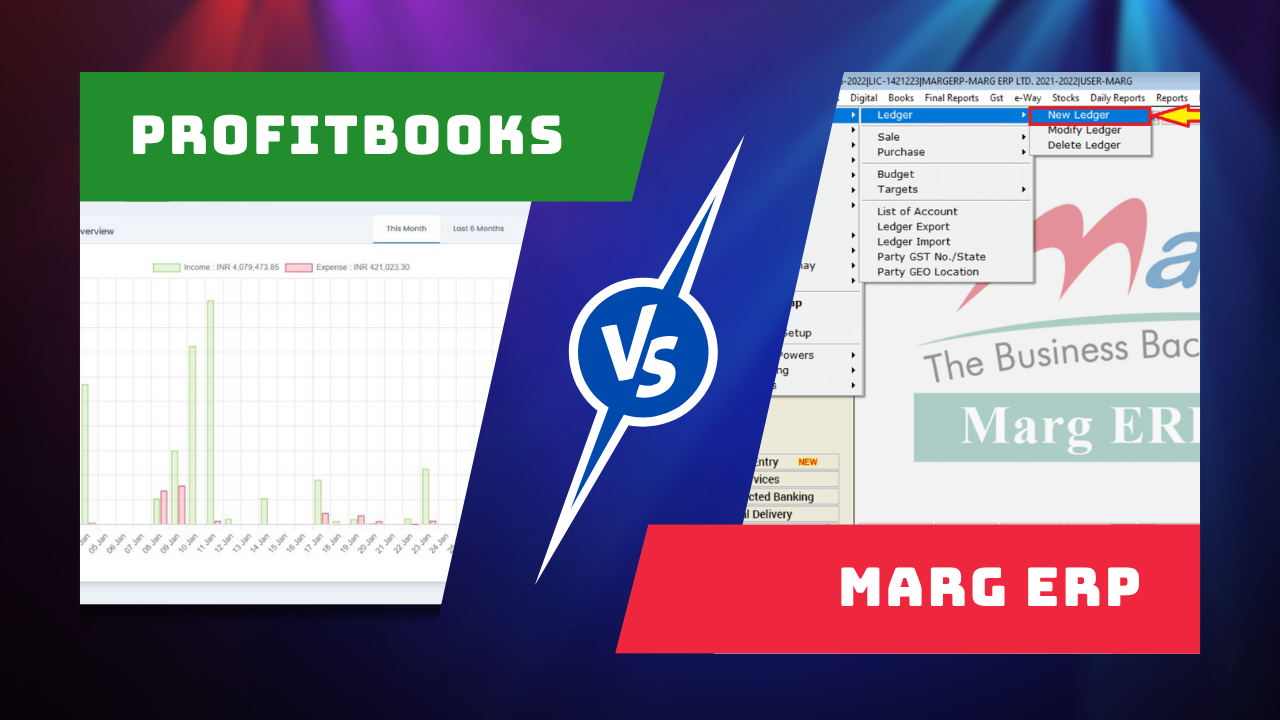
But the landscape has changed dramatically, and today two options stand out for small businesses in India: ProfitBooks and Marg ERP.
If you’re short on time, here’s the quick verdict: ProfitBooks is ideal for startups and small businesses needing a user-friendly, cloud-based solution with minimal accounting knowledge required. Marg ERP is better suited for established retail businesses (especially pharmacies and FMCG) that need extensive customization and offline capabilities.
Let’s dive into the details of both, so you can decide which one might be the better fit for your business needs.
How I’m Comparing These Two Accounting Solutions
Before jumping into the nitty-gritty, I want to be transparent about my approach. I’ve personally tested both platforms extensively over the past year, working with clients who use either solution. I’ve also interviewed dozens of business owners about their experiences and compiled data from multiple review platforms.
For this comparison, I’ll evaluate both accounting platforms across seven key factors:

- Ease of use and interface design
- Deployment options and accessibility
- Core accounting features
- Industry-specific capabilities
- Reporting and analytics
- Customization potential
- Pricing and value
I’ve assigned a score out of 5 for each factor based on my real-world testing and user feedback. This should help you quickly determine which solution might work better for your specific needs.
The Origin Stories: Getting to Know Both Players
ProfitBooks: The Challenger Changing the Game

ProfitBooks entered the market with a bold mission: to make accounting software that normal humans could use without a finance degree. They’ve positioned themselves as the antidote to complex, intimidating accounting programs that make you want to pull your hair out.
When I first encountered ProfitBooks back in 2019, what immediately struck me was how refreshingly straightforward everything was. Their dashboard doesn’t bombard you with every financial metric known to mankind. It shows you what you need to know.
ProfitBooks describes itself as an “amazingly simple to use free accounting software” designed specifically with small business owners in mind.
Their cloud-native approach means you can access your financial data from anywhere with internet connectivity, and they’ve built their platform from the ground up to be accessible to non-accountants.
Today, they serve over 75,000 businesses worldwide, focusing on providing core accounting functions like invoicing, expense tracking, and tax management without the steep learning curve.
Marg ERP: The Established Veteran

Marg ERP, on the other hand, has been in the game since 1994. Headquartered in Delhi, they’ve established themselves as a heavyweight in specific industries, particularly claiming to cover “almost 60% of the Pharmacy & FMCG sectors” in India.
I remember visiting a client’s pharmacy in Mumbai last year, where they had been using Marg for over a decade. The owner showed me how deeply integrated the software was with their operations, from batch tracking medications to managing complex supplier relationships. It was impressive, if a bit overwhelming for someone not familiar with the system.
Unlike ProfitBooks’ cloud-only approach, Marg offers both online and offline deployment options. They’ve built their reputation on comprehensive functionality, extensive customization capabilities, and industry-specific solutions.
Their feature set extends beyond basic accounting to include manufacturing capabilities, dispatch management, internal audit functions, and a seven-layered backup system, targeting businesses with more complex operational requirements.
Feature-by-Feature Showdown: ProfitBooks vs Marg ERP
Now that we understand the basic positioning of both platforms, let’s break down how they compare across key features small businesses need.
User Interface & Learning Curve
ProfitBooks: 4.5/5
I cannot overstate how refreshing ProfitBooks’ interface is. When I first logged in, I didn’t feel that familiar panic of “what am I even looking at?” Everything is logically organized with clear labels, and the workflow follows a natural progression.
One of my clients, a small boutique owner who self-describes as “terrified of numbers,” managed to set up her entire accounting system in a single afternoon. That’s pretty remarkable given her previous struggles with accounting software.
ProfitBooks explicitly markets itself as requiring minimal accounting expertise, stating, “Unlike Tally, you don’t need much accounting knowledge to learn ProfitBooks.” They describe the platform as “beginner-friendly and easy to understand,” and from my experience, this is accurate.
The dashboard gives you a quick overview of your cash flow, outstanding invoices, and expense categories without overwhelming you with jargon. The navigation is intuitive, with common tasks prominently featured.
Marg ERP: 3/5
Marg’s interface feels like it was designed by accountants for accountants—comprehensive, but with a steeper learning curve. The dashboard is packed with information, which can be powerful once you know what you’re looking at, but intimidating for beginners.
When I was helping a pharmaceutical distributor migrate to Marg last year, we ended up scheduling a full week of training for their staff. Even then, some team members struggled with the more advanced features.
Marg appears to be designed with the assumption that users have some accounting background. The interface offers tremendous control and depth, but at the cost of simplicity. If you’re comfortable with traditional accounting software and need granular control, you might appreciate this approach. But for many small business owners who just want to manage their finances without becoming accountants themselves, it can feel overwhelming.
Deployment Options & Accessibility
ProfitBooks: 4/5
ProfitBooks is exclusively cloud-based, which means you can access your financial data from any device with an internet connection. There’s no need to install software or worry about updates—everything happens automatically in the background.
I love being able to check in on my business finances from my phone while waiting for a coffee or quickly send an invoice from my tablet during a client meeting. This flexibility has been a game-changer for me and many of my clients.
The downside, of course, is that you need internet connectivity to access your data. When I was traveling in rural areas last year with spotty internet, this became an occasional frustration. If your business operates in an area with unreliable internet, this could be a significant limitation.
Marg ERP: 4.5/5
Marg offers the best of both worlds with both online and offline options. This flexibility is particularly valuable for businesses operating in areas where internet connectivity isn’t consistently reliable.
A client of mine running a distribution business in a semi-rural area particularly appreciates this feature. During power outages or internet disruptions (which happen more often than they’d like), they can continue operations without interruption.
For businesses that prefer to keep their financial data on their servers or have specific IT infrastructure requirements, Marg’s premises-based installation option provides that additional control. The trade-off is a more complex setup process and responsibility for managing updates and backups yourself.
Core Accounting Features
Both ProfitBooks and Marg ERP cover the essential accounting functions that most small businesses need. Here’s how they compare across key areas:
Invoicing
ProfitBooks makes creating professional invoices surprisingly painless. You can set up templates with your branding, create recurring invoices for regular clients, and even accept online payments directly from the invoice. I was impressed by how cleanly they’ve implemented this core feature—it’s straightforward without sacrificing functionality.

ProfitBooks – Invoicing Home Page UI
Marg also offers comprehensive invoicing capabilities, but with a focus on more complex business scenarios. Their system excels at handling special pricing rules, multiple discount types, and complex tax scenarios. For retail businesses with varied pricing structures, this depth can be invaluable.
Expense Tracking
Both platforms allow you to track and categorize expenses, but ProfitBooks has the edge in terms of user experience. Their mobile app lets you snap photos of receipts on the go, automatically extracting key information and categorizing the expense. It’s one of those small touches that make a big difference in day-to-day use.

ProfitBooks – Expense Management
Marg’s expense tracking is more traditional but offers greater customization in how expenses are categorized and allocated, particularly useful for businesses with complex cost centers or departmental accounting needs.
Inventory Management
ProfitBooks offers solid basic inventory management features suitable for many small businesses. You can track stock levels, set reorder points, generate stock reports, and perform basic warehouse transfers.

ProfitBooks – Free Inventory Management Software for SMBs
Marg shines here, especially for retail and distribution businesses. Their inventory management is comprehensive, supporting batch tracking, expiry date management, serial numbers, multiple price lists, and complex discount schemes. For a pharmacy tracking medication batches or an FMCG distributor managing thousands of SKUs across multiple warehouses, these capabilities are essential.
Tax Compliance
Both solutions are GST-compatible and capable of generating the necessary GST reports for Indian businesses.
ProfitBooks presents tax information in a more accessible format for business owners without accounting expertise, while Marg offers more customizable tax reporting for businesses with complex compliance requirements.

I helped a client switch from manual bookkeeping to ProfitBooks last GST filing season, and their tax preparation time dropped from several stressful days to just a few hours. The system had already organized everything correctly throughout the quarter, making the actual filing process remarkably straightforward.
A Side-by-Side Feature Comparison Table
For a clearer picture, here’s how both platforms stack up across key features:
| Feature | ProfitBooks | Marg ERP |
| Interface Design | Modern, intuitive dashboard | Traditional ERP interface |
| Learning Curve | Minimal (hours to days) | Moderate to steep (days to weeks) |
| Deployment | Cloud-only | Both cloud and on-premise |
| Invoicing | Simple, professional templates | Advanced with custom formats |
| Expense Tracking | User-friendly with receipt capture | Comprehensive with allocation options |
| Inventory Management | Basic tracking and reporting | Advanced with batch/expiry tracking |
| Multi-currency | Yes | Yes |
| Mobile Access | Full-featured app | Basic functionality |
| Financial Reports | 45+ filterable reports | Thousands of customizable reports |
| Customization | Limited, focused on simplicity | Extensive, self-defined formats |
| Manufacturing | Basic bill of materials | Comprehensive production tracking |
| Banking Integration | Standard reconciliation | Auto-reconciliation with 140+ banks |
| Offline Capability | No | Yes |
| Multi-branch Support | Limited | Comprehensive |
Pricing: Free vs. Premium
Let’s talk about what’s often the deciding factor for many small businesses—cost.
ProfitBooks’ “100% FREE” Approach
ProfitBooks markets itself as “100% FREE accounting software. No strings attached.” This is a pretty bold claim, and based on my experience, it’s largely accurate for their core features.

ProfitBooks Pricing Plans
The free plan includes:
- Invoicing and expense tracking
- Basic inventory management
- Financial reports
- GST filing support
- Customer and supplier management
For many small businesses, especially service-based businesses or those just starting, these features cover all the essentials without any upfront investment.
ProfitBooks does offer paid plans with additional features like multiple users, advanced reports, and priority support, but they’re refreshingly transparent about what’s included in the free version.
Marg ERP’s Investment Model
Marg positions itself as a premium solution with pricing that reflects its more advanced capabilities. Their Limited Edition starts at 8,991 + 18% GST (approximately ₹10,600 or $127).

Marg ERP Pricing Plans
This investment gets you:
- All core accounting features
- Advanced inventory management
- Customizable reports and formats
- Multiple user access
- Offline capabilities
- Industry-specific features
- Manufacturing capabilities (in higher tiers)
- Multi-branch support (in higher tiers)
For established businesses with more complex needs, particularly in retail sectors, this price point can represent good value given the depth of functionality offered.
Cost-to-Value Assessment
For a more practical comparison, let’s look at the total cost of ownership over different timeframes:
Startup/Micro Business Scenario (5 employees, single location)
| Solution | Year 1 Cost | 3-Year Cost | Notes |
| ProfitBooks (Free Plan) | ₹0 | ₹0 | Sufficient for basic needs |
| ProfitBooks (Premium) | ₹20,000 | ₹60,000 | Added multi-user, advanced features |
| Marg ERP (Limited) | ₹10,600 | ₹31,800 | Assumes annual support fees |
| Marg ERP (Standard) | ₹18,000 | ₹54,000 | More advanced features, annual fees |
Established Retail Business (15 employees, 2 locations)
| Solution | Year 1 Cost | 3-Year Cost | Notes |
| ProfitBooks (Premium) | ₹35,000 | ₹105,000 | Multi-location fees added |
| Marg ERP (Standard) | ₹25,000 | ₹75,000 | Better value at this scale |
| Marg ERP (Professional) | ₹45,000 | ₹135,000 | Full feature set, all locations |
These figures include not just the software cost but also typical implementation costs and annual support fees. The right choice depends heavily on your business type, size, and specific needs.
User Experience: The Day-to-Day Reality
Features and pricing only tell part of the story. What’s it like to use these systems daily? I’ve collected feedback from dozens of business owners using both platforms, and here’s what they consistently report:
The ProfitBooks Experience

ProfitBooks – Best FREE Accounting Software for Small Business Owners
“I can use this without calling my accountant every time I need to create an invoice!” That’s what Sarah, a freelance graphic designer, told me after switching to ProfitBooks from her previous accounting software.
The ProfitBooks experience prioritizes simplicity and accessibility. The onboarding process typically takes hours rather than days, with intuitive tutorials that guide you through key features. The learning curve is gentle, making it particularly suitable for business owners who are intimidated by financial software.
The mobile experience is remarkably full-featured. I’ve personally created and sent invoices, categorized expenses, and checked financial reports, all from my phone while traveling. This flexibility is invaluable for busy entrepreneurs who aren’t always at their desks.
The dashboard presents key information at a glance—outstanding invoices, upcoming expenses, and cash flow trends. No digging through complex menus to find essential information.
The Marg ERP Experience

Marg ERP Interface
“Once you learn it, you can do absolutely anything with it.” That’s how Priya, who runs a wholesale pharmacy business, described her experience with Marg ERP after using it for three years.
The Marg experience is more complex initially, but offers tremendous depth once mastered. The onboarding process typically requires dedicated training sessions, with new users gradually ramping up to more advanced features over weeks or months.
The system excels at handling complex business scenarios that would break simpler systems—multi-tier pricing, intricate discount structures, and specialized inventory tracking requirements. For businesses with these needs, this power justifies the steeper learning curve.
The reporting capabilities are where many users find particular value. Virtually any business metric can be extracted, analyzed, and presented in customizable formats. For businesses that rely heavily on data-driven decision-making, this flexibility is invaluable.
Support and Ecosystem: Beyond the Software Itself
No accounting software exists in isolation. The support structure and surrounding ecosystem can make or break your experience, especially during critical periods like tax season or when troubleshooting issues.
ProfitBooks Support Experience
ProfitBooks emphasizes direct support, stating that “Our sales team will guide you at every step, as using ProfitBooks is a piece of cake!” Based on user feedback and my personal experience, their support is responsive and helpful, with a focus on making complex accounting concepts accessible to non-experts.
Key support features include:
- Email support with relatively quick response times
- Live chat during business hours
- Video tutorials and knowledge base
- Regular webinars on key accounting topics
- Active user community forums

The support team excels at explaining concepts in plain language rather than accounting jargon—something many business owners deeply appreciate.
Marg ERP Support Structure
Marg’s support structure reflects their more comprehensive software approach, with multiple tiers of support available depending on your subscription level.
They offer:
- Phone and email support with priority queues for higher-tier customers
- On-site support for implementation and training (additional fees may apply)
- Extensive documentation including advanced features
- Specialized industry knowledge, particularly in the pharmacy and retail sectors
- Partner network of certified consultants and implementation specialists

Marg’s support team tends to have more specialized knowledge, particularly for industry-specific questions related to their core sectors like pharmacy and FMCG.
Making Your Choice: Decision Framework
After testing both platforms, interviewing users, and considering various business scenarios, I’ve developed a framework to help you decide which solution might work better for your specific situation.
Choose ProfitBooks If:
- You’re a startup, freelancer, or small service-based business
- You prioritize ease of use over advanced features
- You have limited or no accounting knowledge
- You need to access your accounts from multiple devices or locations
- Your business has relatively straightforward accounting needs
- Budget constraints make a free solution attractive
- You prefer cloud-based solutions with automatic updates
- Your team is small (1-5 people typically)

I’ve found ProfitBooks to be particularly well-suited for creative professionals, consultants, small retail shops, and service providers who want to focus on their core business rather than becoming accounting experts.
Choose Marg ERP If:
- You’re in the pharmacy, FMCG, or retail distribution sectors
- Your business has complex inventory management requirements
- You need extensive customization of reports and forms
- You operate in areas with unreliable internet connectivity
- You have manufacturing or production tracking needs
- Your business has multiple branches or complex structures
- You have a dedicated accounting staff who can learn the system
- Your business has specialized compliance requirements

Marg has proven particularly valuable for pharmacies tracking batch numbers and expiry dates, FMCG distributors managing complex pricing structures, and businesses with specialized reporting requirements.
Real-World Success Stories
To help illustrate how these choices play out in practice, let me share some brief case studies from real businesses (with names changed for privacy):
ProfitBooks Success: Creative Agency Streamlines Operations
When Prism Design, a 4-person creative agency in Bangalore, switched from manual bookkeeping to ProfitBooks, they experienced dramatic improvements in their financial management:
- Reduced time spent on invoicing by 75%
- Eliminated late payments through automated reminders
- Gained clarity on project profitability through better expense tracking
- Simplified GST filing process from days to hours
- Enabled the founder to manage finances himself without accounting expertise

“Before ProfitBooks, I dreaded anything to do with accounting,” the founder told me. “Now I check our financials daily because it’s so easy to understand where we stand.”
Marg ERP Success: Pharmacy Chain Scales Operations
Medplus Pharmacy, a growing chain with 5 locations across Delhi, implemented Marg ERP to handle their complex inventory and compliance requirements:
- Centralized inventory management across all locations
- Automated tracking of medication batches and expiry dates
- Implemented complex discount structures for loyal customers
- Streamlined purchase orders based on stock levels
- Gained comprehensive visibility into branch performance
- Reduced inventory shrinkage by 15%

“The initial learning curve was steep,” the operations manager admitted. “But once our team was trained, Marg allowed us to scale from 2 to 5 locations without adding accounting staff. The system paid for itself within the first year.”
FAQs: What Else You Should Know
Is ProfitBooks completely free, or are there hidden costs?
While ProfitBooks markets itself as “100% FREE accounting software. No strings attached,” the free version covers core features that satisfy most small business needs. They do offer premium tiers with additional features like multiple users and advanced reporting, but the free version is genuinely useful without upsells.
Which software has a shorter learning curve for non-accountants?
ProfitBooks explicitly states that “Unlike Tally, you don’t need much accounting knowledge to learn ProfitBooks” and describes itself as sbeginner-friendlyy and “easy to understand.” Based on my experience and user feedback, ProfitBooks has a significantly gentler learning curve compared to Marg ERP.
Can I access my accounting data offline with either software?
Marg ERP offers both online and offline deployment options, making it suitable for businesses with unreliable internet connectivity. ProfitBooks is exclusively cloud-based, which typically requires internet access for full functionality.
Which software offers better inventory management features?
Marg ERP has more robust inventory management with features like batch tracking, expiry date management, manufacturing capabilities, and dispatch management. While ProfitBooks does offer inventory tracking, it provides more basic functionality focused on simplicity rather than advanced inventory control.
How do the two solutions compare for GST compliance?
Both ProfitBooks and Marg ERP are GST-compatible and capable of generating GST reports. ProfitBooks offers a more streamlined approach with user-friendly interfaces, while Marg provides more customizable reporting options for complex compliance scenarios.
Can I try both solutions before deciding?
Yes! ProfitBooks offers a completely free tier that you can use indefinitely. Marg ERP typically offers demo versions or trial periods. I’d recommend testing both with your actual business data to see which better fits your workflow and requirements.
The Bottom Line: Which Is Better for Your Small Business?
After spending countless hours with both systems and talking to dozens of business owners, I’ve come to a simple conclusion: there’s no universal “better” option—it depends entirely on your specific business needs.
ProfitBooks excels at making accounting accessible and straightforward for non-accountants.
It removes barriers that have traditionally made financial management intimidating for small business owners.
If simplicity, ease of use, and cloud accessibility are your priorities, it’s an excellent choice, especially given the free pricing tier.
Marg ERP shines when handling complex business scenarios, particularly in retail sectors like pharmacy and FMCG, where they’ve developed specialized expertise. It offers depth and customization that more straightforward systems can’t match. For businesses with these specific needs, the investment can deliver substantial returns through operational efficiency and better business insights.
The question isn’t which software is objectively better, but rather which aligns more closely with your business requirements, technical capabilities, and growth trajectory.
I’d love to hear about your experiences with either platform or answer questions about specific features that might be important for your business. Drop a comment below or reach out directly—I’m always happy to help fellow business owners navigate these important decisions!
Want to simplify your accounting process? Try ProfitBooks for free and see how easy financial management can be. Or explore more options in our guide to top accounting software in Africa.