


I’ve reviewed hundreds of small business P&Ls over the last decade, and here’s what surprises me every time: founders can tell me their monthly revenue down to the dollar, but ask them about their operating income, and I get this nervous laugh followed by “Uh, that’s after expenses, right?”
Close. But not quite.
Here’s the thing—operating income is the profit your business earns from its core operations after subtracting operating costs (before interest and taxes). It’s the clearest signal of whether your actual business model works, stripped of the noise from loan payments, tax situations, or that one-time equipment sale you made in March.
By the end of this guide, you’ll know exactly how to calculate your operating income, spot the hidden mistakes that throw it off by 20% or more, and understand what the number is actually telling you about your business health. No textbook formulas—just the practitioner view.
Why Operating Income Matters More in 2026 Than Ever
In 2026, businesses need operating income because expenses are subscription-heavy (SaaS tools, payroll platforms, ads), and investors or lenders want to see operational efficiency—not just top-line revenue. Your gross profit might look healthy at 45%, but if opex is eating into everything, you’re not actually profitable from operations.
Operating income (often called operating profit or close to EBIT in many cases) separates your core performance from non-operating items like interest income, loan costs, or unusual one-time gains.
It answers: Is the thing we do every day making money?
That’s the question that matters when you’re deciding whether to hire, scale, or pivot.

The Operating Income Formula (Both Versions You’ll See)
There are two ways to express the operating income formula, and both get you to the same place:
Version 1: The Full Path
Operating Income = Revenue − COGS − Operating Expenses
Version 2: The Shortcut
Operating Income = Gross Profit − Operating Expenses
(Gross profit is just Revenue − COGS, so this is the same math, one step condensed.)
What’s Excluded?
Operating income excludes:
- Interest expense (or interest income)
- Taxes
- Unusual one-time items like lawsuit settlements or asset sales (depending on reporting standards)
This makes it a clean measure of your business operations without the distortion of financing decisions or tax treatments.
How to Calculate Operating Income: Step-by-Step
Let me walk you through the process I use when I’m auditing a client’s books or setting up their Founder’s Guide to Startup Accounting structure.
Step 1: Start with Total Revenue
Pull your net revenue (total sales minus returns/discounts). If you’re using an income statement from QuickBooks or Xero, this is your top line.
Step 2: Subtract COGS (If Applicable)
If you sell physical products or have direct costs tied to delivering your service (like freelance labor for a project), subtract your COGS.
Stop/Go Check: Does Gross Profit = Revenue − COGS exactly? If it’s off by more than 1%, your sales or COGS data is dirty—go back and reconcile.
Step 3: Get Gross Profit
This is your first profitability checkpoint. Gross profit tells you if your pricing covers your direct costs.
Step 4: Subtract Operating Expenses
Now subtract opex: rent, salaries, marketing, admin costs, utilities, depreciation, software subscriptions, and SG&A (selling, general, and administrative expenses).
Stop/Go Check: Do your opex totals stay under 70% of gross profit? If not, audit your top three expense lines manually—this is where misclassification hides.
Step 5: Result = Operating Income
What’s left is your operating income. If it’s positive, your core operations are profitable. If it’s negative, you’re losing money on the business itself, regardless of financing or taxes.
Real-World Examples
Example 1: Service Business (Minimal COGS)
Let’s say you run a consulting firm.
- Revenue: $80,000 (monthly)
- COGS: $5,000 (contractor fees for client delivery)
- Gross Profit: $75,000
- Operating Expenses:
- Salaries: $35,000
- Rent: $4,000
- Marketing: $8,000
- Software/tools: $3,000
- Insurance: $1,500
- Total Opex: $51,500
Operating Income = $75,000 − $51,500 = $23,500
What this means: Your core consulting operations generate $23,500 in profit before interest or taxes. Your operating margin (operating income ÷ revenue) is about 29%—very healthy for a service business.
Example 2: Product Business (COGS Included)
Now imagine you sell handmade furniture online.
- Revenue: $120,000 (monthly)
- COGS: $48,000 (wood, hardware, packaging, shipping)
- Gross Profit: $72,000
- Operating Expenses:
- Salaries (workshop staff): $28,000
- Rent (workshop): $6,000
- Marketing (ads, social): $12,000
- Utilities: $2,500
- Depreciation (tools/equipment): $3,000
- Admin/software: $2,000
- Total Opex: $53,500
Operating Income = $72,000 − $53,500 = $18,500
What this means: After covering the cost of materials and all operating expenses, you’re left with $18,500 from operations. Your operating margin is about 15%, which is solid for a product business with physical inventory.
If you’re tracking this monthly using What Is a Statement of Accounts? for receivables and clean expense categorization, you can spot trends fast—like when COGS spikes 20% on raw materials and wipes out your margin gains.
Operating Income vs. Gross Profit vs. Net Income
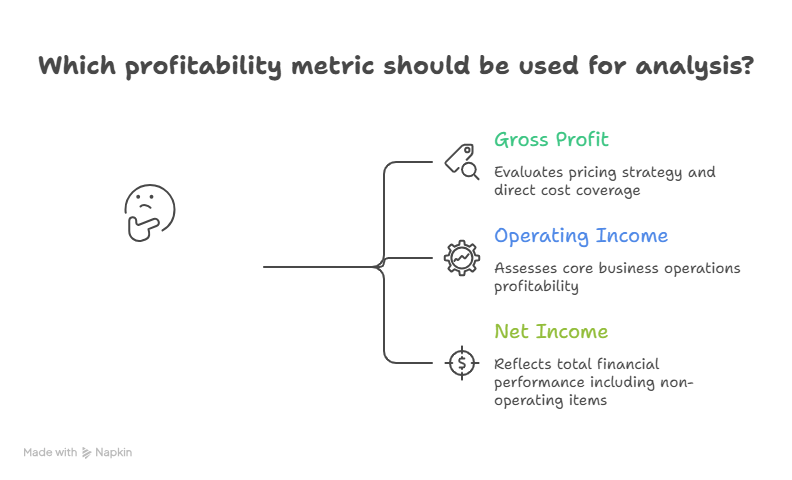
Here’s where people get confused. Let me break down the hierarchy:
Gross Profit
Gross Profit = Revenue − COGS
This tells you if your pricing covers your direct production or delivery costs. It’s the first profitability filter.
Operating Income
Operating Income = Gross Profit − Operating Expenses
This tells you if your business operations (the thing you do every day) are profitable. It excludes financing and taxes.
Net Income
Net Income = Operating Income ± Other Income/Expenses − Taxes
This is your bottom-line profit after everything—interest, taxes, one-time gains or losses.
According to Investopedia, net income includes non-operating items, which is why operating income is often used to evaluate core profitability while net income reflects total financial performance.
Stop/Go Check: Plug your numbers into the operating margin formula (operating income ÷ net revenues). Compare it to industry benchmarks—5-15% for retail, 10-20% for SaaS, 15-30% for consulting. If you’re way off, dig into your contribution margin per unit or client.
Common Mistakes That Distort Your Operating Income
I see these errors constantly, and they can throw your number off by 20% or more.
Mistake 1: Mixing Operating Income with Cash Flow
Operating income is accrual-based. It includes depreciation (a non-cash expense) and doesn’t account for cash timing (like when you actually get paid). Your bank balance might be low even if operating income is positive—because you haven’t collected Invoice vs Bill receivables yet.
The Fix: Reconcile operating income to your cash flow statement separately. Track cash separately from profitability.
Mistake 2: Treating Owner Withdrawals as Operating Expense
If you’re pulling money out as an owner, that’s a distribution, not an operating expense. Burying it in opex inflates your expenses and deflates operating income.
The Fix: Use an “arm’s length adjust”—recast your salary at the market rate for a peer business owner in your role. Treat the rest as a draw, not an expense.
Mistake 3: Including Loan Interest in Operating Expenses
Interest on debt is a financing cost, not an operating cost. It should sit below the operating income line on your income statement.
The Fix: Double-check your P&L categorization. Interest goes in “Other Expenses” or “Non-Operating Expenses.”
Mistake 4: Ignoring Depreciation/Amortization Confusion
Depreciation and amortization are non-cash, but they do reduce operating income. Startups sometimes ignore them or misclassify them, which makes operating income look artificially high.
The Fix: If you’re asset-heavy (equipment, vehicles), add back depreciation for a “cash ops view” in your internal reports, but keep it in the official operating income calc for accuracy.
The “Ghost Error” Table: Symptoms You Might Be Seeing
| Symptom | Root Cause | The Weird Fix |
|---|---|---|
| Operating income flips negative mid-quarter | Misclassifying variable sales costs (e.g., commissions) as fixed opex | Run a “zero-revenue test”: Recalc with $0 revenue; if opex > $0, reclassify variables as COGS |
| Gross profit looks healthy but operating income tanks | Overlooking “below-the-line” opex like bank fees or minor utilities | Use “opex waterfall”: List every line item <1% revenue separately until it balances |
| Inconsistent YoY comparisons | Depreciation/amortization policies change without notes | Normalize by adding back D&A, then track as % of revenue for consistency |
| Startup shows profit but can’t pay bills | Owner draw/salary buried in opex | Recast salary at market rate; treat excess as distribution, not expense |
What Your Operating Margin Tells You
Once you have your operating income, calculate your operating margin:
Operating Margin = (Operating Income ÷ Net Revenues) × 100
This percentage tells you how efficiently your core business converts revenue into profit. In 2026, with payroll, tools, rent, and marketing costs rising, operating income shows whether you’re growing sustainably or just inflating revenue while bleeding margin.
If your margin is shrinking quarter over quarter, you’ve got a scalability problem—your unit economics aren’t holding up as you grow.
How ProfitBooks Helps You Track This Cleanly
Operating income becomes really useful when your income and expenses are recorded cleanly every month. ProfitBooks helps you track sales, categorize expenses correctly, and view your Profit & Loss instantly—so your operating income is always accurate and ready when you need it. You can pull a P&L in seconds, see your gross profit vs. opex breakdown, and avoid the misclassification errors that throw off your numbers. No spreadsheet wrestling, no month-end surprises.
FAQ: Operating Income Questions I Get All the Time
How do I fix operating income showing negative despite sales growth?
Reclassify variable costs from opex to COGS. If costs scale with revenue (like sales commissions or delivery fees), they’re not fixed operating expenses—they’re direct costs.
Why is my operating income lower than gross profit by 100%?
Your opex includes untracked items like utilities, software subs, or admin fees. Run a line-item audit and categorize everything properly.
How do I handle depreciation in a cash-strapped startup?
Use a cash-basis view temporarily for internal decisions—add back depreciation to see “cash ops.” But keep it in the official calc for lenders or investors who expect GAAP.
Why doesn’t operating income match my bank balance?
Operating income excludes non-ops like interest and doesn’t track cash timing. Reconcile to your cash flow statement to see the full picture.
How do I fix inconsistent quarterly operating income?
Standardize categorization across periods. If you’re moving expenses between COGS and opex, your comparisons will be off. Lock in your Chart of Accounts and stick to it.
Why is retail operating income so volatile?
Seasonal COGS spikes (like holiday inventory buys) hit gross profit hard. Smooth it with run-rate adjustments or look at trailing 12-month averages instead of single quarters.
Final Thought: Operating Income Is Your Core Health Check
Revenue is exciting. Net income is what you report to the tax authorities. But operating income? That’s the number that tells you if the business itself works.
If your operating income is positive and growing, you’ve got a foundation. If it’s negative or shrinking, no amount of financing or tax optimization will save you—you need to fix the core model.
Track it monthly. Compare it to gross profit trends. Watch your operating margin like a hawk. And if you’re not confident in your categorization, get your books clean—because operating income is only useful if the data behind it is accurate.
That’s where tools like ProfitBooks come in. Clean data, clean P&L, clean operating income. Every month, no surprises.
Now go pull your last three months of income statements and calculate your operating income. I bet you’ll find something interesting.